

On this page
When you add a sequence of numbers, the total usually keeps growing. But in a geometric progression (GP), if each term shrinks fast enough, adding an infinite number of them yields a finite, exact total. This result has fascinated mathematicians for millennia.
What is the sum of an infinite GP formula?
A geometric progression is a sequence of numbers where each term is found by multiplying the previous one by a fixed constant multiplier. We call the first term a and the multiplier the common ratio r.
When you add up all the terms of a geometric progression that goes on forever, the sum S of the infinite GP is given by the formula: S = a / (1 − r)
The history of this idea goes back to antiquity. The Greek mathematician Zeno explored paradoxes involving time and motion in the 5th century BCE that relied on geometric series. For instance, his dichotomy paradox suggested that to walk a certain distance, you first have to walk half of it, then half of the remainder, and so on, creating a sequence of halves that seemingly never ends.
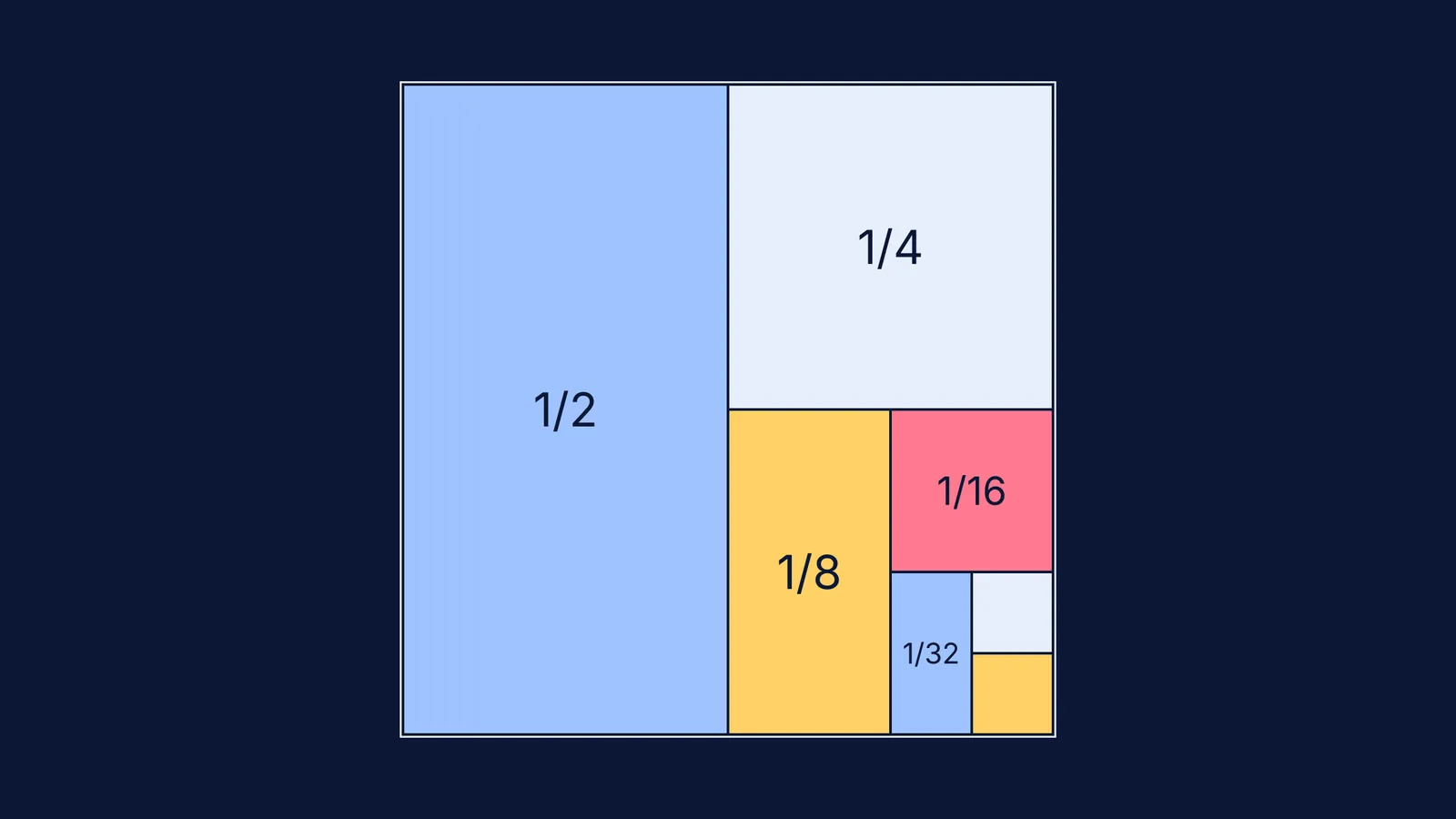
Consider the classic sequence: 1/2, 1/4, 1/8, 1/16, and so on. Here, the first term a is 1/2. The common ratio r is also 1/2. Plugging this into our formula gives: S = (1/2) / (1 − 1/2) = 1
Despite adding an endless number of positive fractions, the total perfectly converges to exactly 1.
How did Archimedes use the infinite GP formula?
The earliest known formal use of an infinite geometric progression to calculate an area comes from Archimedes in the 3rd century BCE. He wanted to find the exact area enclosed by a parabola and a straight line.
To solve this, he broke the area down into a series of triangles. The first triangle was the largest and fit inside the curve. He then added smaller triangles to fill the remaining gaps, finding that each new set of triangles had exactly one-quarter the area of the previous set.
This created an infinite geometric progression where the first term a was the area of the main triangle (which we can call 1 for simplicity) and the common ratio r was 1/4.
Using the formula for the sum of an infinite GP: S = a / (1 − r) S = 1 / (1 − 1/4) S = 1 / (3/4) S = 4/3
Archimedes proved that adding all these infinitely many triangles together gives a total area that is exactly four-thirds the area of the initial triangle. This was a notable achievement in mathematics, showing that an infinite series could have a perfectly finite sum long before the formal tools of calculus were invented.
Why does an infinite GP only converge when |r| < 1?
The formula a / (1 − r) looks simple, but there is a catch. It only works if the common ratio r lies strictly between -1 and 1. In mathematical terms, the absolute value of the ratio must be less than one, written as |r| < 1.
Why is this condition strictly needed? Think about what happens if the ratio falls outside this safe zone:
If r > 1: The terms keep getting larger. A sequence like 1 + 2 + 4 + 8... will rapidly grow towards infinity. There is no finite sum.
If r = 1: The sequence just repeats the first term infinitely, such as 3 + 3 + 3 + 3... This also runs away to infinity.
If r ≤ -1: The terms alternate in sign and either grow or stay the same size. For instance, if r = -1, the sequence 1 − 1 + 1 − 1... bounces endlessly between 1 and 0 without ever settling on a single limit.
When |r| < 1, the terms shrink towards zero as you progress down the sequence. Each new addition becomes microscopically small, meaning the running total eventually settles at a precise limit. If you miss this condition, you might blindly apply the formula to a diverging series and end up with a nonsensical negative answer for a sum of positive numbers.
How do you find the first term or ratio if the sum is given?
In exams like the JEE or school finals, you are rarely just asked to plug numbers into the formula. Instead, examiners provide the infinite sum and expect you to work backwards to find a missing variable.
Let us walk through a common problem: 'An infinite GP has a sum of 4, and its first term is 3. Find the common ratio.'
We start by setting up the equation: 4 = 3 / (1 − r)
To solve for r, multiply both sides by (1 − r): 4 × (1 − r) = 3 4 − 4r = 3
Next, rearrange the equation to isolate the r term: 4r = 4 − 3 4r = 1 r = 1/4
Because 1/4 is strictly between -1 and 1, we know this is a valid infinite GP.
If you struggle with the algebra steps or often hit a conceptual wall while solving backwards, the Fermi Concept Library gives every concept in mathematics its own lesson and its place in the map. For targeted help on harder textbook problems, the Fermi Problem Library provides worked problems with a step-by-step solver that explains the reasoning rather than printing an answer.
Expanding your sequence skills
Learning the infinite sum requires practice with fractions and careful attention to the common ratio. If you are dealing with finite sequences instead, read our guide on recovering aₙ from a formula for Sₙ: the subtraction trick. For problems that mix different types of progressions, brush up on inserting arithmetic and geometric means between two numbers. Every variation you practice builds the mental flexibility needed for tough exams.


