On this page
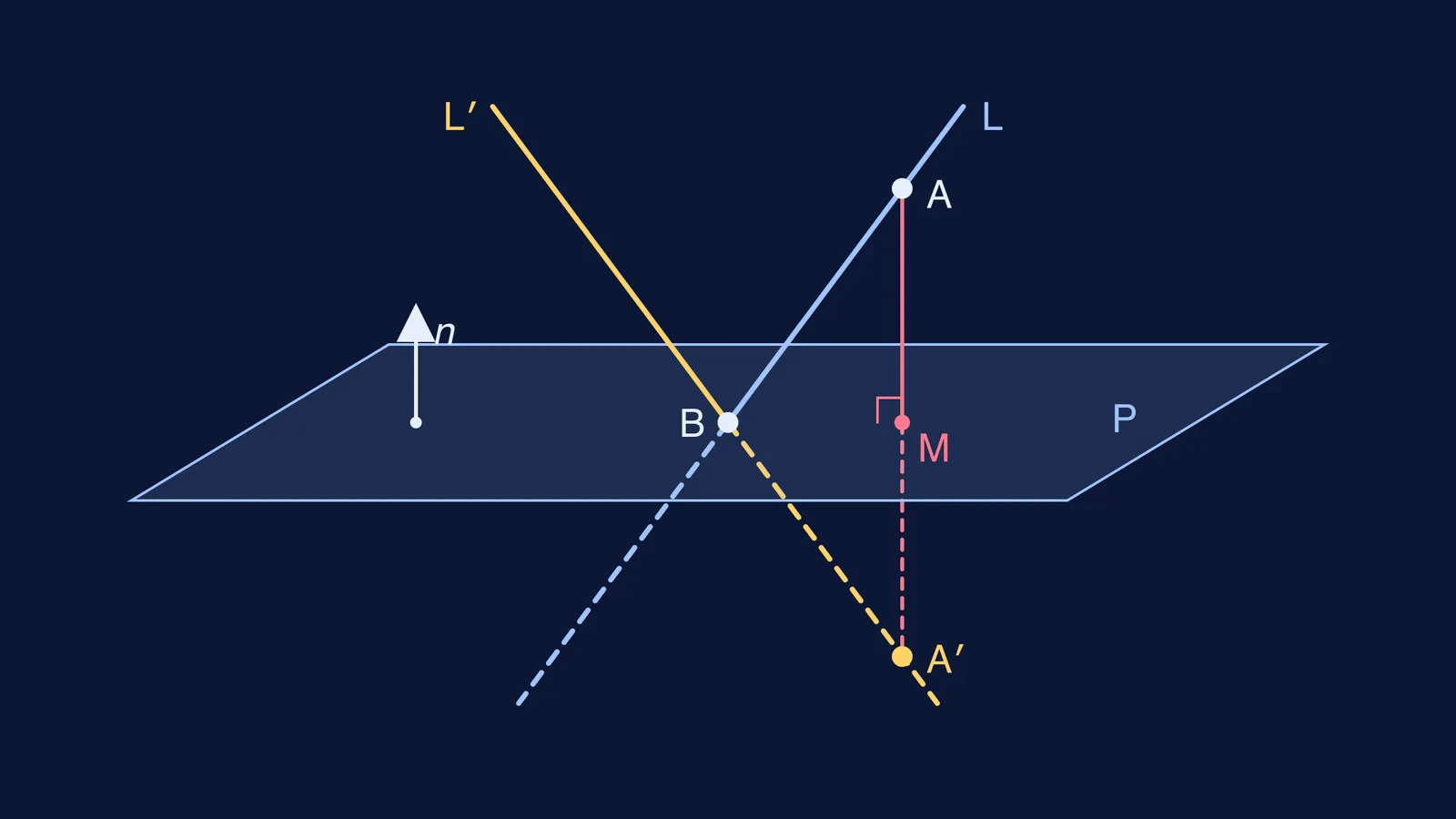
The question gives a line and a plane and asks for the line you would see if the plane were a mirror. You do not need to reflect the whole line: reflect one point, find the point the mirror leaves fixed, and join them.
What is the image of a line in a plane?
A reflection is a map of space to itself that keeps all distances and has the mirror plane as its set of fixed points, as the article on reflection in mathematics) defines it. Two facts follow.
Distances are kept, so the image of a line is another line.
The mirror is fixed, so a point already on the plane is its own image.
So you need just two points: A′, the image of any point A on the line, and B, where the line meets the plane. The image is the line through B and A′.
The same article gives the formula for reflecting a point A in the plane n · r = d: A′ = A − 2(n · A − d)/(n · n) n. For this step slowly, with the foot of the perpendicular drawn in, see our post on how to find the image of a point in a plane.
How do you find the image of a line in a plane, step by step?
Question: Find the image of the line (x − 1)/3 = (y − 2)/1 = (z − 3)/2 in the plane x + 2y + 2z = 2.
Step 1: read off what you have. A = (1, 2, 3), direction (3, 1, 2), normal n = (1, 2, 2), so n · n = 9 and d = 2.
Step 2: reflect A. n · A − d = 11 − 2 = 9, so the factor is 2 × 9/9 = 2 and A′ = (1, 2, 3) − 2(1, 2, 2) = (−1, −2, −1). The midpoint (0, 0, 1) satisfies 0 + 0 + 2 = 2, so it sits on the plane, as it must.
Step 3: find where the line meets the plane. A general point on the line is (1 + 3t, 2 + t, 3 + 2t). Substituting: (1 + 3t) + 2(2 + t) + 2(3 + 2t) = 11 + 9t = 2, so t = −1 and B = (−2, 1, 1). Check: −2 + 2 + 2 = 2.
Step 4: join B and A′. A′ − B = (1, −3, −2). The image line is (x + 2)/1 = (y − 1)/(−3) = (z − 1)/(−2).
How do you check the answer?
A′ lies on your answer. (−1 + 2)/1 = 1, (−2 − 1)/(−3) = 1, (−1 − 1)/(−2) = 1. All three ratios agree.
The direction reflects too. A direction is the difference of two points, so the constant d cancels and you use the through-origin version of the formula: (3, 1, 2) − 2(9/9)(1, 2, 2) = (1, −3, −2). This matches step 4.
Both lines make the same angle with the mirror. n · (3, 1, 2) = 9 and n · (1, −3, −2) = −9, and both directions have length √14. Equal size, opposite sign: same angle, opposite sides. Our post on the angle between a line and a plane explains why that angle uses sin.
Bonus: A is 9/3 = 3 from the plane by the distance of a point from a plane formula, so AA′ should be 6, and (2, 4, 4) has length 6.
What if the line is parallel to the plane?
A line is parallel to a plane when its direction l and the normal n satisfy l · n = 0; it then either lies in the plane or never meets it, as the article on line–plane intersection sets out. Step 3 then fails: substituting gives no value of t.
You do not need B then. With n · l = 0 the direction formula gives l back unchanged, so the image is the line through A′ parallel to the original. A line lying in the plane, or along the normal, is its own image.
Where do students lose marks on this?
Writing n · A instead of n · A − d inside the formula.
Using the plane's constant when reflecting a direction.
Starting step 3 without testing for a parallel line.
If one of these keeps catching you, try similar questions in the Fermi Problem Library, where a step-by-step solver explains the reasoning rather than printing an answer, so you can see which step went wrong. If normal vectors feel shaky, the Fermi Concept Library gives each mathematics concept its own lesson.
Next time, sketch first: one point, its image, the meeting point, and a line through the last two.