On this page
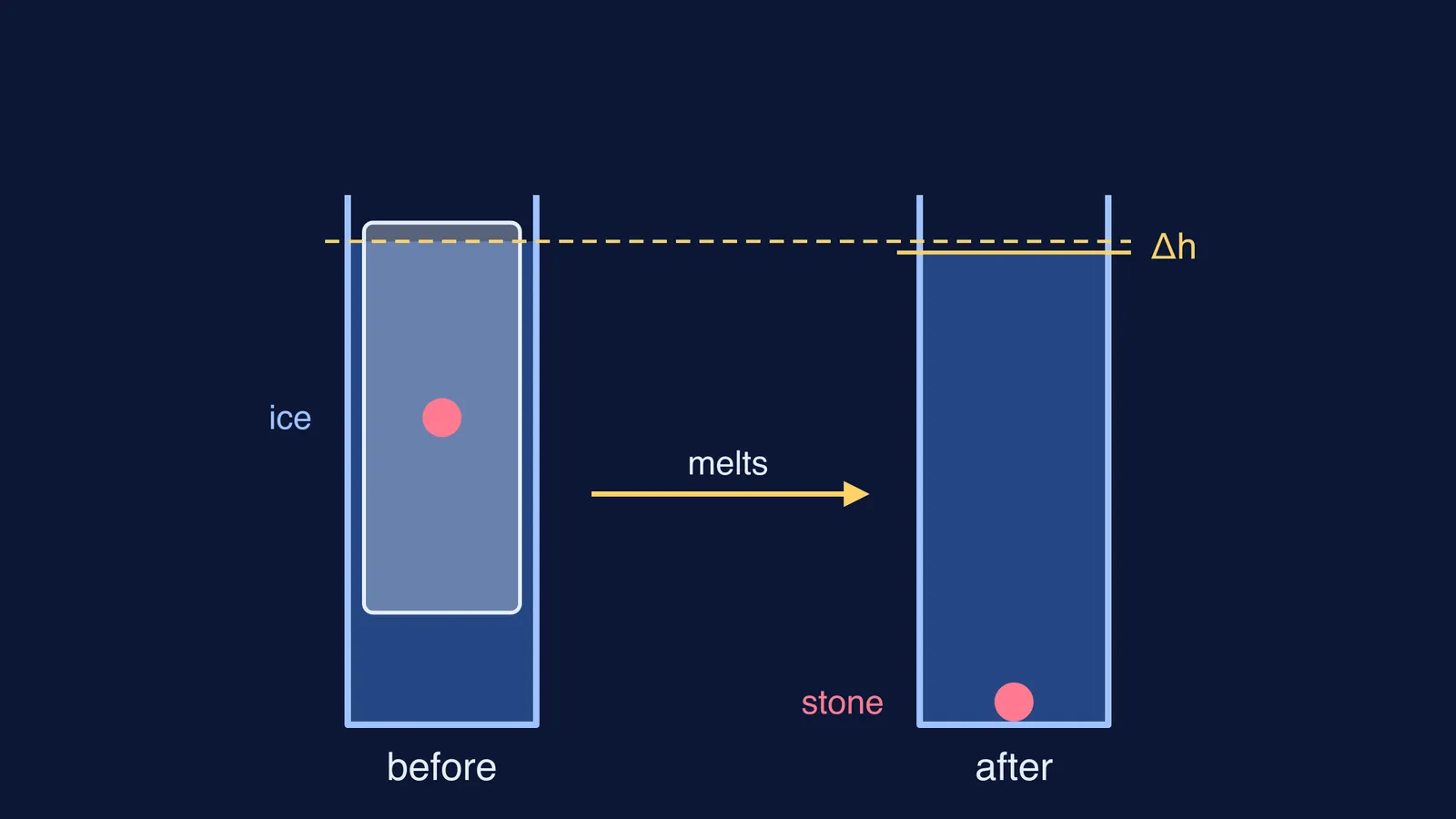
When a floating block of ice with a stone frozen inside melts, the water level in the container goes down. The tempting answer, "it stays the same, like ordinary ice", is wrong, and you can check why with numbers that fit on the back of a notebook.
Why does the water level fall when ice with a stone inside melts?
Archimedes' principle says the buoyant force on an object equals the weight of the fluid it displaces (OpenStax College Physics 2e, section 11.7). So anything that floats displaces exactly its own weight of water.
While the stone is locked in floating ice, the water has to hold up the stone's whole weight. Granite has a density of 2.7 g/cm³ and water 1.000 g/cm³ (OpenStax College Physics 2e, table 11.1), so a granite pebble riding in the ice pushes aside 2.7 times its own volume of water. After the ice melts, the stone sinks. The floor of the container now carries most of its weight, and it displaces only its own volume. That lost displacement is why the level drops.
The ice itself changes nothing. Floating ice displaces its own weight of water, and when it melts it turns into exactly that much water, which fills the hole it was making. We work through that pure-ice case in does the water level rise when floating ice melts.
How do you prove it with displaced volume?
Take water as 1.00 g/cm³, so 1 g of water fills 1 cm³. From the OpenStax density table, ice at 0°C is 0.917 g/cm³ and granite is 2.7 g/cm³.
Worked example: 100 cm³ of ice holding a 2 cm³ granite pebble.
Masses: ice = 100 × 0.917 = 91.7 g; stone = 2 × 2.7 = 5.4 g; total 97.1 g.
Does it float? Average density = 97.1 g ÷ 102 cm³ ≈ 0.95 g/cm³, less than water, so yes.
Water displaced before melting = its whole weight = 97.1 cm³.
After melting: the melt water adds 91.7 cm³ and the sunken stone displaces 2 cm³, a total of 93.7 cm³.
Change = 93.7 − 97.1 = −3.4 cm³. The level falls.
In a beaker with a 50 cm² cross-section, 3.4 cm³ is a drop of 0.068 cm, under a millimetre: a thinking question, not a kitchen experiment.
The general result: the fall in displaced volume = m(stone)/ρ(water) − V(stone) = V(stone) × (ρ(stone)/ρ(water) − 1). For our pebble, 2 × (2.7 − 1) = 3.4 cm³, the same answer.
What if a cork or air bubble is frozen in the ice instead?
The same table in OpenStax College Physics 2e gives cork as 0.24 g/cm³ and air as 1.29 kg/m³, and both stay afloat once the ice is gone.
Cork: freeze 5 cm³ of cork (1.2 g) into 100 cm³ of ice. Before: displaced 91.7 + 1.2 = 92.9 cm³. After: 91.7 cm³ of melt water plus the floating cork displacing its weight, 1.2 cm³, so 92.9 cm³. No change.
Air bubble: a 1 cm³ bubble weighs about 0.0013 g. It adds almost nothing to the displaced water before melting and escapes afterwards. No change.
Steel: a ball bearing (iron or steel, 7.8 g/cm³ in the same table) behaves like the stone. The level falls.
How big can the stone be before the ice sinks?
The block floats only while its average density is below water's. Using OpenStax's densities, that means 0.917 V(ice) + 2.7 V(stone) < V(ice) + V(stone), which rearranges to V(stone) < (0.083 ÷ 1.7) × V(ice). A granite stone must be smaller than about 4.9% of the ice's volume. For steel at 7.8 g/cm³ the limit is 0.083 ÷ 6.8, about 1.2%.
So a stone-laden block floats low: in our example, 97.1 of its 102 cm³ sits under water. The same density ratio sets the fraction of a floating body that is under water.
If the stone is too big and the block rests on the bottom fully under water, the level still falls on melting. It displaced V(ice) + V(stone) before and 0.917 V(ice) + V(stone) after.
A four-step check for any melting-ice question
List what floats before, and what will float or sink after the ice melts.
Floating things displace their weight of water; sunken things displace their volume.
Add up displaced volume before and after. Melt water counts as its mass in grams, read as cm³.
Compare, then sanity-check: if everything that floated before still floats after, the level cannot change.
Once displacement clicks, related questions follow the same logic, such as the rise in water level when a sphere is dropped in a cylinder.
If you want more buoyancy questions to practise on, the Fermi Problem Library has worked problems with a step-by-step solver that explains the reasoning rather than printing an answer. If Archimedes' principle itself feels shaky, the Fermi Concept Library gives each physics concept its own lesson.