

On this page
Drop an ice cube into a full glass of water and wait. Will it overflow, drop, or stay put? Many people guess wrong, and the reason is worth more than the answer. Predict each of the three glasses below before you read on.
Predict first: what happens in each glass?
Glass A: an ice cube floating in fresh tap water.
Glass B: the same cube floating in salt water.
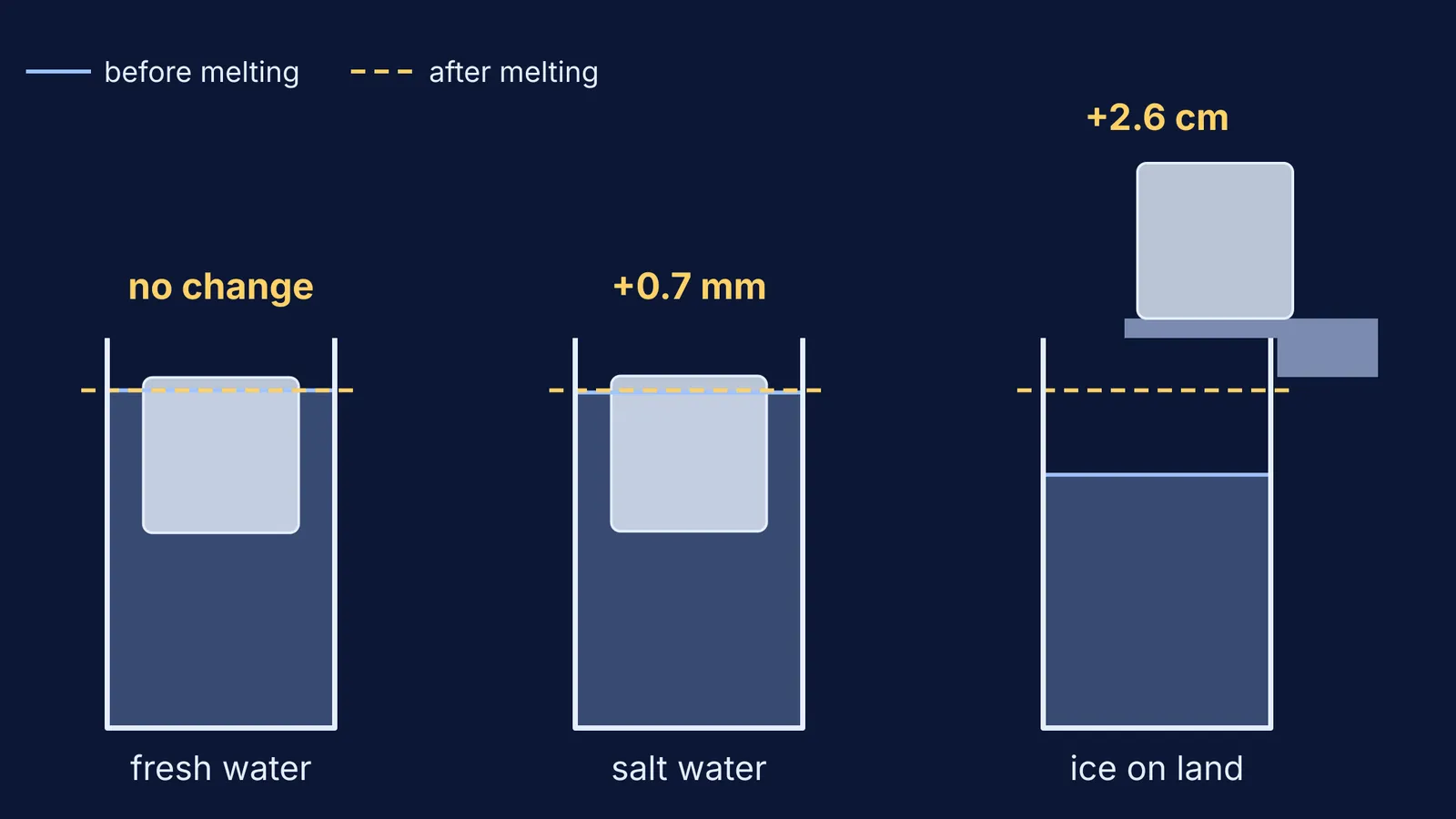
Glass C: the same cube on a ledge above the water, dripping in as it melts. This is ice on land.
Write rise, fall or stay for each, with one line of why.
Why doesn't the water level rise when floating ice melts?
The key is Archimedes' principle: a floating object pushes aside (displaces) a weight of liquid equal to its own weight. Ice floats because it is less dense than water; the density of ice at 0 °C is 0.9167 g/cm³, against 0.9998 g/cm³ for water at the same temperature (University of Illinois Physics Van).
Worked example (the diagram above): a 100 g ice cube in a glass about 7 cm across, base area about 38.5 cm².
The cube's volume is 100 ÷ 0.917, about 109 cm³.
Floating, it displaces 100 g of water, which is 100 cm³ of fresh water. That is about 92% of the cube sitting below the surface.
When it melts, the 100 g of ice becomes 100 g of water, or 100 cm³. It fills exactly the hole it was already making.
Change in level: zero.
A NASA classroom activity built on this experiment reaches the same conclusion for sea ice in its simple model.
Does melting ice raise the level in salt water?
Yes, slightly, and this is where the simple picture needs a correction. Salt water is denser than fresh water; typical seawater density is about 1026 kg/m³, or 1.026 times that of fresh water (Woods Hole Oceanographic Institution).
Run the same 100 g cube through the numbers. It still displaces 100 g of liquid, but 100 g of salt water takes up only 100 ÷ 1.026, about 97.5 cm³. When the cube melts, it adds 100 cm³ of fresh water. The extra 2.5 cm³ spread over 38.5 cm² lifts the level by about 0.07 cm, roughly 0.7 mm. (This ignores the tiny change in volume when fresh and salt water mix.)
Researchers Peter Noerdlinger and Kay Brower made this point for the real ocean: melting floating ice adds a volume of water about 2.6% greater than the seawater it displaced, and if all existing sea ice and floating shelf ice melted, global sea level would rise about 4 cm (Geophysical Journal International, 2007). Archimedes guarantees equal weights, not equal volumes.
What happens when ice on land melts?
In Glass C, the water holds up none of the ice's weight, so nothing is displaced in advance. All 100 cm³ of meltwater is new, and the level rises by 100 ÷ 38.5, about 2.6 cm, close to 40 times the salt-water effect. The same holds for glaciers and ice sheets: as they melt, their water runs into the ocean and raises sea level (NASA My NASA Data).
If the entire Greenland Ice Sheet melted, sea level would rise about 7.4 metres, and if the entire Antarctic Ice Sheet melted, about 58 metres (NSIDC).
How do you handle the exam variations?
Board and JEE-style questions twist this setup. One rule settles most of them: compare the liquid displaced before melting with what is displaced or added after.
Air bubble inside the ice: stays the same. Air adds volume but almost no weight.
Wood or cork inside: stays the same. The wood floats before and after.
Stone or coin inside: falls. Frozen in, the stone displaces its weight in water; once it sinks, only its own volume, which is less.
Ice resting on the bottom, not floating: rises, because the base holds up part of the weight.
Ice in a liquid denser than fresh water: rises, as in Glass B.
For more practice, see our guide to common pressure, buoyancy and Bernoulli mistakes and what Archimedes actually wrote about buoyancy.
How can you test it yourself?
Fill two identical clear glasses with water; stir plenty of salt into one.
Float an ice cube in each and mark the level with tape.
Rest a third cube on a saucer across the rim of a third glass; mark that level too.
When the ice has melted, compare each level with its mark.
The salt-water change is hard to see in a kitchen glass. That is where a simulation helps: when you can vary the liquid's density and the ice, you can watch the levels move. Fermi Simulation Lab has interactive simulations for the ideas that are easier to see than to read. For when a simulation is worth it and when a sketch is enough, see what studies found about simulations versus static diagrams.
Start with your three predictions from the top of this page, and check how many survived.


