On this page
Drop a steel ball into a glass of water and the level creeps up. In Class 10 mensuration this becomes a one-line equation, and every version of it (marbles, lead shots, a toy sunk in a tank) rests on one idea: the volume that goes in equals the volume that comes up.
How do you find the rise in water level when a sphere is dropped in a cylinder?
A solid that is completely under water takes up space the water used to fill, so the water has to move. OpenStax College Physics states Archimedes' principle as: the buoyant force on an object equals the weight of the fluid it displaces. For a fully submerged object, the volume of water displaced equals the object's own volume. In a straight-walled jar the only place that water can go is up, as a flat layer.
So you write two volumes and set them equal:
Volume of the sphere: V = 4/3 πr³, as given by Wolfram MathWorld.
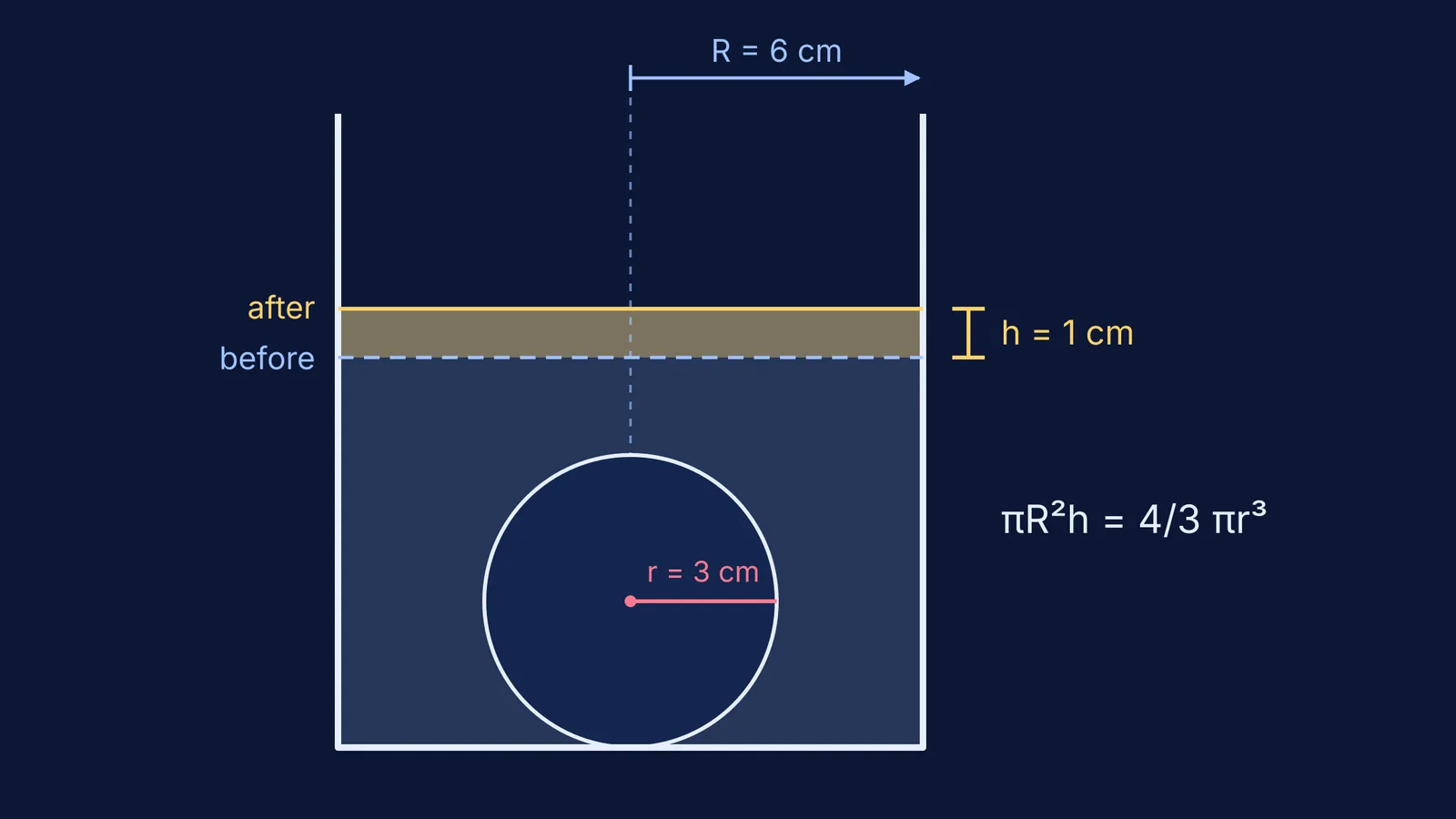
Volume of the new water layer: a short cylinder of radius R and height h, so πR²h, the same capacity formula NCERT uses for a cylindrical glass in Class 10 Chapter 12, Surface Areas and Volumes.
Setting πR²h = 4/3 πr³ gives the rise: h = 4r³/3R².
Worked example: a 6 cm ball in a 12 cm jar
A sphere of diameter 6 cm is dropped into a cylindrical vessel of diameter 12 cm that is partly filled with water. The sphere is completely submerged. By how much does the water rise?
Halve the diameters: r = 3 cm, R = 6 cm.
Sphere volume: 4/3 × π × 27 = 36π cm³.
New layer: π × 36 × h = 36πh cm³.
Equate: 36πh = 36π, so h = 1 cm.
Now the check most students skip. The ball rests on the bottom and is 6 cm tall, so the final level must be at least 6 cm for it to be covered. In 3 cm of water the ball would stick out and the formula would overstate the rise.
The same equation runs backwards. How many marbles of diameter 1.4 cm must go into a beaker of diameter 7 cm to raise the water by 5.6 cm? Write n × 4/3 π(0.7)³ = π(3.5)² × 5.6. Each marble is 0.4573π cm³ and the layer is 68.6π cm³, so n = 150.
Why does the rise depend on the ratio of the radii?
Rewrite the result as h ÷ 2r = 2/3 × (r/R)². The rise, measured against the ball's own diameter, depends only on how wide the ball is compared with the jar. Halve r/R and that fraction drops to a quarter.
The largest ball that fits has r = R. Then h = 4R/3, exactly two-thirds of the ball's diameter. That gives you a free sanity check: a single ball that fits in the jar can never raise the water by more than two-thirds of its diameter.
What if the sphere floats, or the water spills over?
The formula assumes a solid, fully submerged sphere and room in the jar. Change any of those and you change only the left-hand side.
It floats. Only the submerged part displaces water, so use the submerged volume, which comes from the ball's mass and the water's density. Our post on what fraction of a floating body sits under water shows how.
It is hollow. A sealed hollow ball held under displaces its full outer volume; the cavity changes only its mass (see the volume of a hollow sphere).
The vessel is full. Then the water overflows instead of rising, and the overflow equals the volume dropped in. NCERT's Exercise 12.2 has two such problems: lead shots dropped into a brim-full cone until one-fourth of the water flows out, and a cone-on-hemisphere solid placed in a full cylinder.
A four-step checklist for any displacement problem
Convert every diameter to a radius, all in the same unit.
Write the volume of what goes in (times n for n objects).
Write the volume of what comes up (πR²h) or flows out.
Equate, cancel π, solve, then check: is the object fully covered, does the new level fit inside the vessel, and, for a single ball, is the rise under two-thirds of its diameter?
If your answers keep coming out too big by a factor of 2 or 8, the slip is almost always in step 1. The Fermi Problem Library has worked problems with a step-by-step solver that explains the reasoning rather than printing an answer, so you can see which line went wrong. If the volume formulas themselves feel shaky, the Fermi Concept Library gives each concept in mathematics its own lesson.
Try the marbles problem again with a beaker of diameter 14 cm before you look anything up: the answer should be four times as many marbles.