

On this page
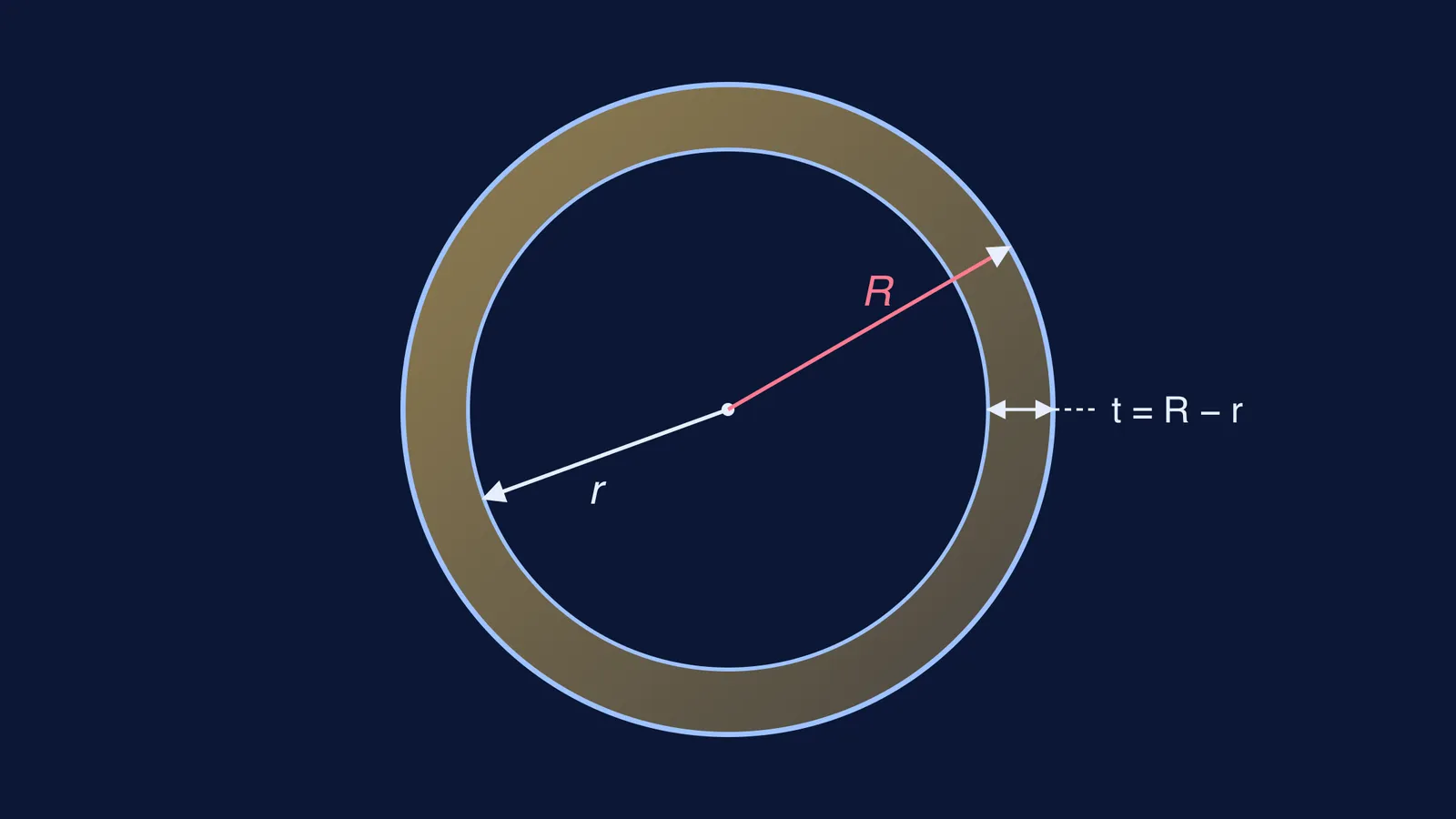
A hollow sphere is a ball with a ball-shaped hole in the middle, like a hollow rubber ball or a spherical tank. Board and entrance questions give you two numbers, the outer radius R and the inner radius r, and ask how much material the shell contains. This post gives you the formula, one worked example with full arithmetic, the factorised form that saves time, and a checklist of the mistakes that cost marks.
What is the formula for the volume of a hollow sphere?
The volume of a solid sphere of radius r is V = (4/3)πr³, measured in cubic units such as cubic centimetres (OpenStax Prealgebra 2e, section 9.6).
A hollow sphere is the big sphere with the small sphere removed, so you subtract one volume from the other:
Volume of the outer sphere: (4/3)πR³
Volume of the cavity: (4/3)πr³
Volume of material in the shell: V = (4/3)πR³ − (4/3)πr³ = (4/3)π(R³ − r³)
How do you find the volume with outer and inner radius?
Take a shell with outer radius R = 5 cm and inner radius r = 4 cm, using the sphere formula from OpenStax.
Cube the outer radius: R³ = 5³ = 125 cm³.
Cube the inner radius: r³ = 4³ = 64 cm³.
Subtract: R³ − r³ = 125 − 64 = 61 cm³.
Multiply by 4π/3: V = (4/3)π × 61 = 244π/3 cm³.
Use π ≈ 3.1416: V ≈ 255.5 cm³.
Now the wrong way, so you recognise it. The wall is 1 cm thick, and (4/3)π(1)³ is only about 4.2 cm³, roughly one sixtieth of the true answer. A quick sense check catches this: the shell is most of the ball, since the outer sphere alone holds about 523.6 cm³ and the cavity about 268.1 cm³.
If the question gives diameters, halve them first. If it gives the inner radius and the thickness t, the outer radius is R = r + t.
To find the mass, multiply the volume by the density of the metal the question gives you. The same subtract-the-hole method works for pipes, as in our post on the volume of a hollow cylinder pipe.
Why factorise R³ − r³?
The difference of two cubes factorises as a³ − b³ = (a − b)(a² + ab + b²), and the second bracket cannot be factorised further (OpenStax Intermediate Algebra 2e, section 6.3).
Applied to the shell, that gives:
V = (4/3)π(R − r)(R² + Rr + r²)
This form helps in three ways:
Thickness appears directly. R − r is the wall thickness, so if a question states the thickness, you plug it in rather than computing R first.
Smaller numbers. For R = 5 and r = 4: (5 − 4)(25 + 20 + 16) = 1 × 61 = 61, the same as before, with no three-digit cubes.
Awkward decimals get easier. For R = 10.5 cm and r = 10 cm, you need 0.5 × (110.25 + 105 + 100) = 0.5 × 315.25 = 157.625, which is quicker by hand than cubing 10.5.
What if the shell is very thin?
When the wall thickness t = R − r is small compared with R, the bracket R² + Rr + r² is close to 3R². The volume then becomes approximately (4/3)π × t × 3R² = 4πR²t, which is the surface area of a sphere, 4πR² (OpenStax), multiplied by the thickness.
Check it with R = 10 cm and r = 9.9 cm. The exact value is (4/3)π(1000 − 970.299) ≈ 124.4 cm³. The approximation gives 4π × 100 × 0.1 ≈ 125.7 cm³, about 1% high. That is close enough to check an answer in an exam, though not to replace the exact formula when the question wants it.
A checklist before you write the final answer
Are both values radii, not diameters?
Did you cube each radius separately, or use the factorised form?
Is the answer smaller than the volume of the outer sphere?
Are the units cubic (cm³ or m³)?
If the question asks for mass, did you multiply by the density it gave?
Shells turn up again in recasting questions, where a melted solid becomes a hollow sphere or the reverse; the method in melting and recasting volume problems uses exactly this subtraction. In physics, the same volume decides whether a hollow ball floats, as in finding the cavity in a hollow sphere that just floats.
If you keep getting a different number from the answer key, the Fermi Problem Library has worked problems with a step-by-step solver that explains the reasoning rather than printing an answer, so you can see which step went wrong. If the algebra itself is shaky, the Fermi Concept Library gives each concept in mathematics its own lesson.


