

On this page
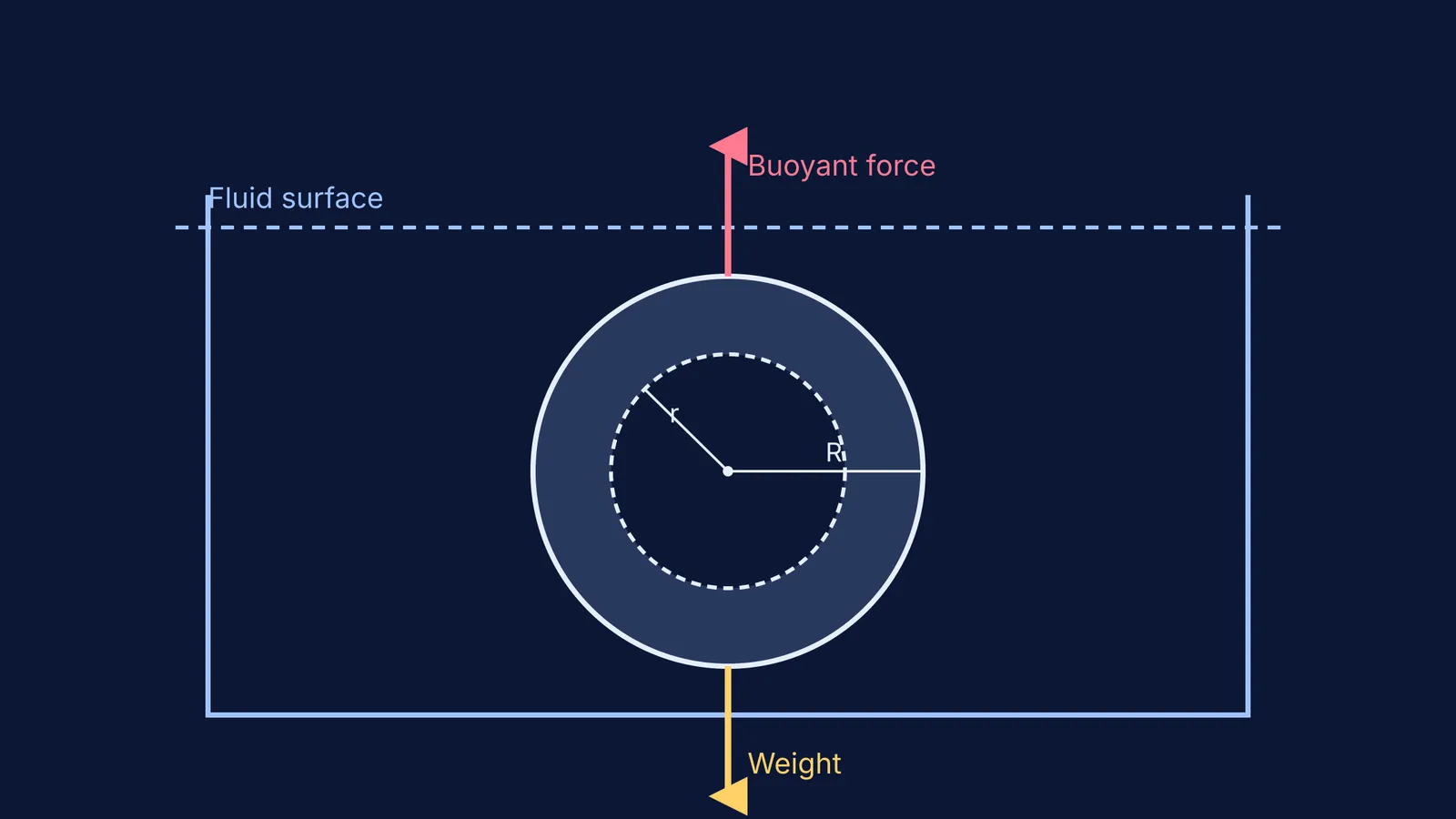
When a physics problem says a sphere "just floats" or is "neutrally buoyant", it means the object is completely submerged in the fluid but does not sink to the bottom. In this equilibrium state, the upward buoyant force exactly equals the downward gravitational force (the weight of the sphere) according to Wikipedia. (You can test this balance in our buoyancy and density simulation).
For a solid object made of a dense material like copper or steel, it would normally sink to the bottom of the tank because its material density is greater than the fluid. However, if the sphere is hollow, the enclosed air (or empty space) lowers the average density of the entire object. When this average density matches the fluid's density exactly, the sphere achieves neutral buoyancy.
The mathematics behind the neutral buoyancy formula
To derive the formula, we start with Archimedes' principle, which states that the buoyant force equals the weight of the fluid displaced by the object.
Because the sphere is fully submerged, the displaced volume is simply the total volume of the sphere (V_total). The buoyant force is therefore ρ_fluid × V_total × g.
The weight of the hollow sphere comes entirely from its solid shell, ignoring the negligible mass of any air inside. The weight is ρ_material × V_m × g, where V_m is the volume of the solid material.
Setting the two forces equal for neutral buoyancy gives: ρ_fluid × V_total × g = ρ_material × V_m × g
If you cancel out gravity (g) and solve for the material volume (V_m), you get: V_m = V_total × (ρ_fluid / ρ_material)
How do you find the volume of a cavity in a hollow sphere?
The volume of the cavity (V_c) is simply the empty space left when you subtract the solid material volume from the total volume. V_c = V_total - V_m
Substituting the V_m we just derived, we get the general formula: V_c = V_total × (1 - ρ_fluid / ρ_material).
To solve exam questions, you can follow this step-by-step physics problem solving framework:
Find the total volume: Use the buoyant force (the weight of displaced fluid) to find how much space the entire sphere takes up.
Find the material volume: Divide the mass of the sphere (its true weight in air) by the density of the solid material.
Subtract to find the cavity: Take the total volume and subtract the material volume.
A worked example: The metal sphere cavity problem
A classic textbook problem asks: A piece of metal (density 8.8 g/cm³) with an internal cavity weighs 264 g in air and 221 g in water. Find the volume of the cavity.
Using our three-step framework:
Find the total volume: The loss of weight in water is equal to the buoyant force. 264 g - 221 g = 43 g. Since the density of water is about 1 g/cm³, displacing 43 g of water means the total volume of the metal piece is 43 cm³.
Find the material volume: The metal material itself has a mass of 264 g. V_m = 264 g / 8.8 g/cm³ = 30 cm³.
Find the cavity volume: Subtract the material volume from the total volume. 43 cm³ - 30 cm³ = 13 cm³.
The volume of the internal cavity is 13 cm³. This simple subtraction logic works for any shape with an internal cavity, provided it is fully submerged.
Why does the shape of the cavity not matter?
A common source of confusion in these problems is whether the cavity is perfectly spherical and centred. You might wonder if an off-centre hole changes the result. Because Archimedes' principle only depends on the total volume of displaced fluid and the total mass of the object, the exact geometry or placement of the cavity inside the shell does not affect the calculation for neutral buoyancy.
Whether the 13 cm³ of empty space in our metal example is one perfect sphere in the middle, or several small irregular air pockets scattered throughout the metal, the total buoyant force remains exactly the same. The only difference an off-centre cavity makes is to the object's centre of mass. If the cavity is off-centre, the hollow sphere will rotate until its heavier side is at the bottom, but it will still "just float" at the same depth.
What happens if the sphere is placed in a denser fluid?
If you take the same hollow sphere that neutrally floats in water and drop it into a denser fluid, like saltwater or glycerin, the buoyant force on the fully submerged volume will increase. Because the buoyant force now exceeds the sphere's weight, the object will rise to the surface. It will then float partially submerged, displacing only enough of the denser fluid to equal its own weight.
Conversely, if placed in a less dense fluid like alcohol, the maximum buoyant force on the completely submerged volume will not be enough to support the sphere's weight, and it will sink. This is why submarines must constantly adjust the volume of water in their ballast tanks (effectively changing their average density) when moving through ocean layers of different temperatures and salinities.
How Fermi helps you master buoyancy problems
Problems involving Archimedes' principle often trip up students because it is hard to picture forces you cannot see. When you are struggling with cavity volume calculations, density ratios, or deciding which volume to use for the buoyant force, Fermi's AI tutor does not just print the final answer. It teaches through the reasoning step by step, drawing the figure and checking your understanding as it goes.
You can find all these topics in the Fermi Concept Library.


