

On this page
Your textbook says scientific names follow "ICBN for plants and ICZN for animals". That line is easy to memorise and easy to misunderstand. They are two separate rulebooks, changed by different bodies, and they do not always agree.
What are ICBN and ICZN?
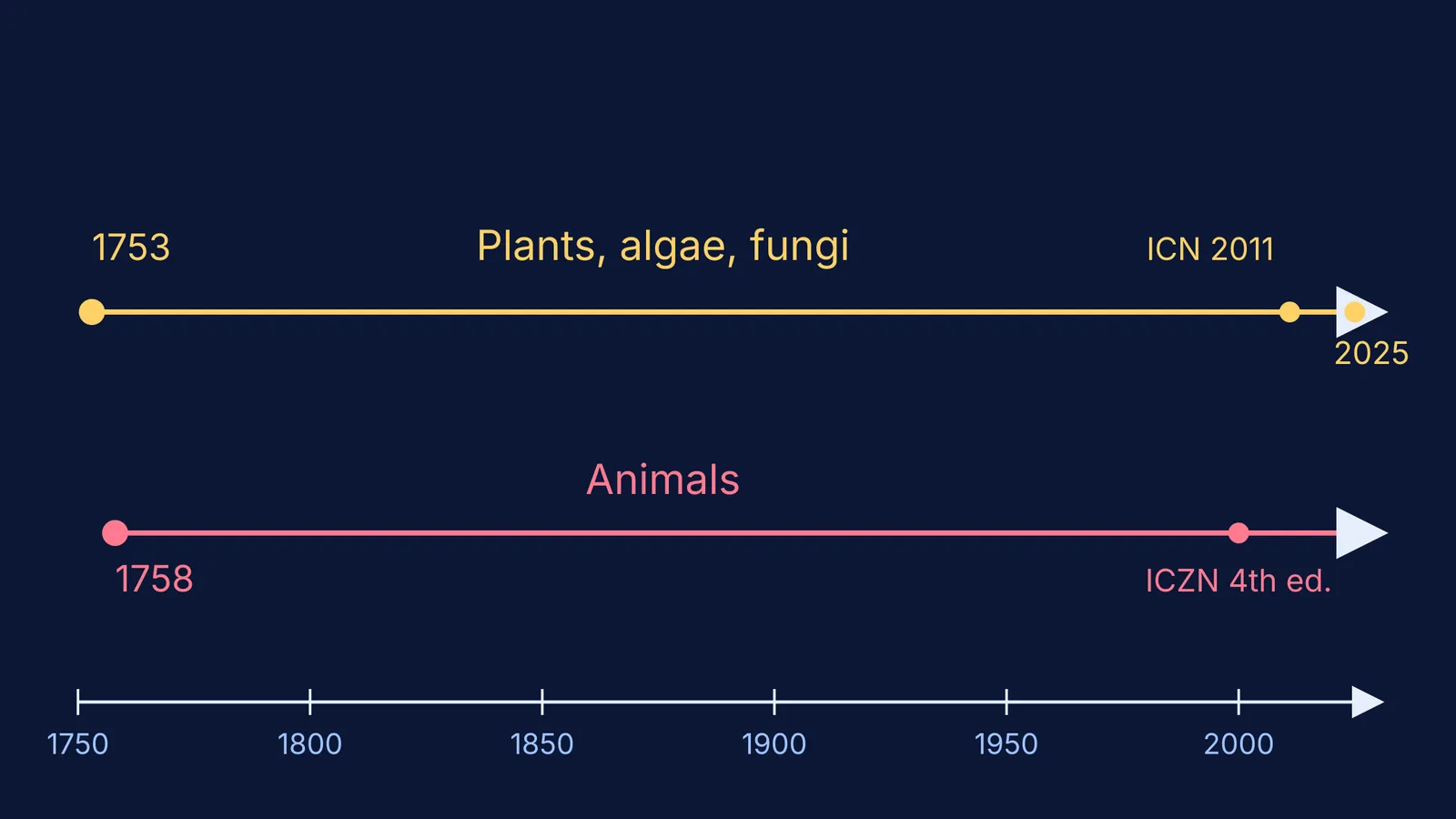
The ICZN is the International Code of Zoological Nomenclature, now in its 4th edition, published in 2000 (ICZN).
Its first article defines its scope: zoological nomenclature is "the system of scientific names applied to taxonomic units (taxa; singular: taxon) of extant or extinct animals" (ICZN Article 1).
ICBN stood for the International Code of Botanical Nomenclature. It was renamed the International Code of Nomenclature for algae, fungi, and plants (ICN) at the International Botanical Congress in Melbourne in July 2011 (overview of the ICN).
The current botanical edition is the Madrid Code, published in 2025 after the Twentieth International Botanical Congress in Madrid in July 2024, which debated 447 proposals to amend the Code (University of Chicago Press).
Why do plants and animals need separate codes?
The short answer is history. Botanists and zoologists drew up their rules separately, each starting from a different book by Carolus Linnaeus, and each kept its own rules from then on.
The botanical code says so in its very first principle. An older edition puts it as: "Botanical nomenclature is independent of zoological and bacteriological nomenclature" (ICBN, Principle I). The current ICN adds viral nomenclature to that list (overview of the ICN).
The zoological code says the same from the other side: the name of an animal taxon "is not to be rejected merely because it is identical with the name of a taxon that is not animal" (ICZN Article 1.4).
The two codes even start on different dates. For plants, priority begins on 1 May 1753, the publication date of Linnaeus's Species Plantarum (overview of the ICN). For animals, "the date 1 January 1758 is arbitrarily fixed" as the starting point, the date given to the 10th edition of Linnaeus's Systema Naturae and to Clerck's book on Swedish spiders (ICZN Article 3).
What do the naming codes standardise?
Both codes share a few core ideas. The older botanical code lists them as principles (ICBN, Division I):
Types: each name is tied to a nomenclatural type, usually a specimen, that fixes what the name applies to.
Priority: names are ranked by date of publication.
One correct name: a group with a given boundary, position and rank has only one correct name, the earliest that follows the rules.
Latin: scientific names are treated as Latin, whatever language they came from.
Retroactive rules: the rules apply to old names unless the code says otherwise.
The zoological code states priority as: "The valid name of a taxon is the oldest available name applied to it", with exceptions set by the Code or by rulings of its Commission (ICZN Article 23). The same article adds that priority exists to promote stability, not to overturn a long-accepted name.
The rules you learn for writing names, such as italics and a capital letter for the genus only, sit on top of these codes. Our post on rules for writing scientific names in binomial nomenclature covers them step by step.
Worked example: where the two codes disagree
The same genus name for a plant and a bird. Prunella is a plant genus (self-heal) and also a bird genus (the accentors) (Prunella). Within one code, two genera should not share a name. Across the codes, both can stand, because the zoological code does not reject an animal name just because a plant has it (ICZN Article 1.4).
Repeating the genus name. The botanical code says the specific epithet "may not exactly repeat the generic name", so a name like Linaria linaria cannot be validly published (ICBN Article 23.4, Tokyo Code text). The current ICN keeps this ban, while in zoology such repeated names, called tautonyms, are allowed: Rattus rattus (black rat) and Gorilla gorilla gorilla are valid (Tautonym).
So if an option says "tautonyms are allowed in all scientific names", it is wrong. They are allowed for animals and not for plants.
How to revise ICBN and ICZN in ten minutes
Use this checklist before a test. Say each answer aloud without looking.
Expand ICBN, ICN and ICZN, and say which groups each covers.
Give both starting dates and the Linnaeus book behind each.
Name the five shared ideas: types, priority, one correct name, Latin, retroactive rules.
Explain why Prunella can be both a plant and a bird.
Write one valid animal tautonym and say why Linaria linaria fails.
If step 1 or 3 feels shaky, the gap is usually in the bigger picture. Read our explainers on taxonomy vs systematics vs classification and how botanical gardens, museums and zoos help taxonomy. In the Fermi Concept Library, each concept has its own lesson and its place in the map, so you can see where naming rules sit within taxonomy.


