

On this page
You can learn the word herbarium in a minute. Telling a banyan from a peepal takes something more: a real, correctly named specimen to compare against. That is what taxonomical aids are for. Here is what each one does, with Howrah's botanic garden as the main example.
What are taxonomical aids in biology?
Taxonomical aids are collections and tools that keep correctly named organisms, living or preserved, so you can compare an unknown organism with a known one.
NCERT's Class 11 Biology textbook defines identification as describing an organism correctly so that we know which organism a name is attached to, and lists characterisation, identification, classification and nomenclature as the processes basic to taxonomy (NCERT, The Living World). If the terms blur together, our explainer on taxonomy vs systematics vs classification separates them.
Note that the 2026-27 reprint of that NCERT chapter has only two sections, Diversity in the Living World and Taxonomic Categories, with no separate section on taxonomical aids (NCERT). Some syllabuses and older study material still cover them, so check your current syllabus.
How does a botanical garden help identify plants?
The Botanical Survey of India describes a botanic garden as "an open museum of living collection" in which plants are "scientifically arranged, properly labelled based on an internationally accepted classification", with closely allied plants grown together (BSI garden brochure).
The Acharya Jagadish Chandra Bose Indian Botanic Garden in Howrah shows how this works. It was established on 6 July 1787 on a proposal by Colonel Robert Kyd, and it holds 1,377 plant species and 14,122 plants, according to the same BSI brochure. Related plants sit together in named sections: trees in the Arboretum, conifers in the Pinetum, palms in the Palmetum, orchids in the Orchidarium and 28 species of bamboo in the Bambusetum. Walking one section shows you what a group shares and where its members differ.
William Roxburgh, superintendent from 1793, built a large herbarium there; the Botanical Survey of India took it over in 1957 and developed it as the Central National Herbarium, which houses more than 2 million specimens (BSI). A herbarium sheet is a pressed, dried plant mounted on paper with a label giving its name and where and when it was collected. The BSI lists comparative study of living and preserved plant specimens as a core role of a botanic garden.
What do museums and preserved specimens add?
Museums keep organisms you rarely see alive, and many soft-bodied animals are kept wet. London's Natural History Museum explains that formalin, made by dissolving formaldehyde gas in water, "creates links between proteins in an animal's tissue, which stops the flesh from decomposing"; the preserved fish it describes were fixed with ethanol or formalin and are stored in ethanol (Natural History Museum).
A preserved specimen stays in the collection, so anyone can re-examine it later and check the name. In India, the Zoological Survey of India, set up in 1916, is custodian of the National Zoological Collections. In 2024-25 it added 1,207 species to those collections and identified 4,951 specimens and 43 photographs, covering 1,243 species, for 225 institutions (ZSI Annual Report 2024-25).
What can a zoo show that a jar cannot?
A zoological park keeps living animals, so you see what a preserved body hides: how an animal moves, feeds, rests and behaves with others. These are characters too. Watching a bird wade and feed tells you things a specimen in a jar cannot. When an enclosure sign gives a scientific name, practise writing it properly: genus with a capital letter, specific epithet in small letters, both italicised in print or separately underlined by hand (NCERT; see our binomial nomenclature rules).
Which taxonomical aid should you use for which question?
To see a living plant among its relatives: a botanical garden.
To check a plant out of season, or a rare one: a herbarium sheet.
To study an animal's structure up close, or one you cannot see alive: a museum specimen.
To observe behaviour, feeding and movement: a zoo.
To narrow an unknown down step by step: a key. Our guide shows how to make a dichotomous key.
How do you use a garden label to identify a plant?
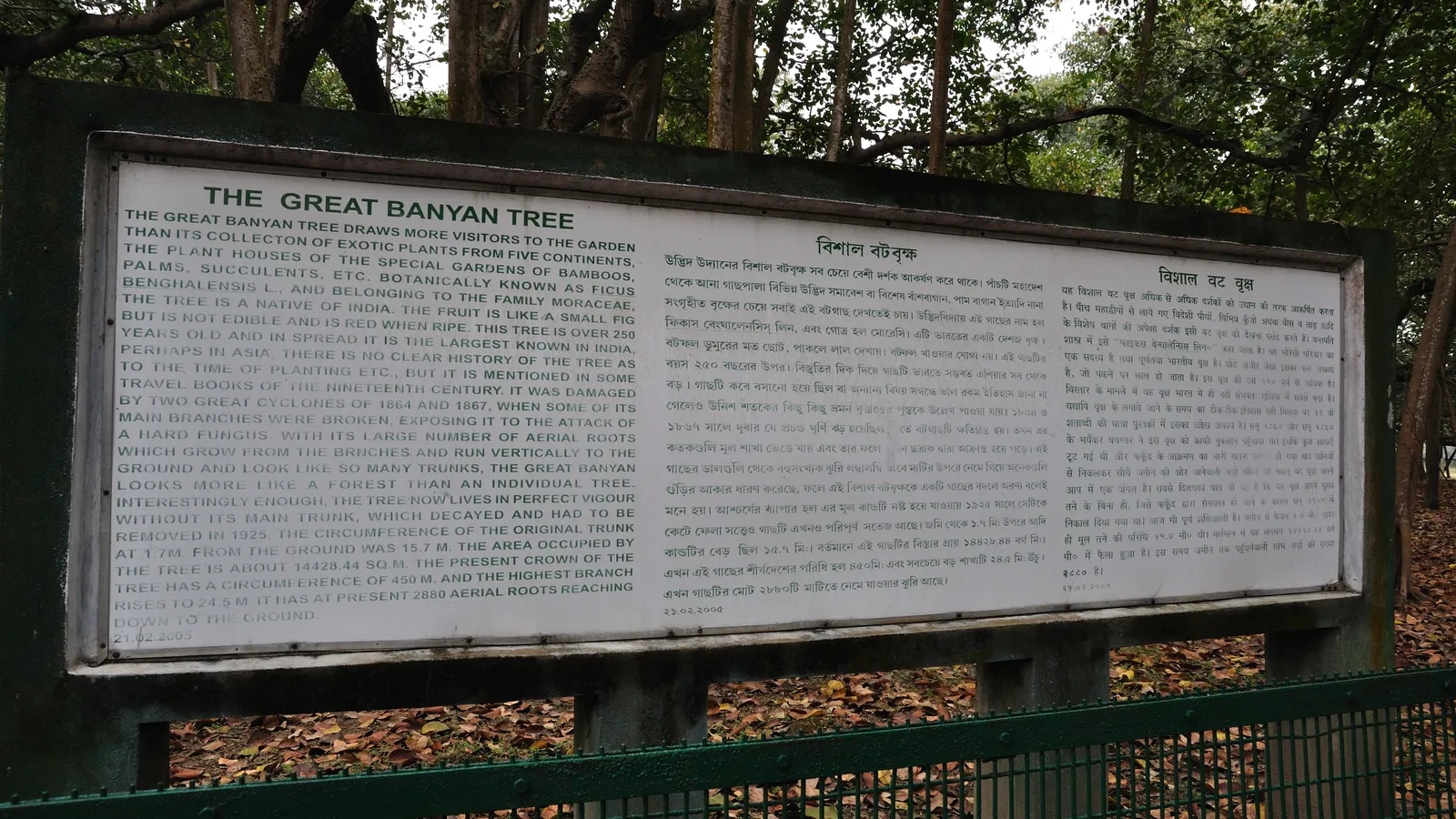
Observe the Great Banyan at Howrah first: aerial roots growing down from the branches like extra trunks, and small figs that turn red when ripe.
Read the label. The sign beside the tree gives the name Ficus benghalensis L. and the family Moraceae (photo of the sign).
Decode it with NCERT's rules: Ficus is the genus, benghalensis the specific epithet, and L. the abbreviated author, Linnaeus, just as the textbook writes Mangifera indica Linn.
Place it in the hierarchy you know: species, then genus Ficus, then family Moraceae.
Compare with a herbarium sheet of the same species to check leaves and figs the canopy keeps out of reach.
If a term like taxon or specific epithet still feels shaky, the Fermi Concept Library gives every concept in biology its own lesson and its place in the map. Fermi's AI tutor can check your understanding as you go.


