

On this page
When you first open Class 11 Biology, Chapter 1 (*The Living World*) throws three closely related terms at you: taxonomy, systematics and classification. They sound like they mean the same thing—organising living things—but they represent different scopes of work.
Getting them mixed up is a common way to lose marks in NEET. Here is the strict biological distinction, directly from the official NCERT textbook.
What is the difference between taxonomy vs systematics vs classification?
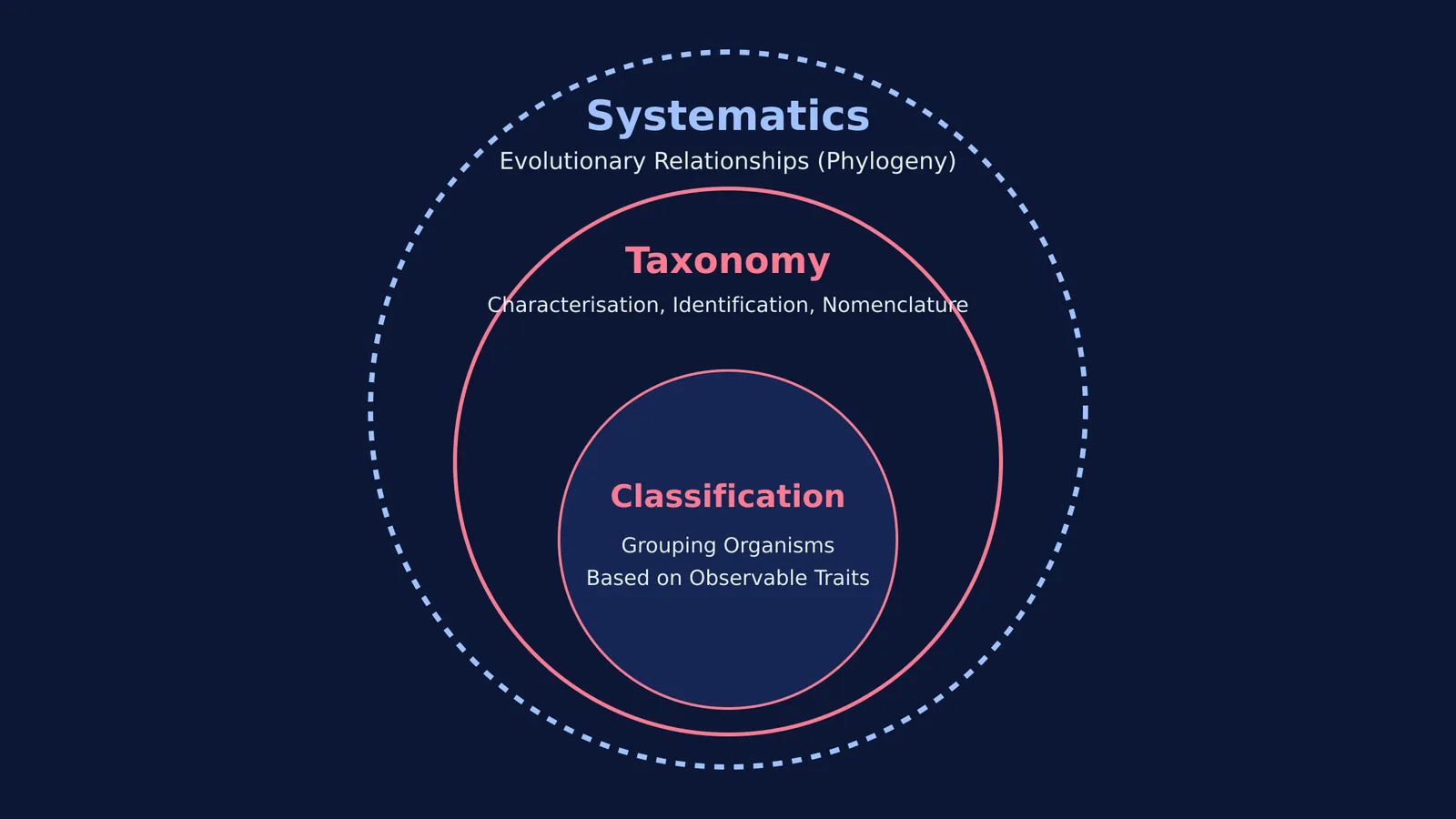
The easiest way to see the difference is to treat them as concentric circles, where one builds on the other.
Classification is the process of grouping organisms into convenient categories (taxa) based on easily observable characters. When you place a dog in the class Mammalia because it has hair and mammary glands, you are classifying it.
Taxonomy is the branch of science dealing with the rules, principles and procedures of doing that work. It is not just about putting things in boxes; it requires you to establish what those boxes should be.
Systematics is the study of the diversity of organisms and their evolutionary relationships. The word comes from the Latin *systema* (systematic arrangement), famously used by Carolus Linnaeus for his publication *Systema Naturae*.
Systematics is the broadest term. It includes all of taxonomy, plus phylogeny—the evolutionary history of the organisms. If a question mentions "evolutionary relationships", the answer is almost always systematics.
Before Linnaeus formalised taxonomy, naturalists wrestled with what made a species unique in the first place. John Ray's seed test was an early attempt to define a species by whether it breeds true, laying the groundwork for modern identification.
What are the four steps of taxonomy?
Modern taxonomy relies on external and internal structure, the structure of the cell, developmental processes and ecological information. According to the textbook definitions, taxonomy consists of four fundamental processes:
Characterisation: Describing all the anatomical and physiological features of the organism.
Identification: Comparing these features with known organisms to see if it is a newly discovered species.
Classification: Grouping the organism into a hierarchy of categories based on its shared characters.
Nomenclature: Giving the organism a universally accepted scientific name (like *Homo sapiens*).
As you can see, classification is simply step three of taxonomy. You cannot scientifically classify an organism until you have characterised and identified it.
Why does systematics include evolutionary history?
Early taxonomists grouped organisms mostly by what they looked like. But looks can be deceiving. A dolphin looks like a large fish, but its internal structure and evolutionary history show it is a mammal, closely related to hippos and cows.
Systematics fixes this by drawing a phylogenetic tree (a family tree of evolution). It ensures that our taxonomic groups reflect actual evolutionary branches. When we discover new fossil evidence or sequence a genome, the systematic relationship might change, which then forces us to update our taxonomy and classification.
If you find it hard to picture how modern cladistics builds on these rules, the Fermi Concept Library holds every concept in biology, each with its own lesson and its place in the map. If you get stuck on a topic, Fermi's AI tutor can work out what you already know and build a plan for the session, so you sit down to a clear next step instead of a blank page.
A quick checklist for exam prep
When reading a multiple-choice question, look for the keyword triggers that give away the answer:
If it says "grouping based on observable characters", it is classification.
If it says "principles and procedures" or lists characterisation, identification, classification and nomenclature, it is taxonomy.
If it says "evolutionary relationships" or "diversity of organisms", it is systematics.
Taxonomy tells you the rules of the game. Classification is playing the game. Systematics is understanding how the game evolved over evolutionary time.


