

On this page
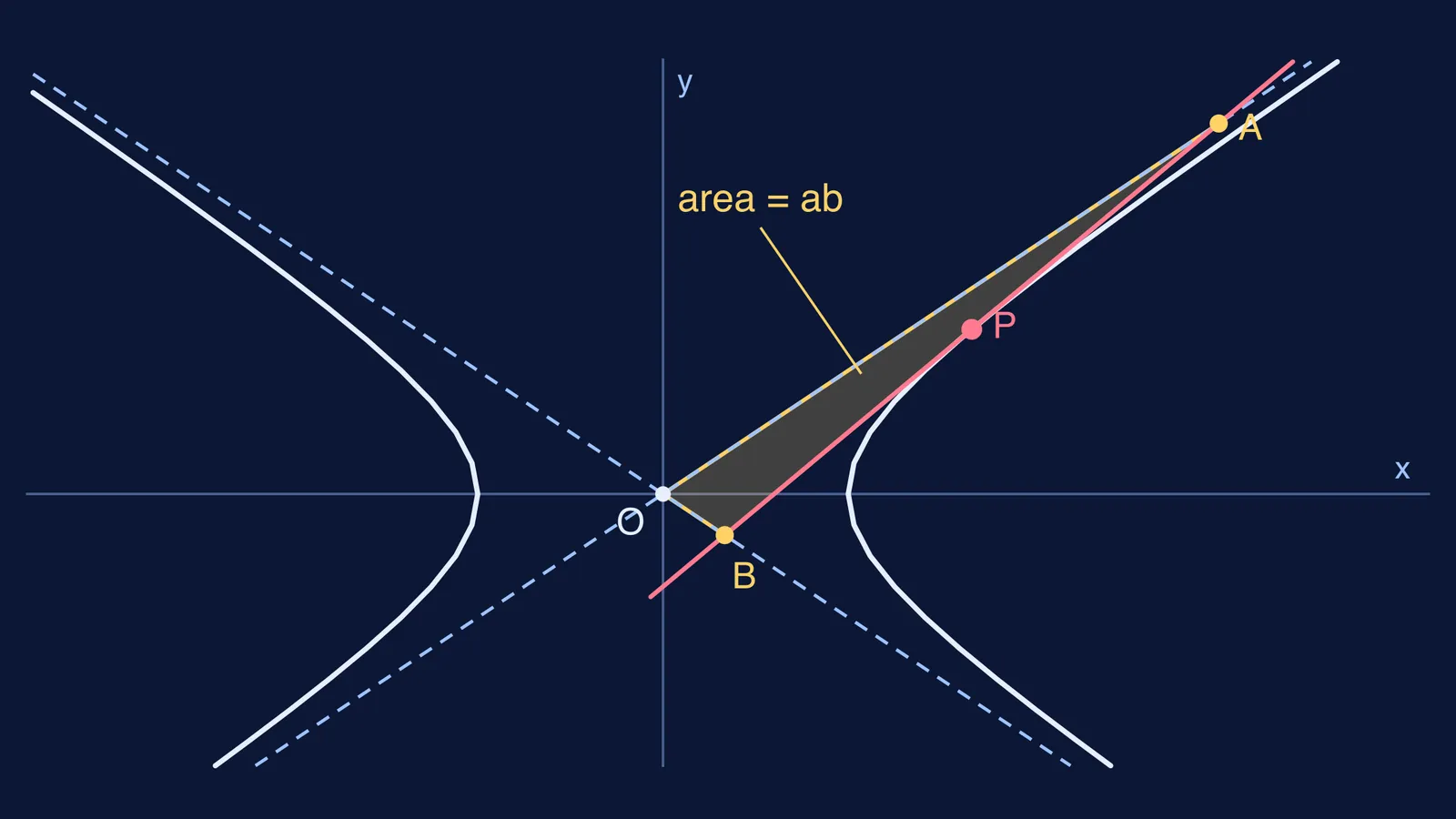
If a question gives you a hyperbola, a tangent at some unnamed point and asks for the area of the triangle with the asymptotes, the answer is a fixed number: ab. Wikipedia's article on the hyperbola states the result directly: the area of the triangle formed by a tangent and the asymptotes is independent of the point on the hyperbola, and equals ab. Here is the proof, a check and common slips.
What are the asymptotes and the tangent of x²/a² − y²/b² = 1?
Three standard facts, all in the Wikipedia hyperbola article and on Wolfram MathWorld, do the work.
The asymptotes are the two lines y = (b/a)x and y = −(b/a)x through the centre O.
Every point on the hyperbola can be written as P(a sec θ, b tan θ).
The tangent at (x₀, y₀) is xx₀/a² − yy₀/b² = 1, so at P it is (x sec θ)/a − (y tan θ)/b = 1.
If the parametric form is new to you, our post on parametric equations of the parabola, ellipse and hyperbola shows where a sec θ and b tan θ come from.
Why is the area of the triangle always ab?
Write the asymptotes in a form that makes the substitution easy.
On y = (b/a)x, every point is (at, bt) for some t. Put it in the tangent: t sec θ − t tan θ = 1, so t = 1/(sec θ − tan θ) = sec θ + tan θ. The tangent meets this asymptote at A = (a(sec θ + tan θ), b(sec θ + tan θ)).
On y = −(b/a)x, every point is (as, −bs). The tangent gives s sec θ + s tan θ = 1, so s = sec θ − tan θ. The second meeting point is B = (a(sec θ − tan θ), −b(sec θ − tan θ)).
The triangle is OAB with O at the origin, so its area is ½|x_A y_B − x_B y_A|.
Substituting: ½|−ab(sec θ + tan θ)(sec θ − tan θ) − ab(sec θ − tan θ)(sec θ + tan θ)| = ½ · 2ab(sec²θ − tan²θ) = ab.
The step 1/(sec θ − tan θ) = sec θ + tan θ is the identity sec²θ − tan²θ = 1 in disguise, and the same identity finishes step 4. That is why θ disappears: the answer cannot depend on where you draw the tangent.
Wolfram MathWorld credits this midpoint result to Apollonius.
Worked check: does it really give ab for a = 3, b = 2?
Take x²/9 − y²/4 = 1, so the claim is that every such triangle has area 6. Choose sec θ = 5/3 and tan θ = 4/3 (these satisfy sec²θ − tan²θ = 25/9 − 16/9 = 1).
Point of contact: P = (3 · 5/3, 2 · 4/3) = (5, 8/3). Check: 25/9 − (64/9)/4 = 25/9 − 16/9 = 1.
Tangent: 5x/9 − (8/3)y/4 = 1, which simplifies to 5x − 6y = 9.
sec θ + tan θ = 3 and sec θ − tan θ = 1/3.
A = (9, 6). It lies on y = 2x/3, and 45 − 36 = 9, so it is on the tangent too.
B = (1, −2/3). It lies on y = −2x/3, and 5 + 4 = 9.
Area = ½|9 · (−2/3) − 1 · 6| = ½|−6 − 6| = 6 = ab.
Midpoint of AB = (5, 8/3) = P.
A faster sanity check uses the vertex (θ = 0). The tangent x = a meets the asymptotes at (a, b) and (a, −b): base 2b, height a, area ab. If your formula fails this, recheck the algebra.
Which mistakes cost marks on this question?
Writing ab/2. The ½ from the triangle formula is cancelled by the 2 from adding the two products.
Dropping the modulus, which leaves −ab.
Using the ellipse point (a cos θ, b sin θ). The hyperbola needs (a sec θ, b tan θ) and sec²θ − tan²θ = 1, or θ will not cancel.
Forgetting the rectangular case. For xy = c², the asymptotes are the coordinate axes and the same idea gives 2c², as shown in our post on the triangle formed by a tangent to xy = c² and the axes. That matches ab with a = b = c√2.
How do you practise this until it sticks?
Redo the check with your own numbers: pick a and b, take sec θ = 13/12 and tan θ = 5/12, and confirm the area is ab and P is the midpoint. If asymptotes feel shaky, start with our post on finding the asymptotes of a hyperbola from a and b.
If you get stuck mid-derivation, the Fermi Problem Library has worked problems with a step-by-step solver that explains the reasoning rather than printing an answer. If the gap is the idea of a parametric point or an asymptote, the Fermi Concept Library gives each concept in mathematics its own lesson.


