

On this page
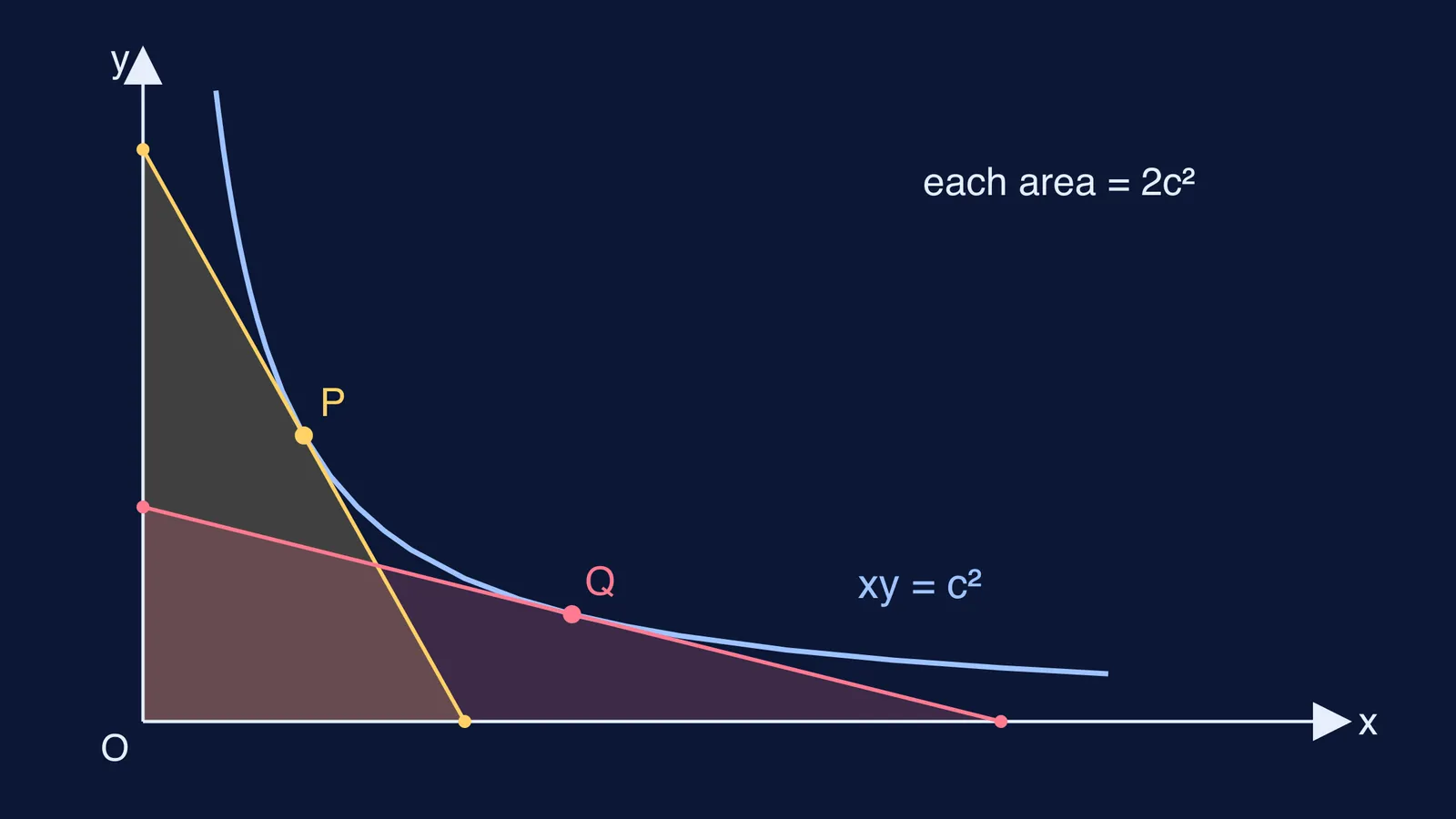
This is a common JEE Main and board-exam question: a tangent touches a curve, runs on to meet both axes, and you are asked for the area of the right triangle it cuts off with the origin. The method is the same for any curve. The surprise comes with xy = c², where the answer does not depend on which point you pick.
How do you find the area of the triangle formed by a tangent and the axes?
Four steps work for any curve y = f(x).
Find the slope at the point of contact (x₀, y₀): m = f′(x₀).
Write the tangent: y − y₀ = m(x − x₀).
Put y = 0 to get the x-intercept, x₀ − y₀/m. Put x = 0 to get the y-intercept, y₀ − m·x₀.
Area = ½ × |x-intercept| × |y-intercept|.
The absolute values matter. An intercept can come out negative (on xy = c², a point in the third quadrant gives two negative intercepts), but an area never does. For the slope step itself, our guide to tangent and normal equations and common slips goes through it in more detail.
Why is the area always 2c² for xy = c²?
Write the curve as y = c²/x. Then dy/dx = −c²/x₀², and since c² = x₀y₀, the slope at (x₀, y₀) is −y₀/x₀.
Put that into the point-slope form and tidy up: y₀x + x₀y = 2x₀y₀. Divide by x₀y₀ and the tangent becomes x/x₀ + y/y₀ = 2.
Now the intercepts can be read straight off. Put y = 0 and x = 2x₀. Put x = 0 and y = 2y₀. So the area is ½ × |2x₀| × |2y₀| = 2|x₀y₀| = 2c², the same for every point on the curve.
In parametric form, with the point (ct, c/t), the same tangent reads x + t²y = 2ct. The intercepts are 2ct and 2c/t, and their product is 4c², so the t cancels and the area is again 2c².
The Wikipedia article on the hyperbola gives the tangent to y = A/x at (x₀, A/x₀) as y = −(A/x₀²)x + 2A/x₀, whose y-intercept 2A/x₀ is exactly twice the point's y-coordinate. The same article proves that the triangle formed by any tangent and the two asymptotes has area ab, independent of the point. For y = A/x the asymptotes are the coordinate axes and both semi-axes equal √(2A), so ab = 2A, which is 2c² when A = c².
If you want the rest of this curve's properties (vertices, foci, eccentricity √2), see our explainer on the rectangular hyperbola xy = c².
Worked examples: does the 2c² answer really hold?
Example 1: xy = 16 at (2, 8). Here c² = 16. The slope is −16/2² = −4, so the tangent is y = −4x + 16. It meets the x-axis at 4 and the y-axis at 16, which are 2 × 2 and 2 × 8. Area = ½ × 4 × 16 = 32 = 2 × 16.
Example 2: xy = 9 at (−1, −9). Using x/x₀ + y/y₀ = 2, the tangent is x/(−1) + y/(−9) = 2. The intercepts are −2 and −18. Area = ½ × 2 × 18 = 18 = 2 × 9.
Example 3, a contrast: y = 1/x². At (1, 1) the slope is −2, the tangent is y = −2x + 3, and the intercepts are 1.5 and 3, giving area 2.25. At (3, 1/9) the slope is −2/27, the intercepts are 4.5 and 1/3, and the area is 0.75. So a constant area is a special property of xy = c², not of every curve that looks like it.
A similar "constant no matter where you touch" result shows up with the astroid, where the tangent's piece between the axes always has the same length; our post on the astroid tangent intercept works through it.
Which mistakes cost marks on this question?
Forgetting the ½ and writing 4c², the product of the intercepts.
Writing 2c instead of 2c², by mixing up c and c².
Leaving the area negative for a point in the third quadrant.
Using the slope formula without substituting the point, so x still appears in the "tangent".
For xy = k with a given number k, the area is 2|k|; check it against your answer.
If your number comes out different and you cannot see why, the Fermi Problem Library has worked problems with a step-by-step solver that explains the reasoning rather than printing an answer, so you can find the exact line that went wrong. If the gap is the idea of a tangent or an asymptote itself, the Fermi Concept Library gives each concept in mathematics its own lesson and its place in the map.


