

On this page
When studying conic sections for the JEE or similar exams, you first meet the hyperbola in its standard form x²/a² - y²/b² = 1. But in coordinate geometry, a special case appears repeatedly: the rectangular hyperbola where a = b.
If you rotate this equilateral hyperbola by 45°, the coordinate axes become its asymptotes, and the equation simplifies to the elegant inverse variation xy = c². This form is not just a mathematical curiosity; it models real-world phenomena like Boyle's Law in physics.
Why does xy = c² represent a rectangular hyperbola?
A hyperbola is called rectangular (or equilateral) when its transverse axis and conjugate axis are equal in length. In the standard equation x²/a² - y²/b² = 1, setting a = b gives x² - y² = a². The asymptotes of this curve are the lines y = x and y = -x, which intersect at exactly 90°.
If we rotate the coordinate axes by 45°, the asymptotes themselves become the new x and y axes. The equation transforms into xy = c², where c² = a²/2. The eccentricity of every rectangular hyperbola is exactly √2 (MathWorld). Because its asymptotes are perpendicular, this shape shares all geometric properties of the standard equilateral hyperbola.
What are the vertices and foci of xy = c²?
Because the hyperbola has been rotated, its geometry lies along the line y = x instead of the x-axis.
Transverse axis: The line y = x.
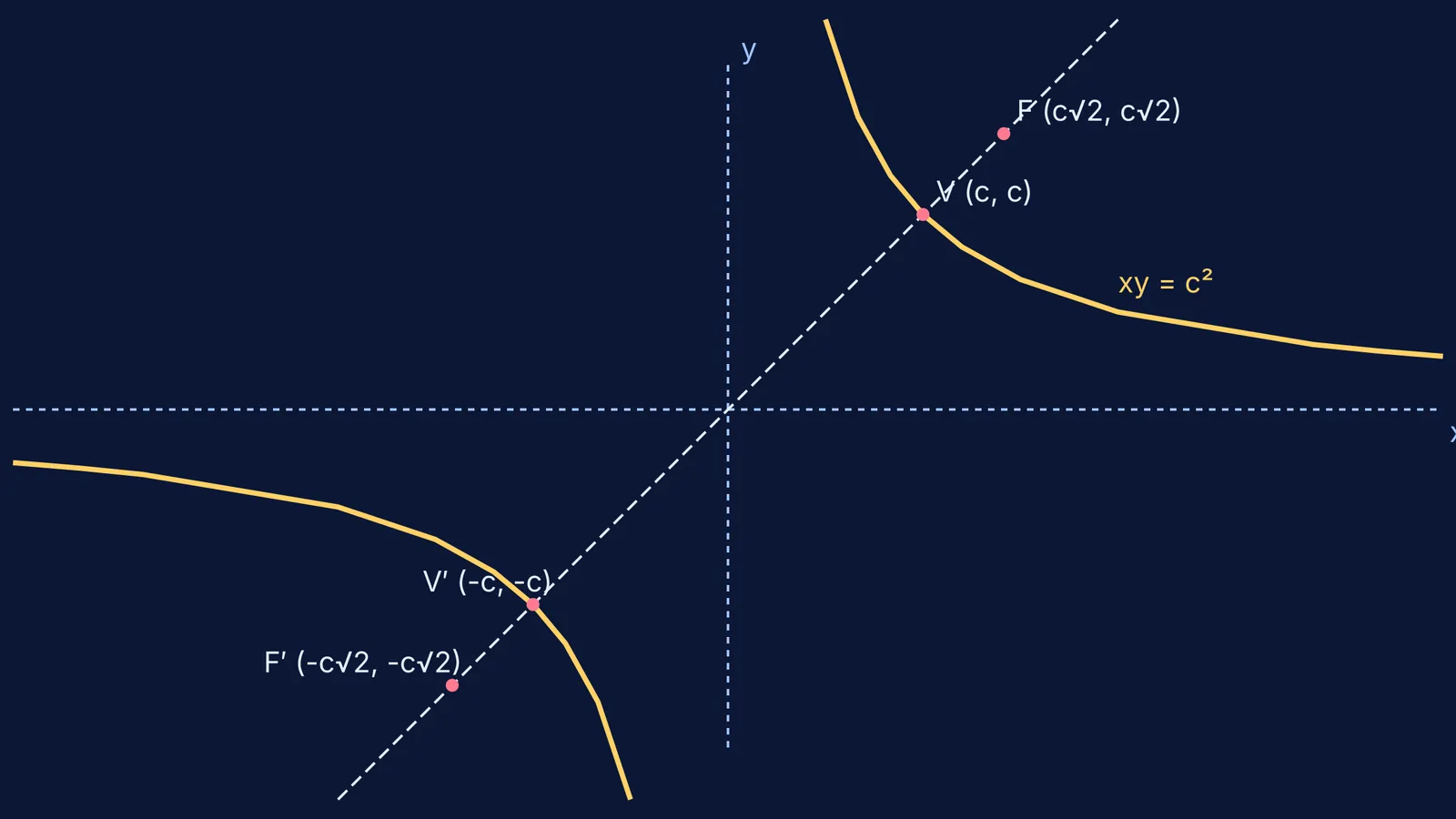
Vertices: The points where the hyperbola crosses its transverse axis. Setting y = x in xy = c² gives x² = c², so x = ±c. The vertices are (c, c) and (-c, -c).
Foci: In the standard form, the distance from the centre to a focus is ae. Since e = √2 and the semi-transverse axis length is a = c√2, the distance from the origin to the foci is ae = (c√2)(√2) = 2c. Along the line y = x, these points are (c√2, c√2) and (-c√2, -c√2).
Knowing how to find these points is a staple of competitive exam geometry, similar to recalling latus rectum length formulas for parabolas and ellipses.
How do you find the parametric coordinates of xy = c²?
To solve locus and tangent problems efficiently, we replace the variables x and y with a single parameter. For the curve xy = c², the standard parametric point is (ct, c/t), where t is a non-zero real number.
When x = ct, multiplying it by y = c/t yields xy = c², proving the point always lies on the curve. This form drastically simplifies calculus applications, such as finding the derivative of parametric functions for a tangent line.
If you are struggling to build intuition for conic sections before diving into complex coordinate geometry, you can review the foundation of every curve in the Fermi Concept Library, which has every concept in physics, chemistry, biology, mathematics and computing, each with its own lesson and its place in the map.
How do you use the parametric point for tangents and normals?
Let us find the equation of the tangent line to xy = c² at the point (ct, c/t).
First, differentiate xy = c² with respect to x using the product rule: x(dy/dx) + y = 0.
Rearrange to find the slope: dy/dx = -y/x.
Substitute the parametric coordinates x = ct and y = c/t: the slope m = -(c/t) / (ct) = -1/t².
Use the point-slope form of a line: y - c/t = (-1/t²)(x - ct).
Multiply through by t² to get t²y - ct = -x + ct.
Rearrange into the standard tangent equation: x + t²y = 2ct.
This predictable algebraic structure makes the parametric form (ct, c/t) powerful. It acts as a shortcut, bypassing the messy algebra of x and y just as you might use the PS + PS′ = 2a property to quickly find focal distances on an ellipse.


