

On this page
A classic JEE-style calculus question: show that the part of any tangent to x^(2/3) + y^(2/3) = a^(2/3) between the coordinate axes has constant length a. Here are two short proofs, a number check, and the mistakes that cost marks.
What is an astroid?
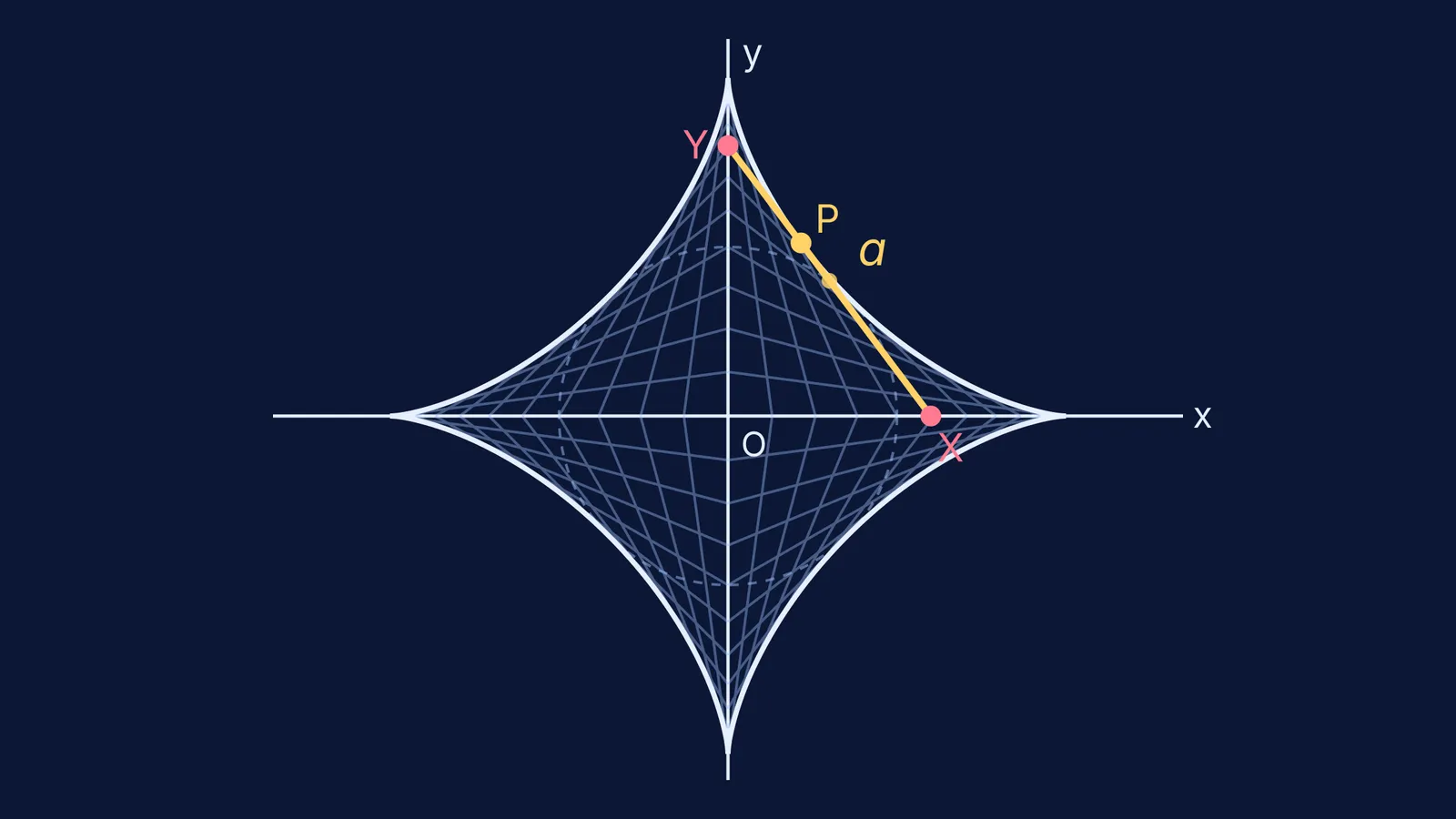
An astroid is a hypocycloid with four cusps: the path of a point on a circle rolling inside a fixed circle four times its radius, as described on Wikipedia's astroid page.
Its Cartesian equation is x^(2/3) + y^(2/3) = a^(2/3), and its parametric form is x = a cos³t, y = a sin³t (Wolfram MathWorld).
The name comes from the Greek word for star, and Joseph Johann von Littrow proposed the term "Astrois" in 1838 (Wikipedia).
How do you prove the tangent intercept is constant?
The parametric route is the cleanest. If it feels shaky, our guide to parametric equations of parabola, ellipse and hyperbola is a good warm-up.
Take the point P(a cos³t, a sin³t), with 0 < t < π/2.
Differentiate: dx/dt = −3a cos²t sin t and dy/dt = 3a sin²t cos t.
Divide: dy/dx = (3a sin²t cos t) / (−3a cos²t sin t) = −tan t.
Tangent at P: y − a sin³t = −tan t (x − a cos³t).
Multiply by cos t and collect: x sin t + y cos t = a sin t cos t (sin²t + cos²t) = a sin t cos t.
Divide by a sin t cos t: x/(a cos t) + y/(a sin t) = 1.
That last line is the intercept form of a line. The tangent meets the x-axis at X(a cos t, 0) and the y-axis at Y(0, a sin t).
So XY² = a²cos²t + a²sin²t = a², and XY = a. The parameter t has cancelled, so the length is the same for every tangent.
Can you prove it without the parametric form?
Yes, with implicit differentiation. It also makes a good cross-check on the parametric proof.
Differentiate x^(2/3) + y^(2/3) = a^(2/3): (2/3)x^(−1/3) + (2/3)y^(−1/3) dy/dx = 0, so dy/dx = −(y/x)^(1/3).
At a point (h, k) on the curve, the tangent simplifies to x/h^(1/3) + y/k^(1/3) = a^(2/3).
The intercepts are a^(2/3)h^(1/3) on the x-axis and a^(2/3)k^(1/3) on the y-axis.
Sum of their squares: a^(4/3)(h^(2/3) + k^(2/3)) = a^(4/3) × a^(2/3) = a².
The last step uses the curve's own equation, h^(2/3) + k^(2/3) = a^(2/3), so write that substitution out.
A worked check with real numbers
Pick a = 125, so the curve is x^(2/3) + y^(2/3) = 25. The point (27, 64) lies on it, because 27^(2/3) = 9 and 64^(2/3) = 16, and 9 + 16 = 25.
Cube roots: 27^(1/3) = 3 and 64^(1/3) = 4.
Tangent: x/3 + y/4 = 25.
Intercepts: x = 75 on the x-axis, y = 100 on the y-axis.
Length: √(75² + 100²) = √15625 = 125, which equals a.
In the parametric picture this point has cos t = 3/5 and sin t = 4/5, so the intercepts are 125 × 3/5 = 75 and 125 × 4/5 = 100, as expected.
What else follows, and where do students slip?
The astroid is the envelope of a segment of fixed length that keeps one end on each axis, so a ladder sliding down a wall traces it (Wikipedia). Each position of the ladder is one tangent. To see why a tangent line is the right object to study, the derivative as the slope of a tangent explainer zooms in on exactly that.
Two follow-ups that exams like, both direct from X(a cos t, 0) and Y(0, a sin t):
The midpoint of XY is (a cos t/2, a sin t/2), so its locus is the circle x² + y² = a²/4.
The perpendicular distance from the origin to the tangent is a sin t cos t = (a/2) sin 2t, which is largest, a/2, at t = π/4.
Common slips to watch for:
Writing dy/dx = tan t instead of −tan t. The curve falls in the first quadrant, so the slope must be negative.
Stopping at the intercepts and forgetting to square and add.
Choosing t = 0 or π/2. Those are cusps, where the tangent lies along an axis.
Mixing up dy/dx with ratios of second derivatives in follow-up parts; see why d²y/dx² is not (d²y/dt²)/(d²x/dt²).
If you want more questions of this type, the Fermi Problem Library has worked problems with a step-by-step solver that explains the reasoning rather than printing an answer. If the gap is parametric differentiation itself, the Fermi Concept Library gives each mathematics concept its own lesson.
Try the same steps on the tangent to x^(2/3) + y^(2/3) = 4 at (1, 3√3) next; the segment should come out as 8.


