

On this page
The chain rule is the engine of calculus, but it also creates one of the most common traps for students working with parametric equations. When you define a curve using a third parameter, t, finding the slope (dy/dx) is straightforward. Finding the curvature (d²y/dx²) is not.
What is the parametric second derivative trap?
When given the parametric equations x(t) and y(t), it is tempting to find the second derivative by differentiating twice and dividing the results.
This incorrect assumption looks like this: d²y/dx² = (d²y/dt²) / (d²x/dt²)
This formula is completely false. As OpenStax Calculus Volume 2 points out, the second derivative of y with respect to x is the rate of change of the slope itself. To find it, you must differentiate the first derivative (dy/dx) with respect to t, and then divide by dx/dt to convert the rate of change back into terms of x.
The correct formula is: d²y/dx² = [d/dt (dy/dx)] / (dx/dt)
How to find the second derivative of parametric equations?
If you are facing a parametric calculus problem on an exam, use this four-step framework to ensure you do not fall into the trap:
Find the individual rates: Differentiate your equations to find dx/dt and dy/dt.
Find the slope: Divide dy/dt by dx/dt to get the first derivative, dy/dx. Simplify this expression as much as possible, leaving it in terms of t.
Differentiate the slope: Take your simplified dy/dx and differentiate it with respect to t. This gives you the numerator: d/dt (dy/dx).
Apply the chain rule: Divide the result from step 3 by your original dx/dt.
This guarantees that you are tracking how the slope changes as x changes, rather than how the slope changes as t changes. For more on curvature testing, see our guide to concavity and points of inflection: the f″ sign-change test.
Why does this matter for a cycloid?
To see why the trap is so dangerous, let us look at a cycloid. A cycloid is the curve traced by a point on the rim of a rolling wheel. Its parametric equations are:
x = r(t - sin t) y = r(1 - cos t)
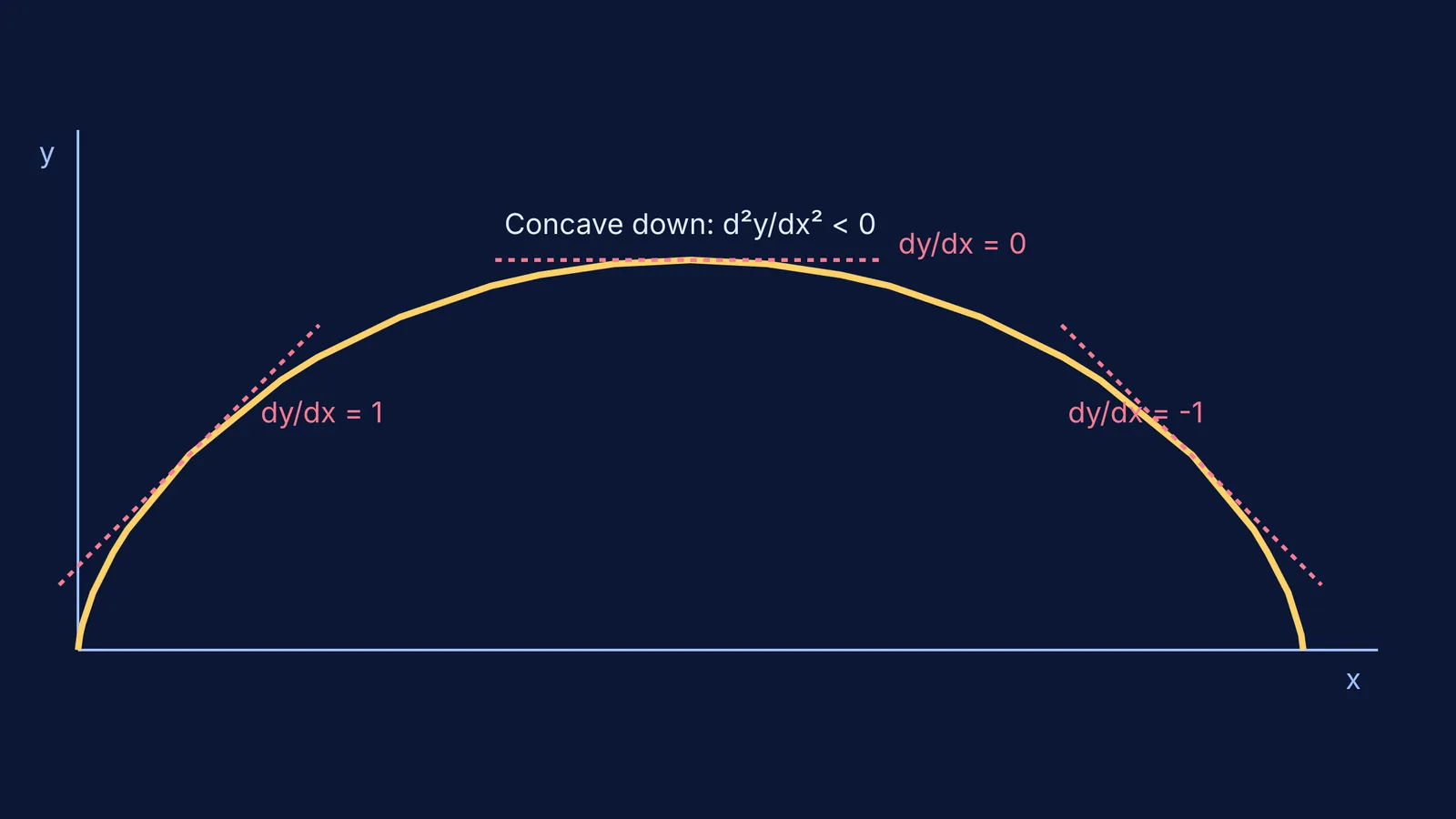
If you look at the graph of a cycloid, it forms a series of arches. It is always concave down, meaning its second derivative (d²y/dx²) must be strictly negative everywhere above the x-axis.
Let us apply the correct four-step framework:
Step 1: dx/dt = r(1 - cos t) dy/dt = r sin t
Step 2: dy/dx = (r sin t) / (r(1 - cos t)) dy/dx = (sin t) / (1 - cos t)
Step 3: d/dt [ (sin t) / (1 - cos t) ] Use the quotient rule: = [ (cos t)(1 - cos t) - (sin t)(sin t) ] / (1 - cos t)² = [ cos t - cos² t - sin² t ] / (1 - cos t)² = [ cos t - (cos² t + sin² t) ] / (1 - cos t)² Because cos² t + sin² t = 1, the numerator becomes (cos t - 1). = (cos t - 1) / (1 - cos t)² = -1 / (1 - cos t)
Step 4: d²y/dx² = [ -1 / (1 - cos t) ] / [ r(1 - cos t) ] d²y/dx² = -1 / [ r(1 - cos t)² ]
Because r is the radius of our wheel (a positive number), and a squared bracket is always positive, this fraction is always negative. The mathematics confirms what our eyes see: the cycloid is entirely concave down.
If you want to practice similar derivations, see our guide to the second derivative of an implicit function: step-by-step.
What happens if I make the mistake?
Let us see what happens if a student falls into the trap and calculates (d²y/dt²) / (d²x/dt²).
d²x/dt² = r sin t d²y/dt² = r cos t
Trap result = (r cos t) / (r sin t) = cot t
This result is incorrect. The cotangent function changes sign depending on the angle. If you evaluate it at t = π/4 (during the first quarter turn of the wheel), cot(π/4) is 1. A positive second derivative means the curve is concave up. The trap has told the student that the arch bends upwards like a bowl, which is physically false.
When you get the wrong concavity, you also find non-existent points of inflection and draw the wrong graphs. If you frequently hit these dead ends in homework, the Fermi Problem Library has worked problems with a step-by-step solver that explains the reasoning rather than printing an answer. Catching the false assumption early saves you from chasing a mathematical mirage.


