

On this page
When you have a function written simply as y = f(x), finding the second derivative means differentiating twice. But when x and y are mixed together in an equation like x² + y² = 25, you are dealing with an implicit function. To find its second derivative, d²y/dx², you must differentiate the first derivative using the quotient rule and substitute dy/dx back into the equation. It is a multi-step process where a single algebraic slip can throw off the final answer.
What is the second derivative of an implicit function?
When an equation relates x and y implicitly, you differentiate both sides with respect to x, remembering to attach dy/dx whenever you differentiate a term with y. This chain rule step gives you the first derivative, dy/dx.
To get the second derivative, you differentiate that dy/dx expression again with respect to x. This always introduces another dy/dx into your new equation. The crucial step is substituting the expression you found for the first derivative back into this second derivative, and then using the original implicit equation to simplify the numerator.
How do you find the second derivative step by step?
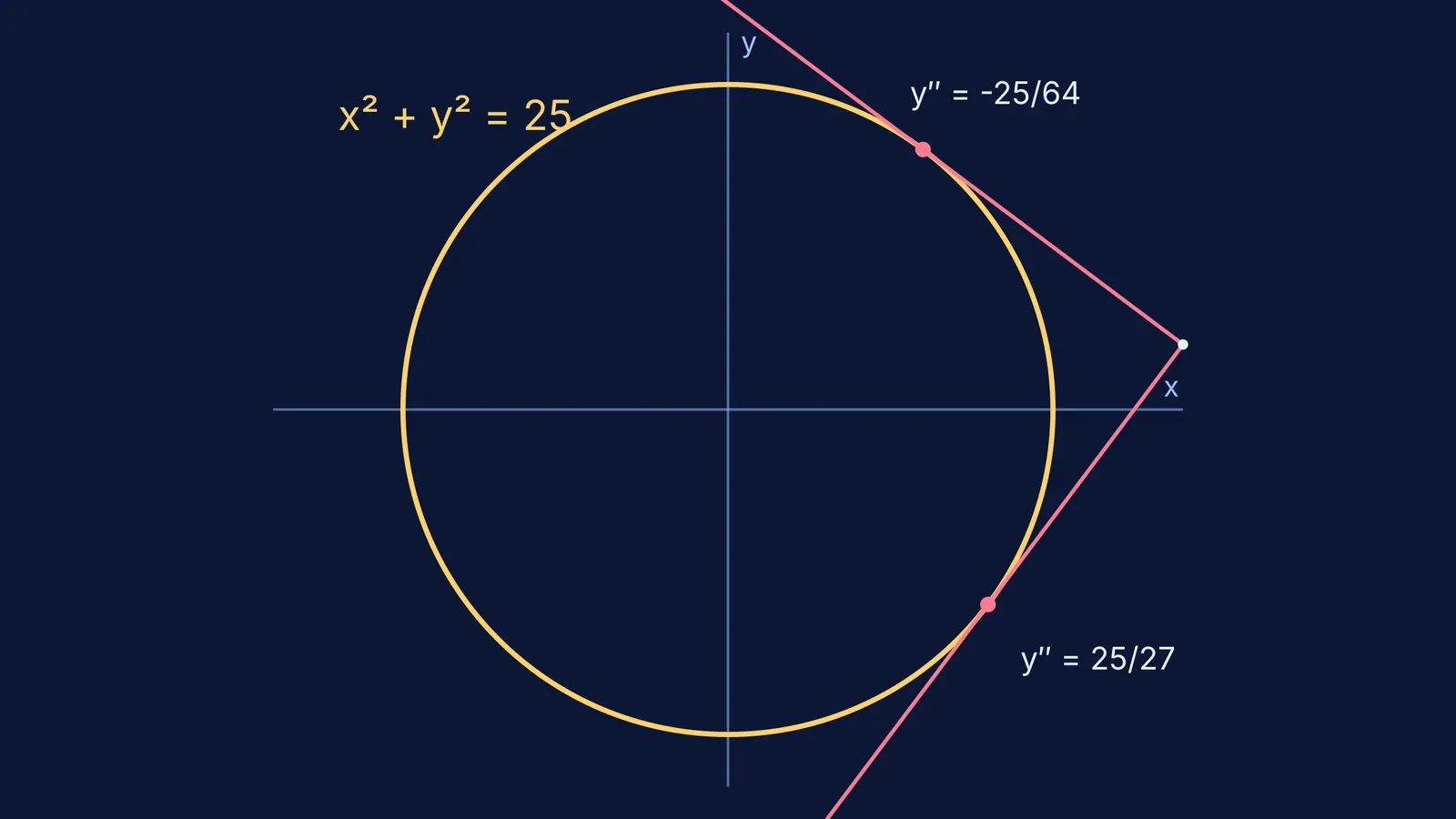
Let's walk through the classic circle equation, x² + y² = 25.
Step 1: Find the first derivative Differentiate both sides with respect to x: 2x + 2y (dy/dx) = 0 Now, isolate dy/dx: 2y (dy/dx) = −2x dy/dx = −x/y
Step 2: Differentiate again using the quotient rule Now differentiate −x/y with respect to x. Since x is in the numerator and y is in the denominator, you need the quotient rule: (vu′ − uv′) / v². d²y/dx² = − [y(1) − x(dy/dx)] / y² d²y/dx² = (−y + x(dy/dx)) / y²
Step 3: Substitute the first derivative Replace the dy/dx in your numerator with −x/y: d²y/dx² = (−y + x(−x/y)) / y² d²y/dx² = (−y − x²/y) / y²
Step 4: Simplify using the original equation Multiply the numerator and denominator by y to clear the fraction: d²y/dx² = (−y² − x²) / y³ Factor out the negative sign: d²y/dx² = −(x² + y²) / y³
Here is where the most elegant simplification happens. Look back at your original equation: x² + y² = 25. You can replace the entire grouped term in the numerator with 25. d²y/dx² = −25/y³
If you frequently lose track of algebra in long calculus problems, the Fermi Problem Library has a step-by-step solver that explains the reasoning rather than printing an answer, helping you spot where your substitution went wrong. For brushing up on calculus fundamentals before diving into implicit forms, check the Fermi Concept Library.
A second example: the hyperbola
The exact same substitution pattern appears in hyperbolas and ellipses. Consider the hyperbola x² − y² = 16.
Step 1: Find dy/dx Differentiate both sides: 2x − 2y (dy/dx) = 0 2y (dy/dx) = 2x dy/dx = x/y
Step 2: Apply the quotient rule Differentiate x/y with respect to x: d²y/dx² = [y(1) − x(dy/dx)] / y² d²y/dx² = (y − x(dy/dx)) / y²
Step 3: Substitute and simplify Replace dy/dx with x/y: d²y/dx² = (y − x(x/y)) / y² d²y/dx² = (y − x²/y) / y² Multiply top and bottom by y to clear the fraction: d²y/dx² = (y² − x²) / y³
Step 4: Use the original equation Your original equation states that x² − y² = 16. Notice that the numerator here is the exact negative of that: y² − x². Therefore, y² − x² = −16. d²y/dx² = −16 / y³
This consistent pattern—finding the second derivative, substituting the first derivative back in, and collapsing the numerator using the original equation—is why exam boards love setting these questions. It tests your calculus, your algebra, and your mathematical foresight in one problem.
Where do students drop marks?
Students lose marks on these problems by forgetting that y is a function of x. When differentiating y² a second time, it becomes 2y (dy/dx), not just 2y. Another common trap is stopping at Step 3 and leaving dy/dx in the final answer. Exam boards require the second derivative to be entirely in terms of x and y. Finally, overlooking the original equation (x² + y² = 25) leaves the answer looking messy and costs simplification marks.
If you are practicing for the board exams, making a habit of writing down "Substitute original equation" next to your working can save you time and help secure full marks on rigorous, multi-step calculus questions. In 2023 alone, 273,987 students took the AP Calculus AB exam, where mastering such multi-step techniques is essential.
Related reading:


