

On this page
You finish a plate of rajma-chawal in eight minutes before tuition and feel fine. Twenty minutes later you feel stuffed. That gap is real, and it is a neat piece of school biology: your nervous system and your endocrine system doing the same job at different speeds.
How does your body know when you are full?
Two kinds of signal tell your brain you have eaten enough: stretch and chemistry.
The first is stretch. Stretch receptors in the stomach wall fire as the stomach fills, and they signal the brainstem directly through the vagus nerve, according to Harvard Health Publishing. Physiologists call these tension receptors. They respond to stretch and detect distension of the stomach (Kentish and colleagues, Journal of Physiology, 2012).
The second is chemistry. As digested food reaches the small intestine, hormone-making cells in the gut lining release hormones that help tell the brain you have eaten. A review in Physiological Reviews by Robert Steinert, Christine Feinle-Bisset and colleagues describes where they come from:
CCK (cholecystokinin): made by cells that are densest in the duodenum and upper jejunum.
GLP-1 and PYY: made by L cells spread along the small intestine and colon.
Ghrelin: the hunger hormone, made in the stomach; its level rises before meals and falls sharply after them.
All of these satiation signals converge on the nucleus of the solitary tract in the hindbrain, which relays them to other brain areas (Physiology and Behavior, 2018).
If nerves and hormones blur together in your notes, our explainer on how a nerve impulse differs from a hormone signal puts them side by side. For the gut hormones that control digestion itself, see gastrin, secretin and the other gut hormones.
Why does it take about 20 minutes to feel full?
The rule of thumb is about 20 minutes, and Live Science reports that it does take around that long, on average, for your body's signals to tell your brain you have had enough. The exact lag depends on what you eat and how you usually eat.
Part of the delay comes from the hormone half of the system. Stretch tells your brain how much is in the stomach, not what it is. The hormone signal has to wait for food to move on into the intestine. In the Physiological Reviews review, blood levels of CCK rose within 10 to 15 minutes of nutrients being infused into the duodenum.
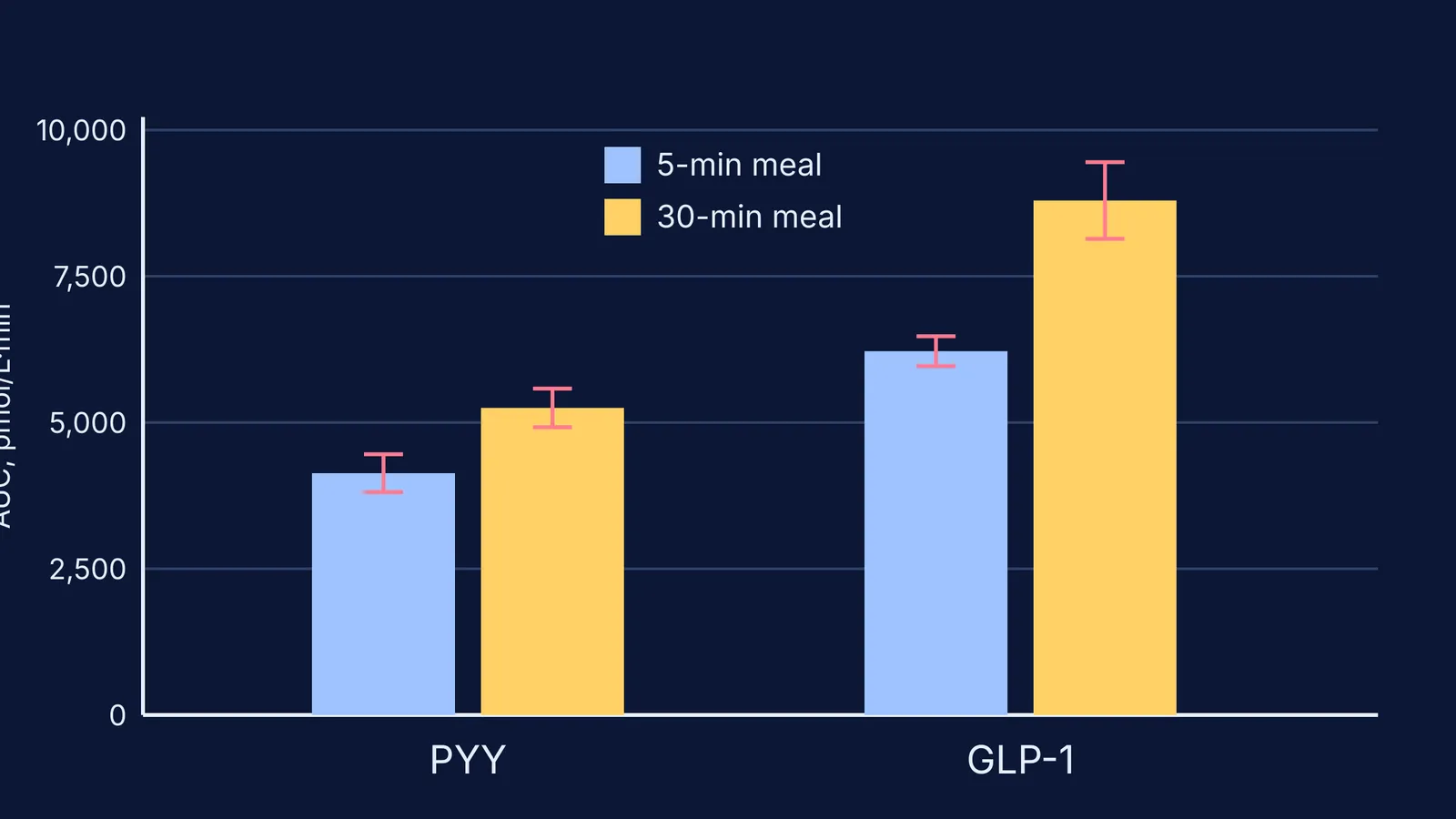
Eating speed changes that signal. In a 2010 crossover study, 17 healthy men ate the same 300 ml of ice cream (675 kcal) twice: once in 5 minutes and once in 30 minutes (Kokkinos and colleagues, Journal of Clinical Endocrinology and Metabolism). After the slow meal, the total PYY response was about 27% higher and the GLP-1 response about 41% higher than after the fast one. Fullness ratings showed only a trend upward, and ghrelin did not differ.
What happens during a fast lunch?
The sequence for a plate you finish quickly:
First bites: the stomach stretches, and tension receptors send a volume message up the vagus nerve.
Food passes into the duodenum: CCK cells start releasing their hormone, which takes minutes, not seconds.
Further along the intestine: L cells add PYY and GLP-1.
In the hindbrain: the nucleus of the solitary tract gathers the stretch and hormone signals, while ghrelin falls.
If you clear your plate in eight minutes, you have stopped eating before the slower hormone part has had much time to build. That is one reason the stuffed feeling can arrive after you have stopped.
Your stomach also signals in the other direction, before a meal. Our post on why your stomach growls covers that side.
How can you use this on a busy exam day?
Try a simple 20-minute plate plan at home or in the hostel mess:
Serve one normal plate. Wait 20 minutes before deciding on seconds.
Put your spoon down between bites and talk to whoever is at the table.
Eat away from your phone and your revision notes, so you notice the stretch signal.
Parents: let family dinner run long rather than rushing it.
For exams, write the answer as two arrows. Nerve route: stomach stretch, tension receptors, vagus nerve, brainstem. Hormone route: food in the intestine, CCK, PYY and GLP-1, blood, brain. Then add one line on ghrelin falling. Drawn as a flowchart, that gives you a clear structure for a long answer.
If the difference between nervous and hormonal control is still a gap in your notes, the Fermi Concept Library gives every biology concept its own lesson and its place in the map. For other topics that are hard to picture, the Fermi Simulation Lab has interactive simulations for ideas that are easier to see than to read.
Next time you finish a plate fast, wait 20 minutes before deciding you need more.


