

On this page
Visualising how waves of muscle contraction travel through the gut can be tricky, which is why students often turn to the Fermi Simulation Lab to see these hard-to-picture physiological processes in motion. But when you are sitting in a silent room, the physical sound of those contractions is impossible to ignore.
A loud stomach rumble during an exam or a study period is a common worry for students. It feels like a broadcast to the entire room that you are hungry. However, the noise is not actually a desperate plea for food from an empty stomach. Instead, it is the sound of your digestive system doing its routine cleaning.
What is that rumbling sound?
The medical term for stomach growling is borborygmus (plural: borborygmi). It is the rumbling, gurgling noise produced when gas and fluids move through your gastrointestinal tract.
Your digestive system is lined with layers of smooth muscle. When you eat, these muscles contract and relax in a coordinated, wave-like motion known as peristalsis. This rhythmic movement mixes and mashes your food, pushing the contents forward through the stomach and down into the small intestine. This process is an essential part of digestion and breathing in Class 7: a chapter guide, and scientists have studied its mechanics since the days of William Beaumont and watching digestion inside a living stomach.
Why is it so much louder when you are hungry?
Peristalsis happens all the time, even when you are full. However, when your stomach contains a recently eaten meal, the solid food acts as a natural muffler. It absorbs the sound of the muscles squeezing and the fluids moving.
When your stomach and intestines are completely empty, they become hollow echo chambers. Without any food to dampen the noise, the vibrations of air and fluid moving through the tight spaces of your gut are heavily amplified. This makes the rumbles loud enough for you—and potentially the person sitting at the next desk—to hear clearly.
Furthermore, an empty stomach secretes a hormone called ghrelin. Often referred to as the "hunger hormone", ghrelin travels to the brain to trigger the physical sensation of hunger, and it also helps stimulate the intense muscle contractions that lead to those loud rumbles.
What is the housekeeper wave?
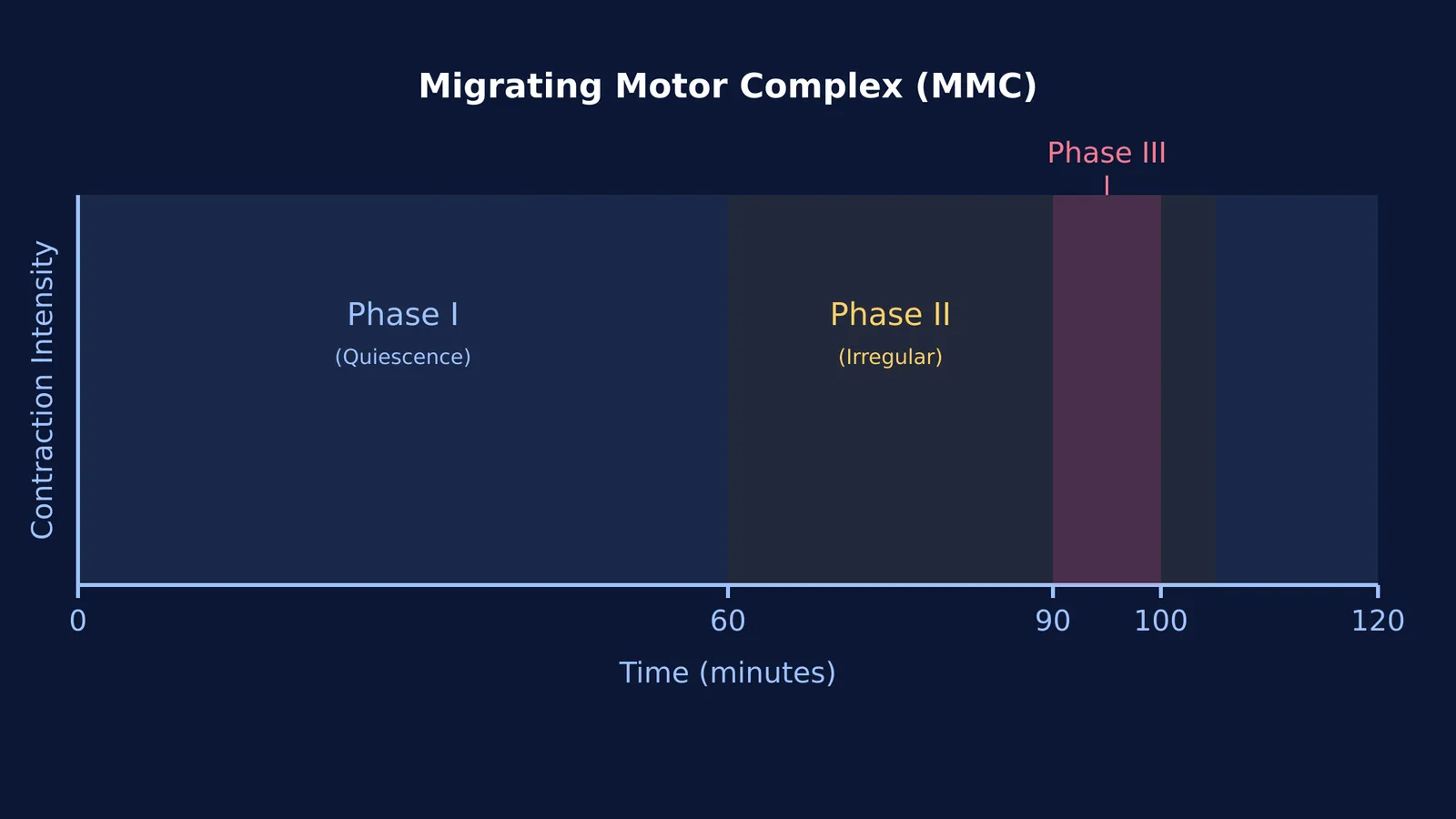
Around two hours after your stomach has emptied its contents, it begins a specialised sequence of contractions called the migrating motor complex. This cycle repeats every 90 to 230 minutes during the periods between meals.
First characterised in 1969 by the physiologist Joseph H. Szurszewski, who nicknamed it the "interdigestive housekeeper", the migrating motor complex acts as a powerful internal sweeper. Its primary job is to clear out any remaining indigestible materials, leftover food particles, and bacteria from the stomach and small intestine, pushing them safely down into the large intestine.
The migrating motor complex cycle is broken down into four phases. It begins with a long period of quiet, followed by a phase of irregular contractions. It then builds up to a short but intense burst of activity known as Phase III. For 5 to 10 minutes, the muscles in the stomach and small intestine contract powerfully and rhythmically. These intense sweeping contractions, combined with an empty, echoing gut, produce the loud borborygmi we associate with hunger.
How can you stop the growling during an exam?
If you want to keep your stomach quiet during a long study session or a crucial exam, the physiological solution is simple: do not let it remain completely empty for hours on end.
The moment you swallow even a small amount of food, the migrating motor complex is immediately interrupted. The digestive tract switches off its noisy, sweeping housekeeper waves and returns to the quieter, fed state of peristalsis to process the new meal.
Understanding how your body works helps remove the anxiety around perfectly natural processes. The next time your stomach growls in a quiet room, you will know it is just the housekeeper wave doing its job.


