On this page
Nail polish dries hard enough to survive days of handwashing, yet a pad of remover wipes it off in seconds. The trick is not scrubbing: a solvent turns the film back into the liquid it started as.
What is nail polish made of?
The key ingredient in nail polish is nitrocellulose, a film-forming material made from cellulose, according to Chemical & Engineering News. DuPont chemists used it in a car paint that debuted in 1920, and nail enamel patents using it followed soon after, which is why polish behaves so much like paint.
C&EN notes that polishes also contain plasticisers such as camphor, pigments and solvents. When you brush polish on, the solvents evaporate and leave a thin, hard film of nitrocellulose holding the colour.
Water does little to that film: the ILO-WHO safety card for nitrocellulose lists its solubility in water as "none".
How does nail polish remover dissolve nail polish?
Remover runs the drying step backwards. A 1991 US patent for a nail polish remover says such products "depend primarily upon the solvent action of acetone or an acetone-like solvent to soften or dissolve the nail lacquer" (US5077038); the softened lacquer is then wiped or rubbed away. Acetone (CH3-CO-CH3) molecules work their way between the long nitrocellulose chains and carry them off into solution, so the solid film becomes a liquid again.
Chemists sum this up as "like dissolves like": a solvent dissolves substances whose molecules attract it in a similar way. We explain the rule with polar and non-polar examples in why like dissolves like. Acetone sits in the middle: its polar C=O group lets it mix completely with water, according to the ILO-WHO safety card for acetone, yet it dissolves the polish film that water cannot.
Why does nail polish remover evaporate so fast and feel cold?
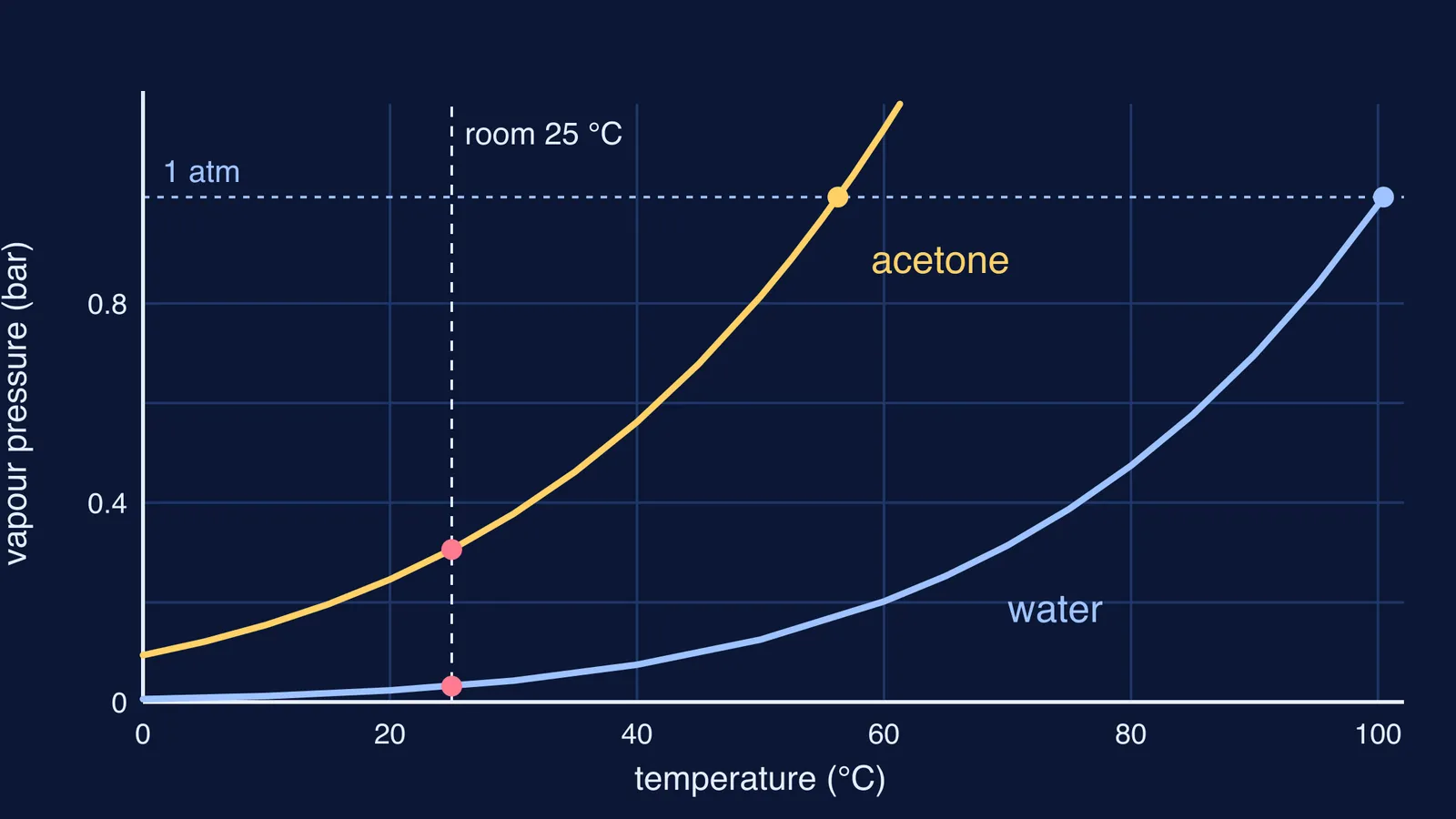
Acetone boils at 56 °C, according to the ILO-WHO safety card, while water's vapour pressure reaches 760 mm Hg only at 100 °C (PubChem). Using NIST's vapour-pressure equations for acetone and water, we calculate that at 25 °C acetone's vapour pressure is about 0.31 bar and water's about 0.032 bar, nearly 10 times lower.
Each escaping molecule carries energy away. Acetone's heat of vaporisation is 30.99 kJ/mol at 25 °C (PubChem, citing the CRC Handbook). The liquid takes that energy from whatever it is touching, which is your skin.
Worked example: how much heat does 1 mL of remover take?
Acetone's relative density is 0.8 (ILO-WHO card), so 1 mL weighs about 0.8 g.
Its molecular mass is 58.1, so that is 0.8 ÷ 58.1 ≈ 0.0138 mol.
Heat taken = 0.0138 mol × 30.99 kJ/mol (PubChem) ≈ 0.43 kJ, or about 430 J.
Here is the surprise: per gram, water needs more. Its heat of vaporisation is 9.717 kcal/mol, about 40.7 kJ/mol (PubChem, citing the Merck Index), or about 2.26 kJ per gram against about 0.53 kJ per gram for acetone (PubChem gives no temperature for the water figure, so treat this as rough). Acetone feels colder because it evaporates so much faster, so it pulls heat out of your skin more quickly even though each gram takes less.
The same physics explains why you feel cold after a bath; you can watch fast molecules escape in our evaporation cooling simulation, and the Fermi Simulation Lab has interactive simulations for more ideas that are easier to see than to read.
Why must nail polish remover be kept away from flames?
The flash point of acetone is −18 °C, according to the ILO-WHO safety card: above that temperature it gives off enough vapour to catch fire, and any room you live in is far warmer. The card also says acetone vapour is 2.0 times as dense as air, so it can travel along the floor to a distant flame, and that vapour-air mixtures containing 2.2 to 13 percent acetone by volume are explosive.
The US Food and Drug Administration warns that some nail products "can easily catch fire if exposed to the flame of the pilot light of a stove, a lit cigarette, or other heat source, such as the heating element of a curling iron" (FDA). The polish film burns too: dry nitrocellulose is highly flammable, according to its ILO-WHO card.
A safety checklist for home
Open a window or run a fan; the FDA advises good ventilation when you use nail products.
Keep the bottle away from the gas stove, diyas, agarbattis, candles and mosquito coils.
Wait until the remover has fully evaporated before using a hair dryer, straightener or curling iron.
Close the cap straight after use; store the bottle away from heat and young children.
Rinse off spills: the ILO-WHO card says repeated contact defats the skin and can leave it dry or cracked.
If the fumes cause a headache or dizziness, move to fresh air. If anyone swallows remover or feels unwell, contact a doctor.
One bottle holds three ideas from school chemistry: solubility, vapour pressure and flammability. If any is shaky, the Fermi Concept Library gives each concept in chemistry its own lesson and its place in the map.