On this page
A hot straightener turns a curly lock flat. A day of Mumbai monsoon air brings the curl back. Both come down to which bonds in keratin the heat moves and which it leaves alone.
What holds the shape of a hair?
Each hair is mostly keratin: long protein chains wound into alpha-helices and packed side by side. A review in the International Journal of Trichology lists the forces that hold the helix coiled: ionic forces, hydrogen bonds, van der Waals forces and disulphide bonds. A 2024 review by Breakspear, Nöcker and Popescu also links hair's behaviour to its hydrogen, disulphide and ionic bonds.
For straightening, two of them matter:
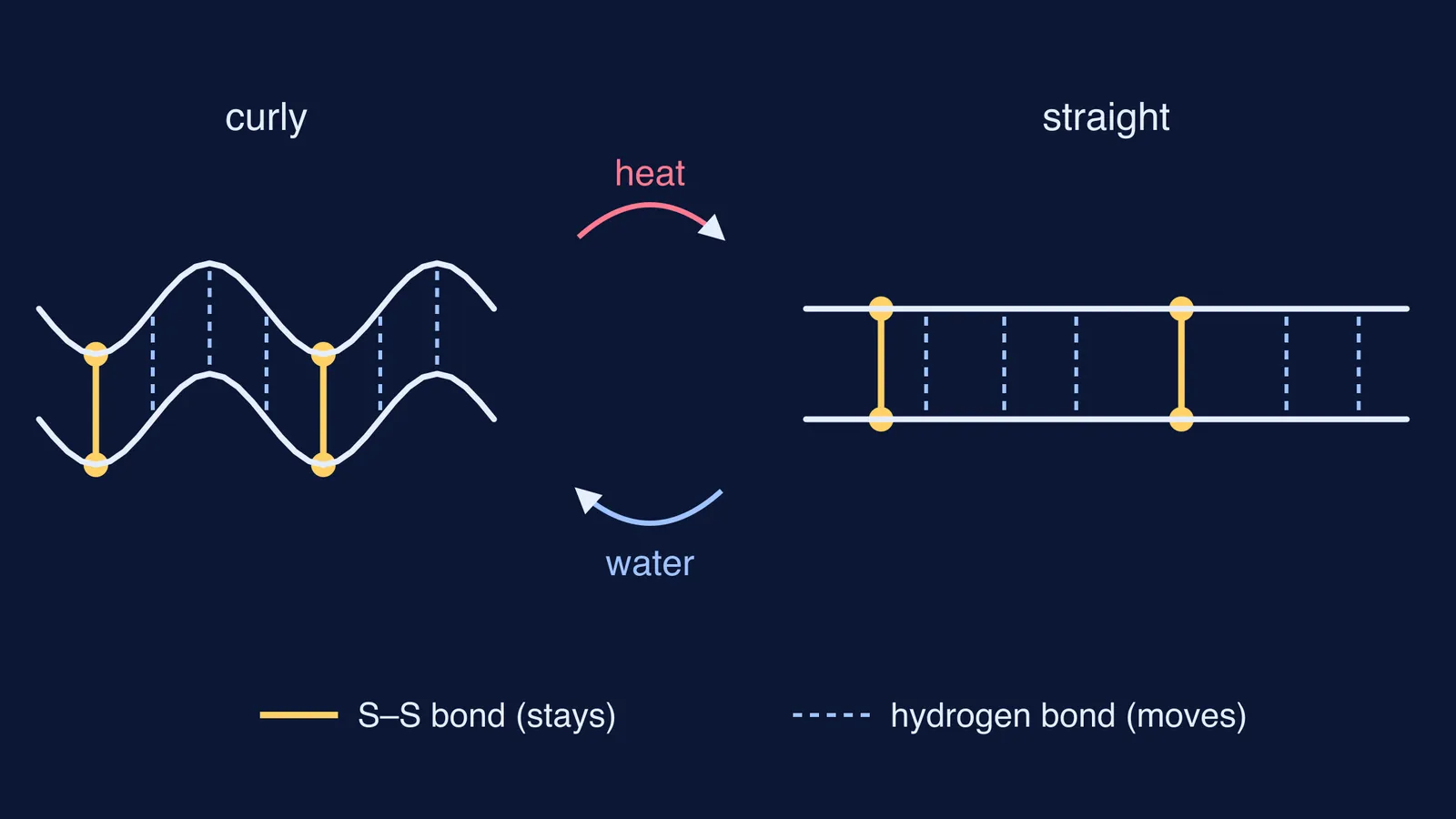
Disulphide bonds are covalent S–S links between cysteine units on neighbouring keratin chains. A Kao hair-treatment patent puts it plainly: the shape of hair "is largely determined by the disulfide bonds". Our explainer on the role of disulphide bonds in protein structure covers why these links are so sturdy.
Hydrogen bonds are weak attractions between the C=O and N–H groups of adjacent protein filaments, as a 2023 review in Polymers describes. There are many of them, and they break and re-form easily.
How does a hair straightener make hair straight?
Heat breaks the hydrogen bonds. The same Kao patent states: "The high temperature of the iron leads to a breakage of hydrogen bonds in the keratin of the hair, achieving a temporary straightening."
The plates press the chains flat. With those bonds loosened, the keratin chains can slide into a straight line.
Cooling locks the new shape. As the hair cools, hydrogen bonds re-form between groups that now sit next to each other in the straight position, and they hold it there.
A 2021 review of hair straightening in Skin Appendage Disorders notes that using a dryer and a flat iron together dehydrates the hair, keeping it straight. It calls these methods temporary solutions that last until the next washing.
Why does humidity bring the curls back?
Water molecules form hydrogen bonds themselves. On a humid day they slip between the keratin chains and break up the hydrogen bonds holding the straight shape. The Kao patent describes it this way: the hydrogen bonds "are formed again by the action of moisture", so hair goes back to its original shape over time in humid air, and washing removes the effect entirely.
Why the old shape? Because the disulphide bonds never moved. They still link the chains at the same points, so once the hydrogen bonds are free, the chains settle back into the curl those links define.
Why are disulphide bonds not affected, and when are they?
Disulphide bonds are covalent, so a quick pass with a straightener breaks few of them. Breaking them takes chemistry: in chemical straightening, says the International Journal of Trichology review, an alkaline reducing agent cleaves them while the hair is combed straight, so they re-form in new positions. That is why a salon treatment lasts and a straightener does not.
There is a limit, though. In a 2013 Journal of Cosmetic Science study, Dussaud and colleagues ironed curly hair over repeated cycles at 120 to 175 °C and found it could become irreversibly straight, depending on the temperature and the number of cycles. They judged ironing at about 154 °C, before much disulphide bond breaking set in, a good compromise between speed, straightening and hair integrity. The 2021 review adds that 235 to 250 °C on dry hair, or 155 to 160 °C on wet hair, may denature the hair's proteins. Like a boiled egg, which our post on denaturation of proteins explains, that change does not undo itself.
What does this mean when you use a straightener?
The chemistry gives you a short checklist (general hair care, not medical advice):
Dry your hair first. Per the 2021 review, protein damage can start at a much lower temperature in wet hair than in dry hair.
Use the lowest setting that works. Higher temperatures and more cycles pushed hair towards permanent change in the 2013 study.
Expect frizz in humid weather. That is hydrogen bonds re-forming, not a faulty straightener.
Notice if curls stop coming back. That suggests the heat has changed the keratin for good. If you are worried about breakage or hair loss, see a dermatologist.
How do you explain it in an exam answer?
If you are asked "Why does straightened hair curl again on a humid day?", you could write:
Keratin holds its shape through disulphide bonds (covalent, strong) and hydrogen bonds (weak, many).
Heat breaks the hydrogen bonds; the hair is pressed straight and new ones form as it cools.
The disulphide bonds survive, so they still encode the original curl.
Water in humid air breaks the new hydrogen bonds, and the chains return to the shape the disulphide bonds set.
If hydrogen versus covalent bonds still feels shaky, the Fermi Concept Library gives each chemistry and biology concept its own lesson. For more on what hair is, read why cutting your hair and nails does not hurt.