
On this page
Drop a cat upside down with no spin, and it still lands on its feet. That seems to break a Class 11 rule: with no external torque, angular momentum stays constant. The answer is that a cat is not a rigid body.
Why is a falling cat a physics puzzle?
In 1894 the French physiologist Étienne-Jules Marey photographed a cat dropped upside down, and the pictures were reported in Nature as Photographs of a Tumbling Cat. As physicist Greg Gbur explains in BBC Science Focus, the photographs showed that "the cat begins falling upside-down without any rotation but nevertheless manages to turn over to land on its feet." Gbur writes that one member of the Academy said Marey "had presented them with a scientific paradox in direct contradiction with the most elementary mechanical principles."
The principle at stake is conservation of angular momentum: L = Iω, where I is the moment of inertia and ω the angular velocity. Gravity acts at the centre of mass, so it exerts no torque about it. Ignoring air resistance, the cat's total angular momentum stays zero all the way down.
How do cats always land on their feet?
Zero total angular momentum does not mean every part stays still. It means the parts' angular momenta add up to zero.
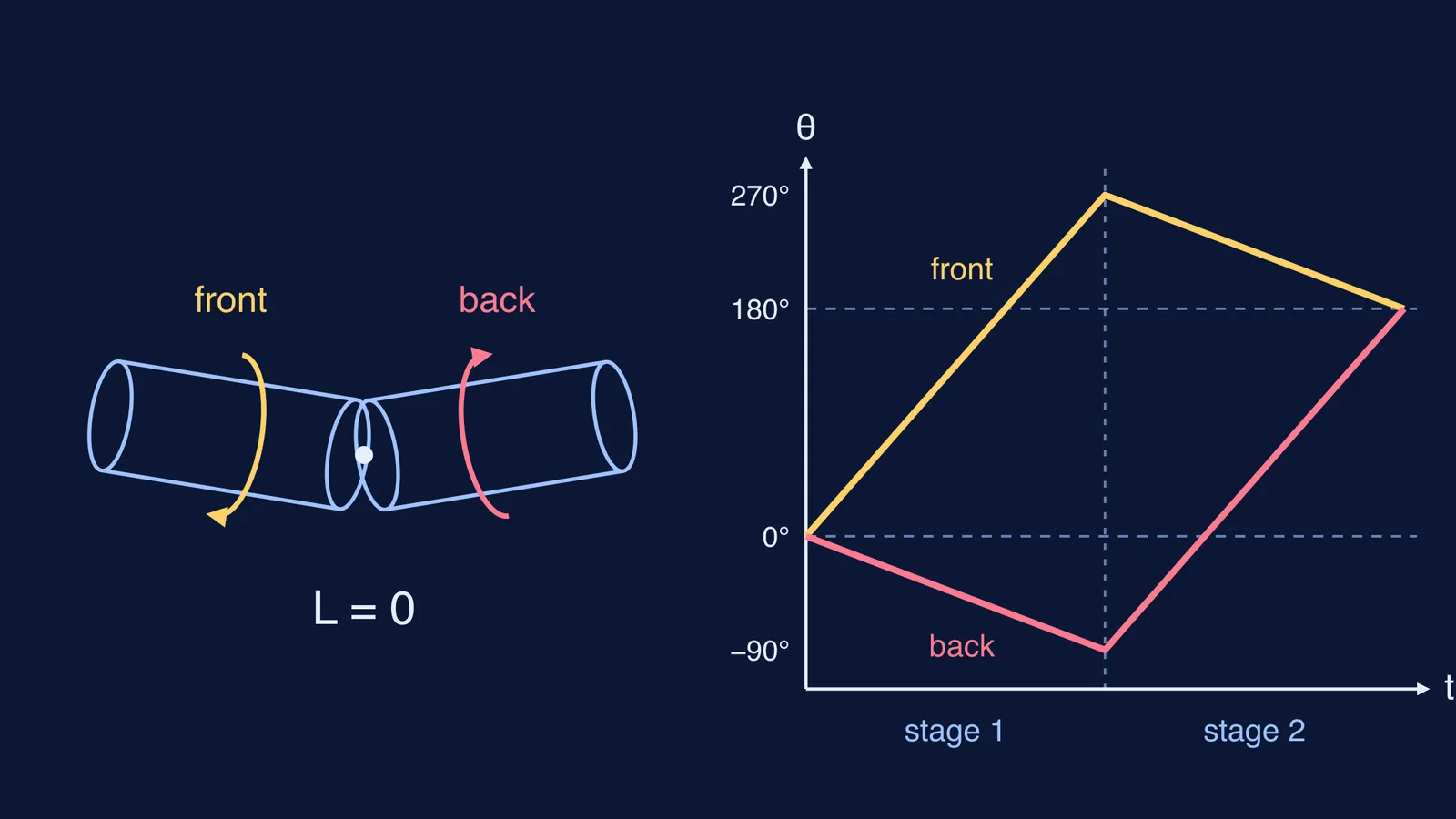
Gbur writes in BBC Science Focus that in 1935 the Dutch physiologists Rademaker and ter Braak pictured the cat as two cylinders: the front and rear halves of its body. In his words, "If the cat bends at the waist, it can then twist the two halves of its body in opposite directions, causing their opposing angular momenta to largely cancel." When it straightens out, it faces a new way.
In 1969 T. R. Kane and M. P. Scher published A dynamical explanation of the falling cat phenomenon in the International Journal of Solids and Structures. They modelled the cat as two linked bodies and showed how it can turn over with no starting spin. Real cats combine several motions, Gbur adds, with bend-and-twist the most important.
The reflex does not depend on sight. In a 1984 study in Experimental Brain Research, kittens blinded from birth developed air righting on the same schedule as sighted kittens, mature by 33 days. The authors conclude that the reflex is controlled mainly by the vestibular (balance) system.
Worked example: how can you turn 180° with zero angular momentum?
A Class 11 version: two halves turning about one shared axis, the spine, with moments of inertia I₁ (front) and I₂ (back). At every instant, I₁ω₁ + I₂ω₂ = 0. If each I stays fixed during a stage, the angles turned obey I₁Δθ₁ = −I₂Δθ₂.
Tucking the legs in brings mass closer to the axis, which lowers I (see moment of inertia and the axis theorems). Suppose, for illustration only, that a half with its legs tucked has one-third the moment of inertia it has with its legs stretched out.
Stage 1: front legs tucked (I₁ = I), back legs out (I₂ = 3I). The front turns +270°. Then 3I × Δθ₂ = −I × 270°, so the back turns −90°.
Stage 2: swap. Front legs out (I₁ = 3I), back legs tucked (I₂ = I). The back turns +270°, so the front turns −90°.
Add it up. Front: 270° − 90° = 180°. Back: −90° + 270° = 180°. Both halves have turned over, with total angular momentum zero throughout.
Try it: with a ratio of 2, how far must the tucked half turn in each stage? Why does a ratio of 1 fail? Answer at the end.
It is the same physics as a skater pulling in their arms (see why a spinning skater gains kinetic energy). If counter-rotating halves are hard to picture, the Fermi Simulation Lab has interactive simulations for ideas that are easier to see than to read.
Do cats always land safely?
No. Feet first does not mean unhurt. A 1987 study in the Journal of the American Veterinary Medical Association described 132 cats seen at a New York animal hospital over five months with high-rise syndrome, the injuries from falling out of tall buildings. Ninety percent had some form of chest injury, and 39% had limb fractures. Of the cats that needed treatment, 90% survived.
How does the falling cat help in Class 11 rotation?
A checklist for any spin problem:
Name the system and ask if any external torque acts. If none does, total L is constant.
L is conserved for the whole system, not each part. Parts can spin if their angular momenta cancel.
If I changes and L is fixed, ω changes. Kinetic energy need not be conserved, because muscles do work.
If you are stuck on a similar numerical, the Fermi Problem Library has worked problems with a step-by-step solver that explains the reasoning rather than printing an answer.
Answer: with a ratio of 2, the tucked half turns 360° and the other half turns back 180° in each stage, so both end at 180°. With a ratio of 1, each stage undoes the other. That is why tucking the legs matters.