

On this page
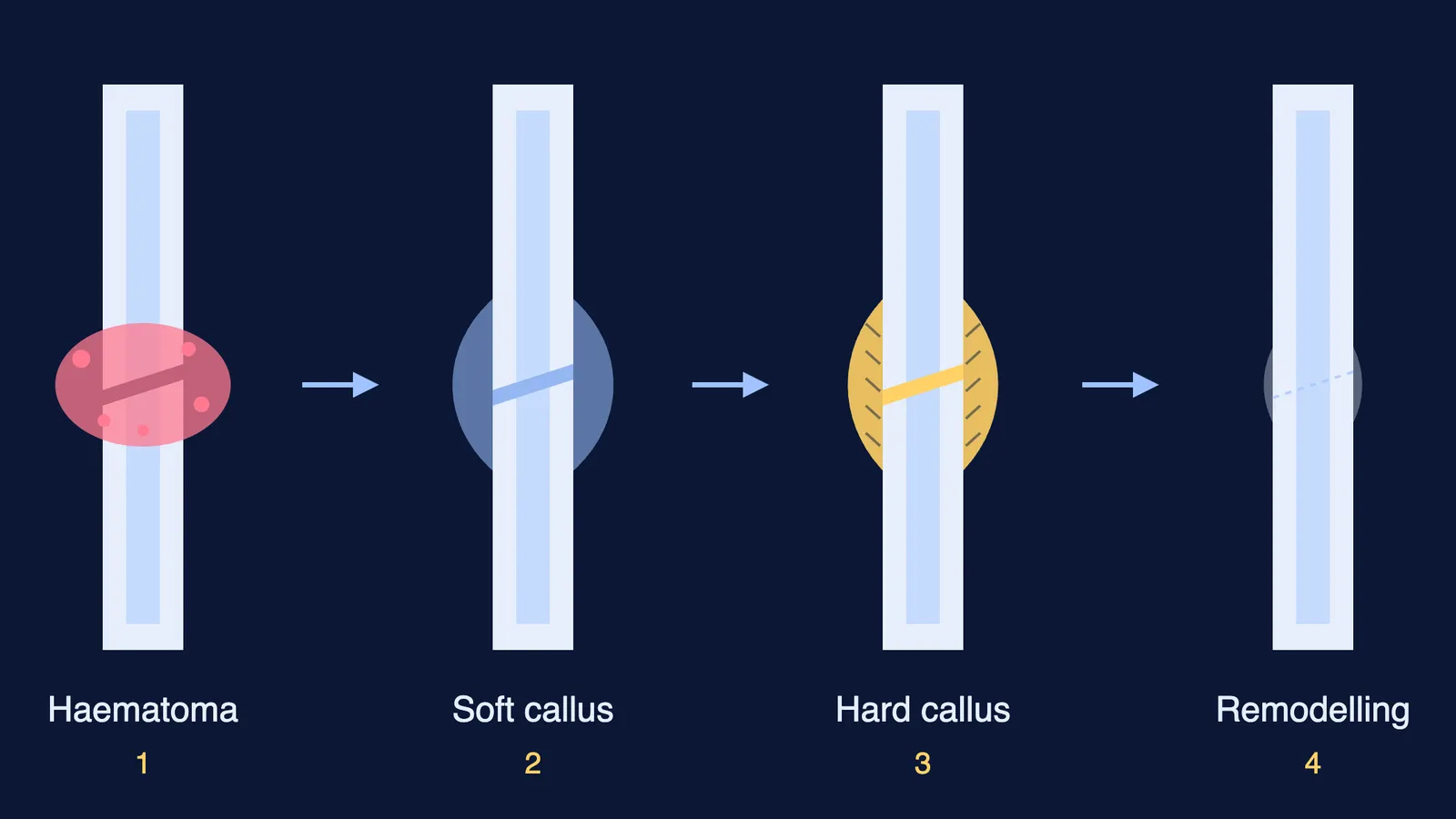
A deep cut usually heals with a scar, but a broken bone that heals normally is usually restored to its pre-injury composition, structure and strength. Fractures are the most common large-organ traumatic injuries in humans, and about 10% do not heal properly, according to a 2015 review by Einhorn and Gerstenfeld in Nature Reviews Rheumatology. A typical fracture held in a cast heals through four overlapping stages.
What happens in the first days after a bone breaks?
Stage 1: haematoma and inflammation. Bone is living tissue with its own blood supply, so a break bleeds. Immediately after the injury a haematoma forms from blood and bone marrow cells and clots between and around the broken ends, making a template for the callus, as Marsell and Einhorn explain in the journal Injury. The acute inflammatory response peaks within the first 24 hours and is complete after about 7 days, the same review reports. The authors call this early inflammation critical for regeneration.
A fibrin-rich granulation tissue then forms, and stem cells are recruited to build the next stage.
How does a fracture go from soft callus to hard bone?
Stage 2: soft callus. Where the fracture is least stable, the new cells lay down cartilage, which forms a soft callus that gives the fracture a stable structure (Marsell and Einhorn). In rats, rabbits and mice, soft callus formation peaks 7 to 9 days after the injury.
Stage 3: hard callus. The cartilage is then mineralised and replaced by woven bone, a quickly made, loosely organised bone. In animal models the hard callus usually peaks by about day 14, and once it bridges the gap the fracture has a semi-rigid structure that allows weight bearing, according to the same review.
Stage 4: remodelling. The hard callus is rigid but does not fully restore the properties of normal bone. Osteoclasts resorb it while osteoblasts lay down orderly lamellar bone, and the marrow cavity is rebuilt. Remodelling starts as early as 3 to 4 weeks after the break but may take years to finish (Marsell and Einhorn).
Why does a broken bone need a cast?
Movement changes what the bridge is built from. Less stability goes with more cartilage, more stability with more bone, and an optimal window of movement seems to be needed for a normal callus to bridge a fracture, write Einhorn and Gerstenfeld. A separate review by Claes, Recknagel and Ignatius adds that poor mechanical conditions in the fracture zone can impair healing. The NHS puts a cast's job simply: it keeps the leg still and holds the bones in place while they heal (NHS: broken leg).
Worked example: why a fraction of a millimetre matters
Movement at a fracture is described as strain: how much the gap changes divided by how wide it is. Bone can join by direct contact healing, with no callus, only when the gap is under 0.01 mm and the strain is below 2%, according to Marsell and Einhorn. Any direct healing needs the pieces lined up and rigidly fixed. Picture a 1 mm gap whose ends shift by 0.3 mm each time you move:
Strain = 0.3 mm ÷ 1 mm = 0.3, which is 30%.
That is 15 times the 2% limit for contact healing, in a gap 100 times wider than 0.01 mm.
So bone cannot join straight across. The body lays down cartilage first, the soft callus steadies the fracture, and bone can follow.
A cast holds the bones still enough for each stage to hand over to the next.
How long does a broken bone take to heal?
A broken arm or wrist usually takes around 6 to 12 weeks to recover from (NHS: broken arm or wrist). A broken leg usually takes 6 to 12 weeks, though it can sometimes take longer (NHS: broken leg). The NHS stresses following the advice of the hospital or fracture clinic. Systemic inflammation, as seen in people with diabetes or multiple injuries, can increase healing time and the rate of complications, including non-union (Claes and colleagues).
What should you watch for while wearing a cast?
The NHS lists these among the signs to get urgent advice (arm or wrist, leg):
the cast feels too tight or too loose, is rubbing, or breaks
your fingers or toes feel numb, or feel like they are burning
the limb looks swollen or turns blue or white
there is a bad smell, discharge or wetness under the cast
Read why astronauts lose bone and muscle in space, why babies have more bones than adults and how osteoporosis differs from gout and arthritis.
If you are revising the skeletal system for a biology test, the Fermi Concept Library gives every concept in biology its own lesson and its place in the map.


