

On this page
India's first bullet train will run between Mumbai and Ahmedabad at an operational speed of 320 km/h, with a design speed of 350 km/h, using Japanese Shinkansen technology, according to a Press Information Bureau backgrounder. At that speed the curves must be tilted and very wide, and the physics behind both is Class 11 circular motion.
How do high-speed trains take turns?
Anything moving in a circle needs a net force pointing towards the centre of that circle. OpenStax College Physics defines it plainly: any net force causing uniform circular motion is called a centripetal force, and its size is F = mv²/r.
On a flat curve, the rails would have to shove the wheels inwards. So engineers bank the track: the outer rail sits higher than the inner one. The track's normal force now leans towards the centre of the curve, and its horizontal part does the turning.
For an ideally banked curve, where no sideways friction is needed, the angle obeys tan θ = v²/(rg), and θ does not depend on the mass of the vehicle (OpenStax). We explain that mass result in why banking angle depends on speed, not vehicle mass.
Why is the track radius measured in kilometres?
The needed centripetal acceleration grows with the square of speed: double the speed and, for the same tilt, the curve's radius must be four times as large. The same PIB backgrounder puts the highest design speed on Indian Railways today at around 180 km/h, achieved by semi-high-speed services such as Vande Bharat. Going from 180 to 320 km/h multiplies v² by (320/180)², about 3.2, so a curve with the same banking needs a radius about 3.2 times larger.
In the horizontal alignment that the design consultants sent to NHSRCL in May 2017, reproduced in JICA's follow-up study of the corridor, nearly every curve on the main stretch has a radius of 6,000 m or 8,000 m; the exceptions are one 2,000 m and one 4,000 m curve. The tightest curves, 600 to 1,600 m, are in the Vadodara and Ahmedabad-to-Sabarmati sections, which that letter lists as still to be finalised.
How much does a 6 km curve need to tilt?
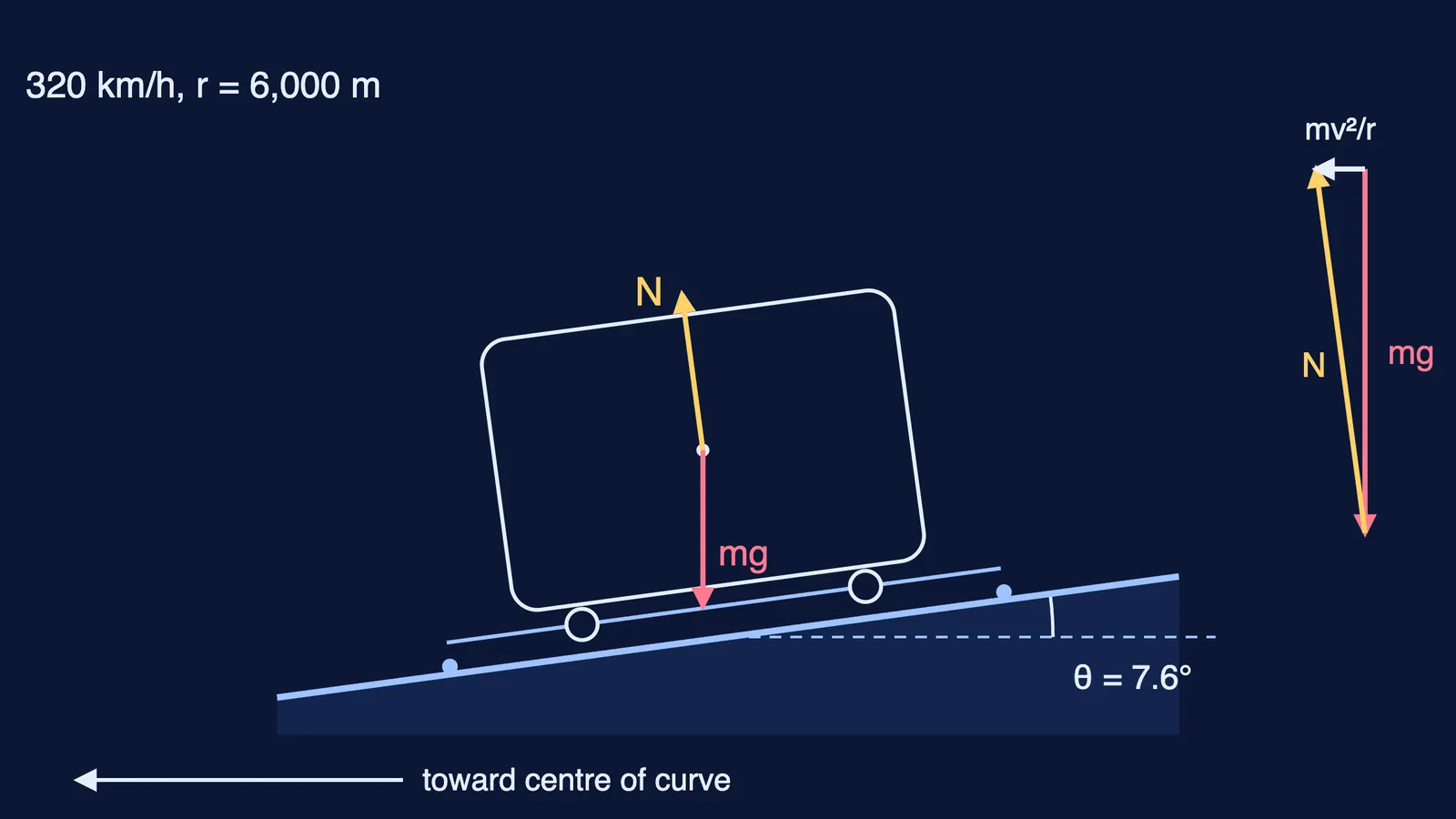
Here is the calculation for a train at 320 km/h on a 6,000 m curve, the most common radius in that 2017 alignment table, using the OpenStax banking formula with g = 9.81 m/s².
Convert the speed: 320 km/h ÷ 3.6 = 88.9 m/s, so v² ≈ 7,901 m²/s².
Centripetal acceleration: v²/r = 7,901 ÷ 6,000 ≈ 1.32 m/s², about 0.13 g.
Ideal angle: tan θ = 1.32 ÷ 9.81 ≈ 0.134, so θ ≈ 7.6°.
Height of the outer rail: h ≈ d sin θ. The line uses 1,435 mm standard gauge (corridor overview); taking that as the rail spacing, h ≈ 1,435 × 0.133 ≈ 191 mm.
Now shrink the curve to 1,000 m: v²/r ≈ 7.9 m/s², θ ≈ 39°, and the outer rail would sit about 900 mm higher. A train stopped on a slope that steep would be in danger of toppling inwards, so the radius goes up instead.
The rail-height version of this formula, h = dv²/rg, is worked through in how high the outer rail is on a railway curve.
What if the train is faster or slower than the design speed?
Banking is exact for one speed only. The difference between the cant a train would need and the cant actually built is called cant deficiency (cant, road and rail)). The same page notes that for high-speed railways in Europe, maximum cant is 180 mm when slow freight trains are not allowed.
Our worked example needed about 191 mm. If that European 180 mm cap applied, a train at full speed on that curve would still need a little sideways push from the rails, and passengers would feel a gentle lean outwards. A slower train feels the opposite. OpenStax makes the same point for cars: friction lets a vehicle take a curve faster or slower than the ideal speed.
If the tilt is hard to picture, the Fermi Simulation Lab has interactive simulations for ideas that are easier to see than to read.
How do you solve a banked-curve problem without the usual mistake?
Use this five-step check on any JEE banking question:
Draw the cross-section of the track, not the top view, so the angle is visible.
Treat mv²/r as the net force, never as an extra force on the diagram.
Resolve the normal force, not the weight: N cos θ = mg and N sin θ = mv²/r. On a banked curve N = mg/cos θ, larger than mg, unlike the block on an incline in why normal force is mg cos θ on an inclined plane.
Convert km/h to m/s before squaring.
Sanity-check the answer: a real high-speed curve tilts by a few degrees, not tens of degrees.
If your answer still comes out wrong, the Fermi Problem Library has a step-by-step solver that explains the reasoning rather than printing an answer. And Fermi's AI tutor draws the figure and checks your understanding as it goes.
Next time you see a curved viaduct, look for the raised outer rail and try the numbers yourself.


