

On this page
Leave a pot of dal on the kitchen counter on a hot afternoon and by night it may smell sour and look frothy. That is spoilage. But food that smells fine can still make you ill. Once you see what bacteria need to grow, salting, drying and cooling make sense instead of being a list to memorise.
How do bacteria spoil food?
To a bacterium, cooked food is a warm, wet meal of sugars and proteins. Bacteria arrive from hands, raw ingredients, water and surfaces, then feed, divide and give off by-products: acids that sour milk, gas that puffs up a sealed packet, foul-smelling compounds from broken-down protein. Those changes are spoilage.
Growth comes in stages: a slow start, rapid doubling, then a plateau. Our post on the phases of the bacterial growth curve lets you watch each one. Food safety rules try to keep bacteria from reaching the rapid-doubling phase. And the smell test only detects spoilage, not safety: the bacteria that cause disease are not always ones you can smell.
How do bacteria in food cause disease?
The WHO food safety fact sheet says foodborne illnesses are usually infectious or toxic in nature. That gives two routes:
Infection: live bacteria in the food grow inside your gut. WHO names Campylobacter, Shigella, Listeria, Vibrio cholerae and some types of E. coli among the causes.
Intoxication: bacteria grow in the food first and release a toxin. You get ill from the poison even if the bacteria are dead.
The scale is large. WHO estimates that 866 million people fall ill after eating contaminated food every year and 1.52 million die. Children under 5 carry 29% of this health burden, with 143,000 deaths in 2021, according to the same WHO fact sheet.
Two toxin makers are worth knowing. Staphylococcus aureus can reach food from unwashed hands. The CDC page on Staph food poisoning says cooking can kill Staph but does not destroy the toxin, and symptoms usually start within 30 minutes to 8 hours.
Bacillus cereus is linked to cooked rice. A 2023 review in the journal Foods by Yang and colleagues explains that B. cereus spores survive cooking and can germinate when cooked food cools slowly to room temperature. It describes the vomiting toxin, cereulide, as extremely stable when heated at 121°C for 2 hours and during roasting, frying and microwave cooking.
Why do salting, drying and cooling slow bacteria down?
Each method takes away something bacteria need: warmth or water.
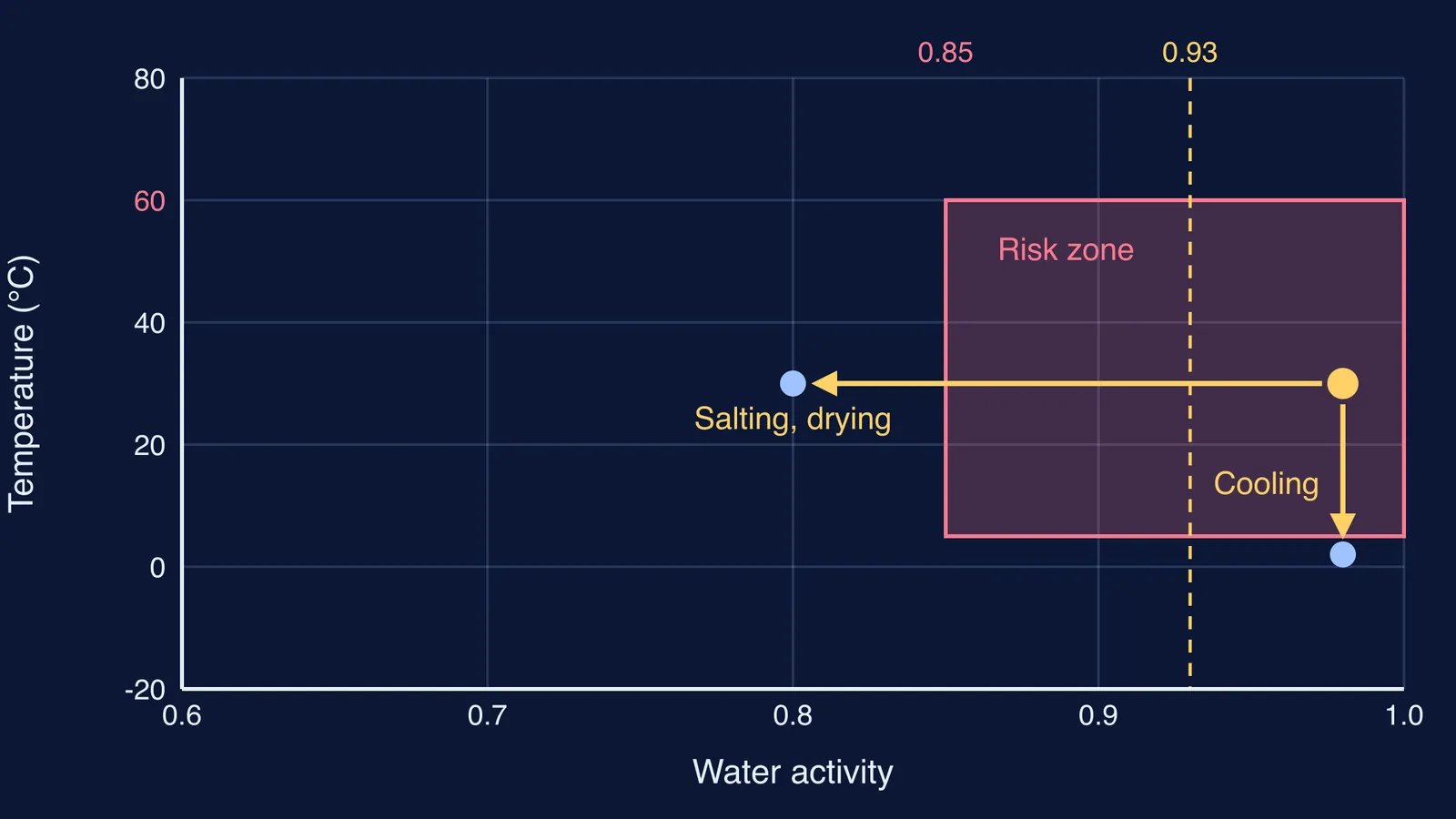
Cooling. WHO Europe's summer food safety advice says a fridge set below 5°C protects most foods, but not indefinitely, because cold slows bacterial growth without stopping it. It also advises keeping cooked food above 60°C until you serve it. The CDC's food safety steps call 40°F to 140°F (about 4°C to 60°C) the danger zone, where bacteria multiply rapidly.
Salting and drying. Bacteria need water they can actually use. Food scientists measure this as water activity, the ratio of the food's vapour pressure to that of pure water, as defined in the FDA's guide to water activity. Salt and sugar lower the vapour pressure, so less water is available. The FDA guide notes that most foods have a water activity above 0.95, while Clostridium botulinum needs about 0.93 or more to grow. This is part of why salty achar, papad and dried fish keep on a shelf far longer than fresh fish. Our post on pasteurisation, salt, sugar and vinegar covers more methods.
None of these methods removes a toxin that is already there. Boiling has limits too, as we explain in does boiling water kill all germs?
How should you store leftover rice?
Here is the theory applied to one plate of rice cooked at 1 pm.
Cooking. Most growing bacteria die, but B. cereus spores can survive, as the Foods review above explains.
The first hour or two. The CDC says not to leave perishable food out for more than 2 hours, or 1 hour above 90°F (about 32°C). On a hot afternoon, treat 2 pm as your deadline.
Cool it fast. Spread the rice in a shallow container so it cools quickly, then refrigerate it below 5°C, the limit in WHO Europe's advice.
Reheat until steaming. This kills bacteria that are still growing. It only helps if steps 2 and 3 kept the toxin from forming in the first place.
Ask three questions before you eat any leftover:
How long was it at room temperature?
Was it kept hot (above 60°C) or cold (below 5°C)?
Is it moist, like rice, dal or curd, or dry and salty, like papad?
If the answers are long, neither and moist, throw it out.
If water activity still feels shaky, the Fermi Concept Library gives each concept in biology and chemistry its own lesson. For numericals, the Fermi Problem Library has worked problems with a step-by-step solver that explains the reasoning rather than printing an answer.


