

On this page
Most neutral organic bases in your syllabus, like amines, are weak. Guanidine, HN=C(NH2)2, is different: in neutral water it exists almost entirely in its protonated form. The reason lies in what it becomes after it takes a proton. Below are the numbers, the resonance argument, and a four-step check for basicity questions in JEE Main or board exams.
Why is guanidine such a strong base?
A base is strong when its conjugate acid is stable, because a stable conjugate acid has little reason to give its proton back. So the question to ask is: how stable is the guanidinium ion?
Guanidinium has a pKa of 13.6 in water, which makes guanidine a very strong base, according to the Wikipedia article on guanidine, which cites Perrin's tables of dissociation constants of organic bases. For comparison, the pKa of methylammonium, the conjugate acid of methylamine, is 10.66 (Wikipedia: Methylamine), and the pKa of the ammonium ion is 9.25 (Wikipedia: Ammonium).
That gap of about 3 pKa units means guanidine's base constant is close to 900 times larger than methylamine's (10 to the power 2.94, from the values above).
Some books give a lower number. PubChem lists a pKa of 12.5 for guanidine, taken from the Merck Index (PubChem: Guanidine). Quoted values for guanidine groups vary in other places too. Arginine's side chain is a guanidine group, and a 2015 study in Protein Science measured the pKa of that group as 13.8 ± 0.1 by potentiometry and NMR, well above the value of about 12 often used in textbooks (Fitch et al., 2015). Whichever value your book uses, the ranking is the same: guanidine is far more basic than ordinary amines.
What do the three resonance structures of guanidinium look like?
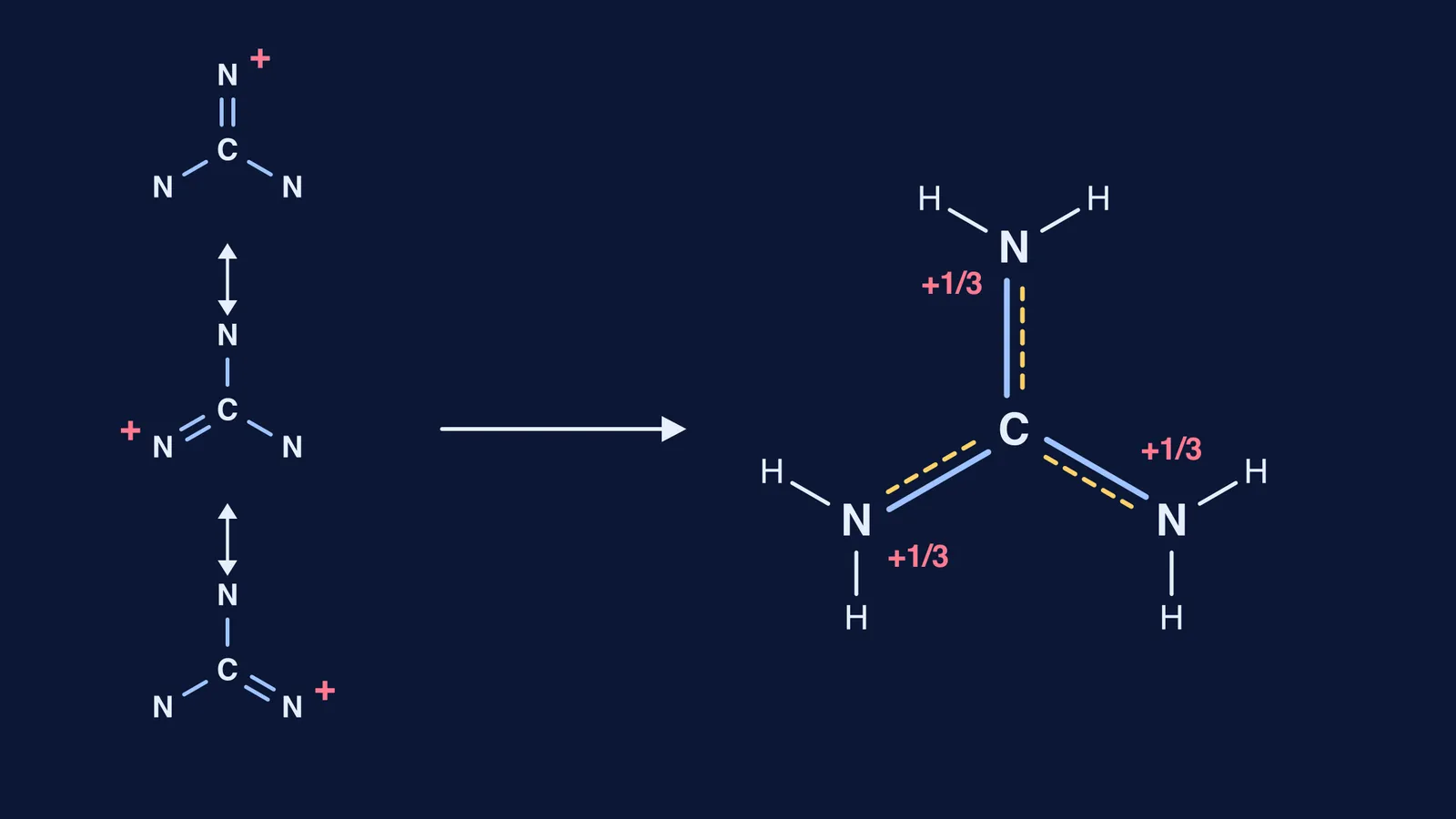
The proton goes onto the =NH nitrogen, whose lone pair sits in an sp2 orbital, free to bond. The two NH2 nitrogens are poor sites, because their lone pairs are already shared with the C=N bond. The product, C(NH2)3+, has three resonance structures:
C=N double bond to nitrogen 1, plus charge on nitrogen 1.
C=N double bond to nitrogen 2, plus charge on nitrogen 2.
C=N double bond to nitrogen 3, plus charge on nitrogen 3.
All three are identical in energy: same atoms, same bonds, only rotated by 120 degrees. Identical contributors mix equally, which gives a large resonance stabilisation. In the hybrid, the ion is planar and symmetric, and each carbon-nitrogen bond has a bond order of 4/3 (Wikipedia: Guanidine). If you want practice telling truly different structures from repeats, our guide on how to count resonance structures without double-counting covers it.
Crystal structures show this sharing. In a methyl-substituted guanidinium salt studied in 2013, the three C-N bonds of the CN3 core measured 1.3388, 1.3390 and 1.3540 angstroms, "indicating partial double-bond character in each" (Tiritiris, Acta Cryst. E, 2013).
How is this different from amines and amides?
Compare what happens to the lone pair in each case:
Methylamine: the lone pair is free and the methyl group pushes in electron density, but the cation's charge sits on one nitrogen. Moderately basic.
Amide (like acetamide): the lone pair is already delocalised onto oxygen, and protonating nitrogen would destroy that resonance. Very weakly basic.
Guanidine: protonation creates resonance instead of destroying it. Strongly basic.
The last point is the one examiners test. Resonance in the base lowers basicity; resonance in the conjugate acid raises it. The same logic explains why benzylamine is more basic than aniline, and hybridisation adds a second factor, covered in why sp3 amines are more basic than imines and nitriles.
How do you answer a basicity question step by step?
Use this four-step check on any "which is more basic?" question:
Find the proton's landing spot. Pick the nitrogen whose lone pair is most available, usually the one not already in resonance.
Draw the conjugate acid. Write the protonated form with its plus charge.
Count equivalent resonance structures of the cation. More equal contributors means a more stable cation and a stronger base.
Check what protonation costs. If it breaks resonance the base already had (amides, aniline), the base is weaker.
Worked example: rank guanidine, methylamine and ammonia. Step 3 gives guanidinium three equal structures; the other two cations have none. Methyl donation puts methylamine above ammonia. So the order is guanidine > methylamine > ammonia, matching the pKa values of 13.6, 10.66 and 9.25 cited above.
If resonance and conjugate acids still feel shaky, the Fermi Concept Library has a lesson on each concept in chemistry and shows where it sits in the map, so you can go back to the idea that is missing. For practice on ranking questions, the Fermi Problem Library has worked problems with a step-by-step solver that explains the reasoning rather than printing an answer.
Next time you see a basicity question, draw the conjugate acid first. The answer is usually there.


