

On this page
You have probably heard "googol" used as a joke-sized number. It has an exact meaning, and it sits at the top of a ladder of names you already use: thousand, lakh, crore, million, billion. Here is what each rung means and how to feel its size.
What is a googol?
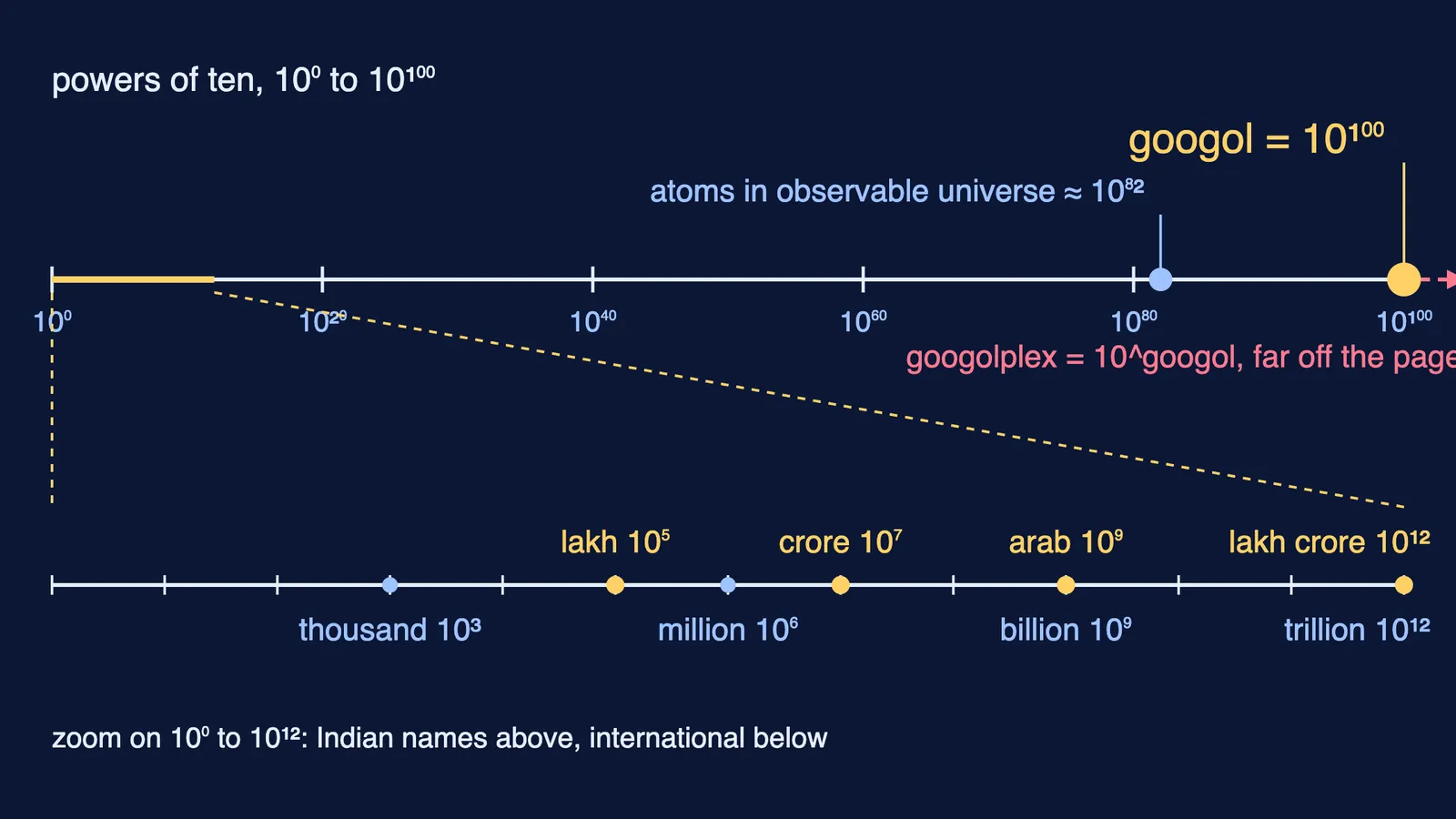
A googol is 1 followed by 100 zeros, written 10^100 (Wolfram MathWorld: Googol).
The name came from Milton Sirotta, the nine-year-old nephew of the American mathematician Edward Kasner. Kasner popularised it in Mathematics and the Imagination (1940), a book he wrote with James R. Newman (Wikipedia: Googol). Sources differ on the year: MathWorld says 1938, Wikipedia 1920, which fits Sirotta's 1911 birth.
The search company borrowed the idea. Google's own history page says its name "was a play on the mathematical expression for the number 1 followed by 100 zeros" (Google: Our story). The spellings differ, though: the number is googol, the company is Google.
How big is a googolplex?
A googolplex is 10 raised to the power of a googol: 1 followed by a googol zeros (Wolfram MathWorld: Googolplex). The same page notes that Kasner extended his nephew's word to name this larger number.
You cannot write a googolplex out in full. A Live Science estimate puts the number of atoms in the observable universe at about 10^82 (Space.com, originally published on Live Science). A googol is 10^18 times larger than that. Writing out a googolplex needs a googol zeros, so even with one zero on every atom in the observable universe you would run out of atoms long before you ran out of zeros.
How do lakh and crore compare with million and billion?
NCERT's Class 7 maths textbook, Ganita Prakash, sets the two systems side by side in its chapter on large numbers (NCERT: Large Numbers Around Us):
One lakh is 1,00,000: 1 followed by 5 zeros, or a hundred thousand.
Ten lakh is 10,00,000, which is one million.
One crore is 1,00,00,000: 1 followed by 7 zeros, or ten million.
One arab, or a hundred crore, is 1,00,00,00,000, which is one billion.
The commas tell you which system you are reading. The same chapter explains that the Indian system groups digits in a 3-2-2-2 pattern from the right, while the international (American) system groups them 3-3-3. It reads 9876501234 as 987 crore 65 lakh 1 thousand 234 in the Indian system, and as 9 billion 876 million 501 thousand 234 in the American one.
Each Indian name is 100 times the one before it: a crore is 100 lakh, and an arab is 100 crore. Put lakh and crore together and you get a lakh crore: 10^5 × 10^7 = 10^12, which is one trillion. For more practice, see our guide on how to convert lakh and crore to million and billion.
How can you get a feel for numbers this big?
Names stop meaning much after a few zeros, so borrow a ruler you already understand: time. NCERT's chapter offers one anchor: living one lakh days would mean living for about 274 years (NCERT: Large Numbers Around Us).
Imagine counting out loud at one number per second, without ever stopping. Using 1 day = 86,400 seconds and 1 year ≈ 3.16 × 10^7 seconds:
One lakh (10^5 seconds) takes about 28 hours, a little over a day.
One crore (10^7 seconds) takes about 116 days, close to four months.
One billion (10^9 seconds) takes about 32 years.
One googol (10^100 seconds) takes about 3 × 10^92 years.
Going from lakh to crore adds two zeros and multiplies the time by 100: the exponent does the work. To see why multiplying powers means adding exponents, read our explainer on why same-base powers add, subtract or multiply.
How do you convert any big number name?
Use this three-step method for any name, in either system:
Write the name as a power of ten: lakh = 10^5, million = 10^6, crore = 10^7, billion = 10^9.
Multiply the number in front by that power, then tidy it into scientific notation. 45 lakh = 45 × 10^5 = 4.5 × 10^6, which is 4.5 million.
Place the commas for the system you need: 45,00,000 in the Indian system, or 4,500,000 in the international one.
Try one more: 250 crore = 250 × 10^7 = 2.5 × 10^9, which is 2.5 billion, or 2 arab 50 crore.
The same habit carries into physics and chemistry. Our post on scientific notation in chemistry calculations shows how to multiply, divide and fix the exponent.
If powers of ten still feel shaky, the Fermi Concept Library has every concept in mathematics with its own lesson, so you can rebuild the basics first. For practice, the Fermi Problem Library has worked problems with a step-by-step solver that explains the reasoning rather than printing an answer.
Your next step: pick one large number from today's newspaper, write it as a power of ten, then say it aloud in both the Indian and international systems.


