

On this page
When reading Indian news alongside international publications, large financial figures often describe the same quantities with different vocabulary. The Indian system uses thousands, lakhs, and crores, whereas the international system proceeds through thousands, millions, billions, and trillions. Converting between them quickly requires anchoring your thinking to two fundamental equivalences.
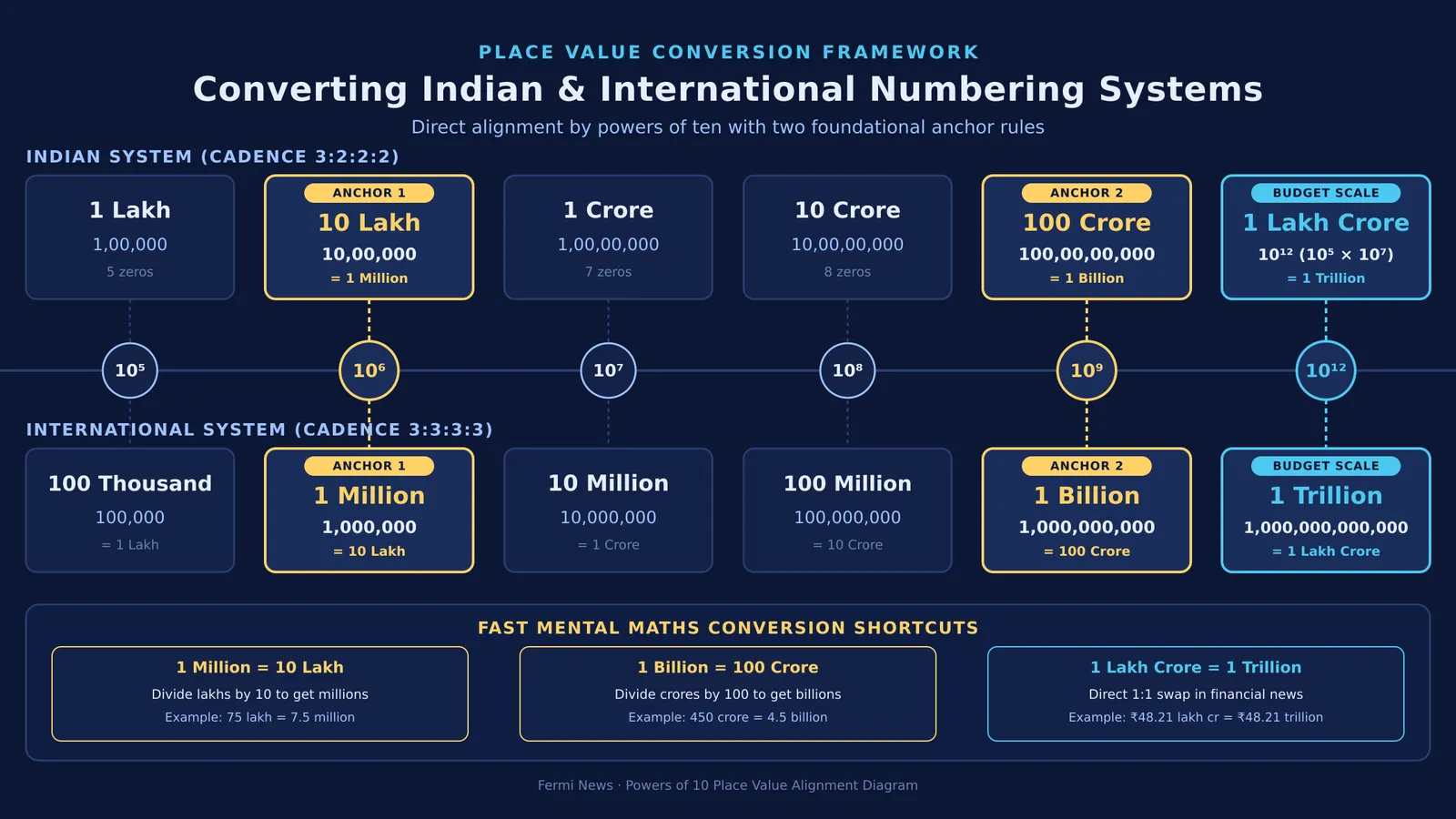
According to the NCERT Class 6 Mathematics textbook portal, 1 million equals 10 lakh, and 1 crore equals 10 million. These two relations form the bridge between both counting frameworks. Because 1 lakh is 100,000 (10⁵), multiplying it by 10 yields 1,000,000 (10⁶), which defines 1 million. Similarly, because 1 crore is 10,000,000 (10⁷), it contains ten groups of 1 million.
The complete place-value relationship scales systematically across powers of ten:
1 lakh equals 100 thousand (10⁵).
10 lakh equals 1 million (10⁶).
1 crore equals 10 million (10⁷).
10 crore equals 100 million (10⁸).
100 crore equals 1 billion (10⁹).
Once you establish these anchor points, shifting between units becomes straightforward arithmetic. Just as with solving ratios with different units, matching the powers of ten ensures you never misplace a zero during calculation.
Why do the Indian and international systems group digits differently?
The confusion between lakhs and millions comes down to punctuation and digit grouping. Both systems begin identically: the first comma is placed after the hundreds place, separating the first three digits from the right. After that initial threshold, their grouping conventions diverge completely.
The Indian system groups subsequent digits in pairs. As outlined in the NCERT Class 6 Mathematics curriculum, commas follow a 3:2:2:2 cadence to mark thousands, lakhs, and crores. For instance, ten million is written in India as 1,00,00,00, denoting one crore. In contrast, the international system maintains an unvarying three-digit cadence (3:3:3:3), writing the same quantity as 10,000,000 to highlight ten blocks of one million.
This distinction shapes official financial reporting. In market operations published by the Reserve Bank of India, government securities auctions—such as sovereign bond sales totalling ₹16,000 crore—are routinely denominated in crores, aligning central bank announcements with everyday Indian banking usage.
How do you convert lakh crore to billion and trillion in news reports?
National budgets, corporate valuations, and economic surveys regularly report figures in "lakh crore." While the term sounds like an unusual hybrid, it is simply multiplication of two base Indian units: one lakh multiplied by one crore.
In exponential notation, 1 lakh is 10⁵ and 1 crore is 10⁷. Multiplying them together gives 10⁵ × 10⁷ = 10¹², which corresponds to 1 followed by 12 zeros: 1,00,00,00,00,000. In the international numbering system, 10¹² is defined as 1 trillion. It also equals 1,000 billion, since 1 billion is 10⁹. This gives you a direct rule of thumb: 1 lakh crore equals exactly 1 trillion.
You can observe this rule directly in government budgets. In the Union Budget 2024-25, released by the Press Information Bureau, the Ministry of Finance estimated India's total expenditure at ₹48.21 lakh crore. Replacing "lakh crore" with "trillion" gives ₹48.21 trillion, which equals ₹48,210 billion. Similarly, the capital expenditure allocation of ₹11,11,111 crore in the same release translates to approximately ₹11.11 lakh crore, or ₹11.11 trillion.
What is a quick mental maths framework for conversions?
To convert large numbers on the fly during discussions, exams, or news analysis, you do not need paper or a calculator. You can execute quick conversions using a three-step mental framework:
Move one decimal place for millions and lakhs. To turn lakhs into millions, divide by 10 (shift the decimal one place left): 75 lakh becomes 7.5 million. To turn millions into lakhs, multiply by 10: 4.2 million becomes 42 lakh.
Move two decimal places for billions and crores. To turn crores into billions, divide by 100 (shift the decimal two places left): 450 crore becomes 4.5 billion. Conversely, 8.5 billion multiplied by 100 becomes 850 crore.
Use a 1:1 swap for lakh crore and trillion. Read any Indian figure in lakh crore directly as trillion in international terminology. To express it in billions, multiply by 1,000.
Understanding powers of ten is just as essential when using dimensions to check your calculations or mastering unit area conversions from square metres to square centimetres. When multi-step numericals cause uncertainty, the Fermi Problem Library provides worked problems with a step-by-step solver that explains the reasoning rather than printing an answer. To strengthen foundational intuition across powers of ten, the Fermi Concept Library maps mathematics and science concepts with structured lessons.


