

On this page
Knead atta with water and a crumbly heap turns into a dough you can roll into a thin roti. That change is chemistry, and the substance behind it is gluten.
What is gluten made of?
Gluten is the main storage protein of wheat grains, according to the review What is gluten? in the Journal of Gastroenterology and Hepatology. It is not one molecule but a mixture of hundreds of related proteins, mainly gliadins and glutenins.
The two families behave differently, as Herbert Wieser's review Chemistry of gluten proteins sets out:
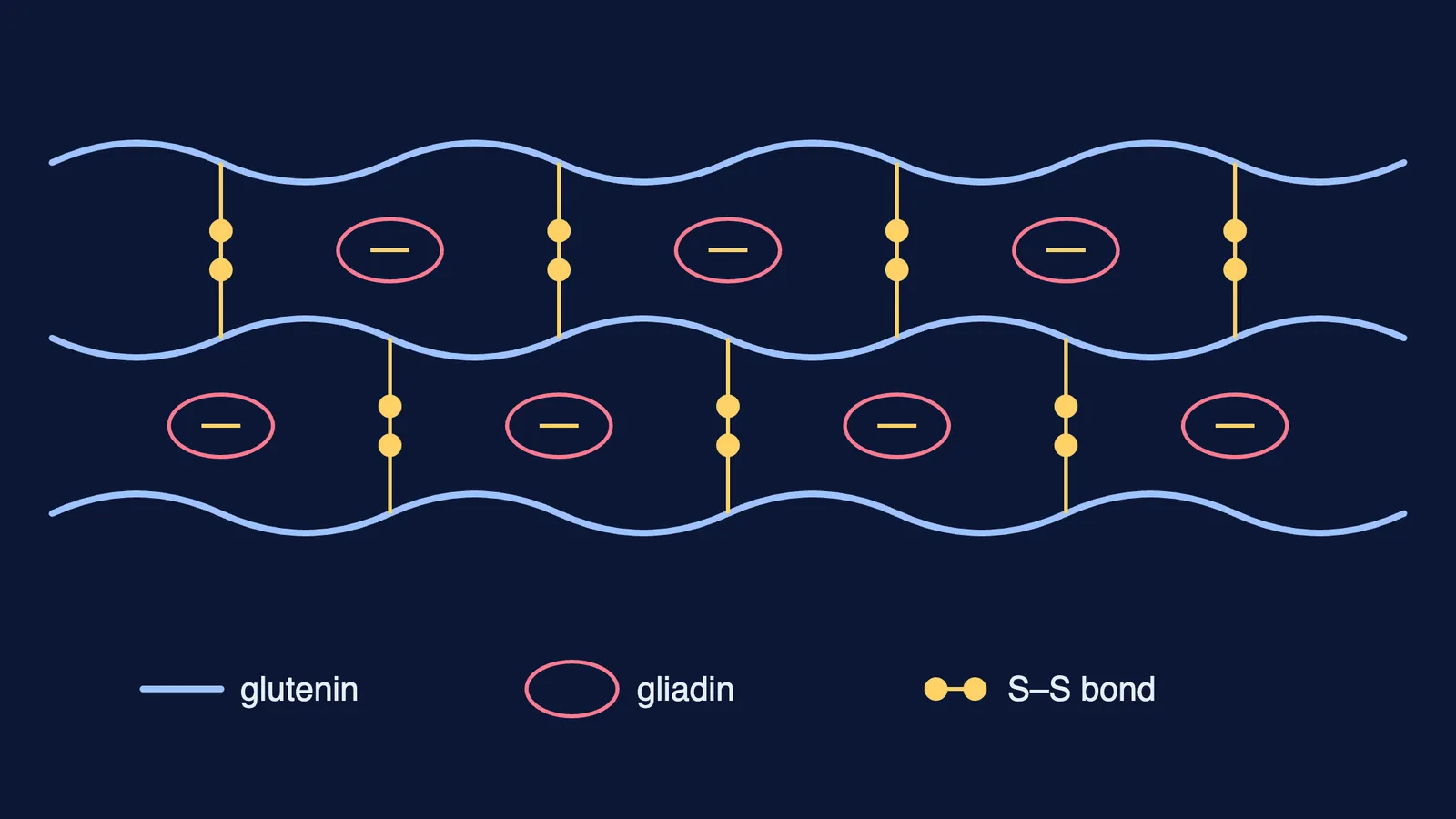
Gliadins dissolve in aqueous alcohol and are mostly single chains, with molecular weights of about 28,000 to 55,000. Where they have disulphide bonds, the bonds link one part of a chain to another part of the same chain.
Glutenins do not dissolve in aqueous alcohol. Their chains are joined to one another by disulphide (S–S) bonds into aggregates of about 500,000 to more than 10 million in molecular weight.
Why does gluten make dough stretch?
Gluten proteins give dough its water absorption, cohesiveness, viscosity and elasticity, Wieser's review says. Glutenin chains, cross-linked by covalent S–S bonds, form a large network, and weaker hydrogen, ionic and hydrophobic interactions help gliadins and glutenins cling together.
That ties two syllabus ideas to your kitchen. The S–S bridges are the bonds in our post on how disulphide bonds hold protein structure together, and the heat of the tawa changes proteins too, which is what happens when proteins are denatured.
If protein structure still feels shaky, the Fermi Concept Library covers every concept in physics, chemistry, biology, mathematics and computing, so you can revise the idea behind the dough before a test.
Is coeliac disease the same as avoiding gluten?
No. Coeliac disease is a condition where your immune system attacks your own tissues when you eat gluten, damaging the small intestine so the body cannot properly take in nutrients, as the NHS explains. Symptoms include diarrhoea, stomach aches, bloating and tiredness. It is a case of autoimmunity, the body attacking itself.
It is not rare. A 2018 meta-analysis of 96 studies in Clinical Gastroenterology and Hepatology put global prevalence at 1.4% by blood tests and 0.7% when confirmed by biopsy. In India, a community study in the Delhi National Capital Region in which 10,488 people took part found a prevalence of 1.04%, or about 1 in 96.
Other people avoid gluten for different reasons:
Non-coeliac gluten or wheat sensitivity: symptoms similar to coeliac disease that go away when gluten is removed from the diet, in people who test negative for coeliac disease and wheat allergy. The Celiac Disease Foundation adds that research has not confirmed gluten is the culprit.
Preference: choosing to eat less wheat, with no medical condition behind it.
Which Indian grains have no gluten?
Wheat, barley and rye contain gluten, and so do their forms such as semolina (sooji), durum, bulgur, couscous and spelt, according to the NHS treatment page. That covers atta, maida and sooji.
Rice, corn, millet, sorghum, amaranth, buckwheat and quinoa are naturally gluten-free, as are beans, according to the Celiac Disease Foundation's food list. The Agriculture Ministry and NAFED's International Year of Millets booklet gives the Indian names: sorghum is jowar, pearl millet is bajra and finger millet is ragi.
Oats do not contain gluten but can become contaminated with other cereals that do, the NHS treatment page notes. FSSAI's 2019 guidance note on gluten-free food, as reported by FnBnews and hosted on FSSAI's site, says only food with 20 mg of gluten per kg or less can be labelled gluten-free, and warns that foods labelled wheat-free may still contain rye or spelt.
A checklist before you cut out gluten
Ask why. Preference is fine. Symptoms are a reason to see a doctor first.
Keep eating gluten until you are tested. The NHS diagnosis page says tests need gluten in your diet, and not to go gluten-free until a specialist confirms coeliac disease.
Use a short script with the doctor. A parent might say: 'Could this be coeliac disease, and should we keep wheat in the diet until the tests?'
If it is confirmed, swap rather than skip. Jowar, bajra or ragi roti for wheat roti; poha or rice for sooji upma; rice and dal for wheat-heavy meals.
Read every label. Look for the gluten-free claim and for a line saying it was processed in a plant that also handles gluten.
Start with step 1: know why you are asking, then ask the right person.


