

On this page
You will meet autoimmunity in one short paragraph of NCERT Class 12 Biology, Chapter 7 (Human Health and Disease), squeezed between allergies and the lymphoid organs. It is short, but it shows up in one-mark definitions and "give an example" questions, and the idea behind it links much of the immunity section together.
What is autoimmunity, in NCERT's words?
Start with the idea the NCERT chapter on Human Health and Disease builds on: memory-based acquired immunity evolved in higher vertebrates based on the ability to tell foreign organisms, such as pathogens, apart from self-cells. Autoimmunity is what happens when that ability fails.
Autoimmunity is when the body attacks its own cells, and the damage this causes is called an auto-immune disease (NCERT, section 7.2.6). NCERT gives the cause as "genetic and other unknown reasons", and it admits that we still do not understand the basis of how the body tells self from foreign.
Rheumatoid arthritis is not the only autoimmune disease. MedlinePlus, from the US National Library of Medicine, says there are more than 80 types, including type 1 diabetes, where the immune system attacks the pancreas, and alopecia areata, which causes hair loss. The same page notes that women develop many types of autoimmune diseases much more often than men.
Why is rheumatoid arthritis NCERT's example of autoimmunity?
NCERT's only stated reason is that rheumatoid arthritis "affects many people in our society".
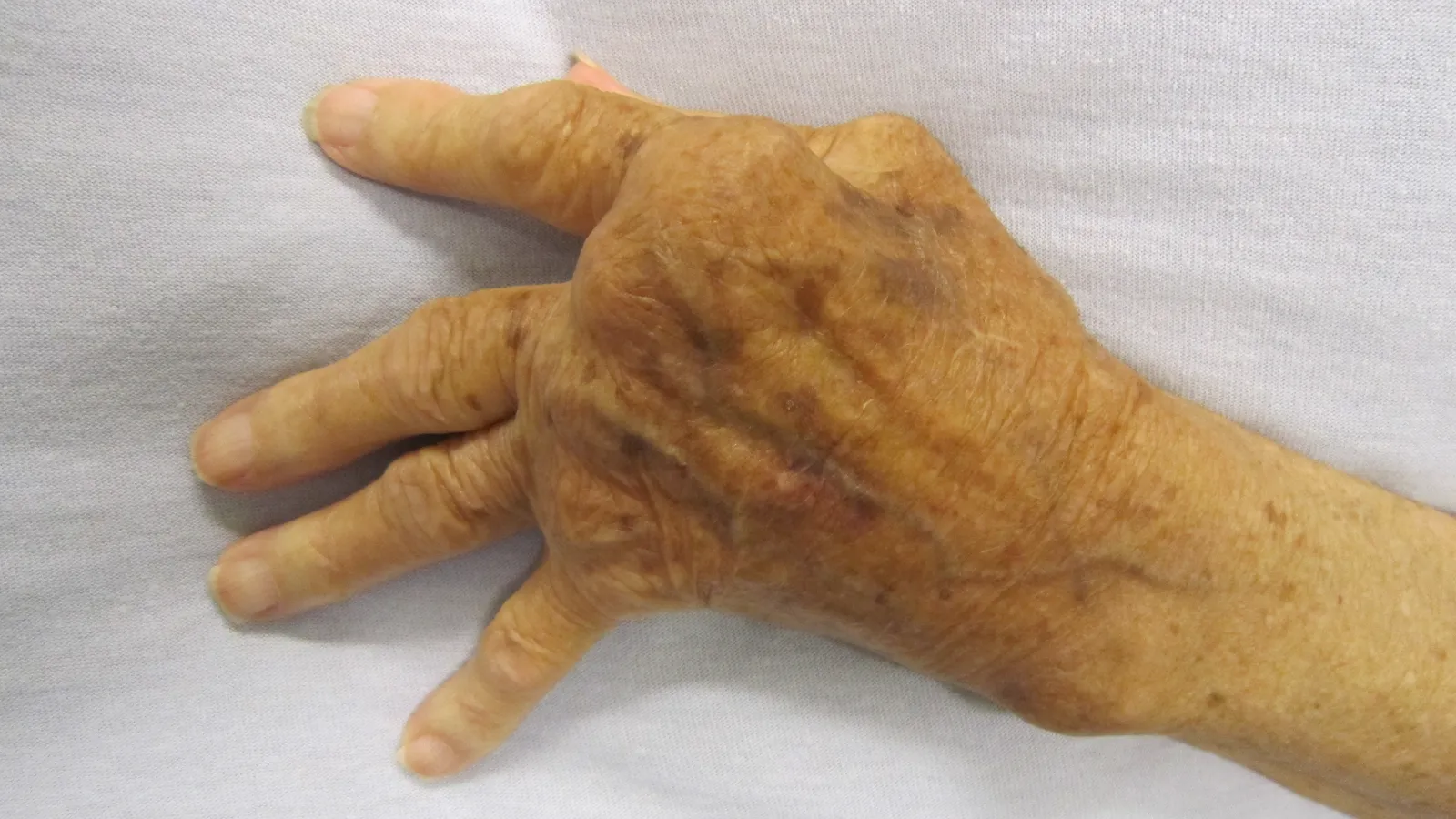
The self tissue involved is the synovium. MedlinePlus Genetics explains that in rheumatoid arthritis the immune system triggers abnormal inflammation in the synovium, the membrane that lines the joints. Inflamed synovium causes pain, swelling and stiffness, and in severe cases the inflammation also affects the bone and cartilage within the joint. The disease frequently affects the hands and feet, and joints are typically affected in a symmetrical pattern: if one hand is involved, both tend to be.
The same page fills in NCERT's "genetic and other unknown reasons": an estimated 50 to 60 percent of the risk is due to genetic factors, the most significant being variations in HLA genes, especially HLA-DRB1, and long-term smoking is a well-established risk factor (MedlinePlus Genetics).
The World Health Organization reports that 18 million people worldwide were living with rheumatoid arthritis in 2019, and about 70% of them were women.
How is autoimmunity different from allergy and AIDS?
The NCERT chapter places three immune problems close together: allergies (7.2.5), auto immunity (7.2.6) and AIDS (7.3). Students mix them up. Sort any question by asking two things: what is the immune system reacting to, and is it doing too much or too little?
Allergy: an exaggerated response to antigens from the environment, such as pollen, mites in dust or animal dander. NCERT says the antibodies are of the IgE type, and mast cells release histamine and serotonin.
Autoimmunity: a response against the body's own cells. NCERT's example is rheumatoid arthritis.
Immunodeficiency: the immune system is weakened. In NCERT this is AIDS, Acquired Immuno Deficiency Syndrome, caused by HIV.
If the words antigen and antibody still blur together, first read how to tell antigen, antibody and antibiotic apart.
How do you write an exam answer on autoimmunity?
Here is a four-line answer for a short-answer question:
Acquired immunity depends on the ability to tell foreign organisms apart from self-cells.
Sometimes, due to genetic and other unknown reasons, the body attacks its own cells.
This damages the body and is called an auto-immune disease.
Example: rheumatoid arthritis, in which the immune system inflames the synovium lining the joints, causing pain and swelling.
Lines 1 to 3 follow the NCERT text closely. The synovium detail in line 4 comes from MedlinePlus Genetics and adds depth when the question asks for more.
Three slips to check before you move on:
Writing that autoimmunity is caused by a pathogen. NCERT gives genetic and other unknown reasons.
Giving a pollen or dust-mite allergy as the example. Those are reactions to outside antigens, not to self.
Calling AIDS autoimmune. AIDS is an immunodeficiency caused by a virus.
To place autoimmunity next to T cells and graft rejection, read humoral vs cell-mediated immunity. For how the body gains immunity in the first place, see active vs passive immunity with examples.
If words like synovium or HLA are new to you, the Fermi Concept Library covers every concept in biology, each with its own lesson and its place in the map, so you can see where autoimmunity sits in the rest of immunity. You can also work through sorting examples into allergy, autoimmunity or immunodeficiency with Fermi's AI tutor, which decides whether to explain, ask or show, and checks your understanding as it goes.
For tonight: write the four-line answer from memory, then sort five examples of your choice into the three groups above.


