On this page
If you are revising Biomolecules for CBSE boards, JEE Main or NEET-UG, "how is glucose prepared?" comes straight from the NCERT text. The answer is two hydrolysis reactions, and the detail that is easiest to get wrong is the conditions.
What are the two methods of preparing glucose?
Both methods are in Unit 10, Biomolecules, of the NCERT Class 12 Chemistry textbook (Part II), under "Preparation of Glucose".
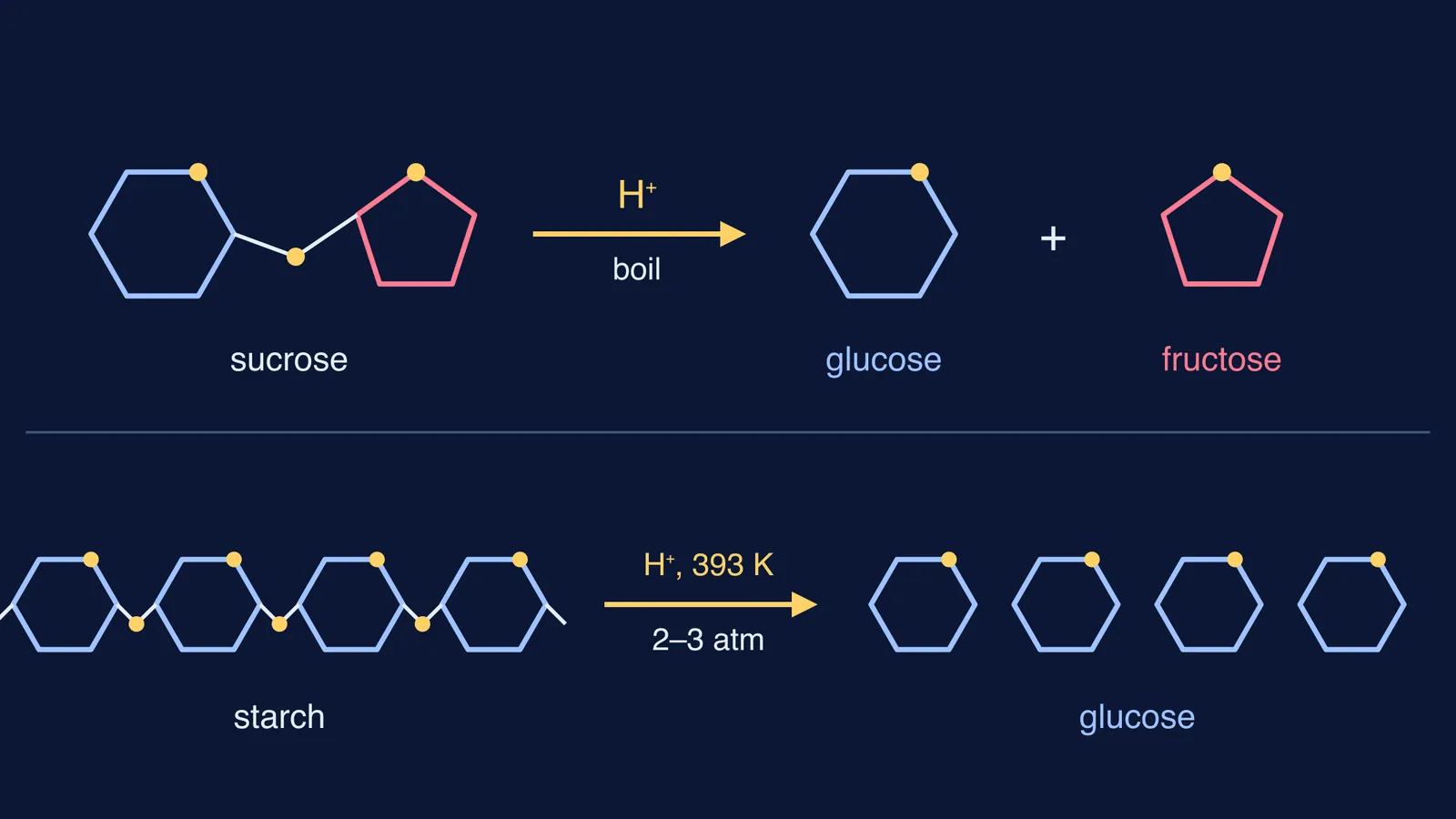
From sucrose (cane sugar): if sucrose is boiled with dilute HCl or H2SO4 in alcoholic solution, glucose and fructose are obtained in equal amounts. The equation is C12H22O11 + H2O → C6H12O6 (glucose) + C6H12O6 (fructose), with H+ written over the arrow.
From starch (commercial method): glucose is obtained by boiling starch with dilute H2SO4 at 393 K under pressure. The equation is (C6H10O5)n + nH2O → nC6H12O6, with "H+, 393 K, 2-3 atm" written over the arrow.
Both reactions are hydrolysis: water breaks the glycosidic linkages that hold sugar units together, and acid speeds this up. The difference is in what those units are.
Why does sucrose give both glucose and fructose?
Sucrose is a disaccharide made of two different sugars. The NCERT chapter describes it as α-D-glucose and β-D-fructose joined by a glycosidic linkage between C1 of glucose and C2 of fructose. Breaking that one bond releases one molecule of each, which is why the textbook says "equal amounts" and "equimolar mixture".
This mixture has a name you should know. Sucrose is dextrorotatory, but after hydrolysis the mixture is laevorotatory, because the laevorotation of fructose (-92.4°) is larger than the dextrorotation of glucose (+52.5°), according to the same NCERT section on disaccharides. The sign of rotation flips, so the product is called invert sugar. If you want the story behind the "+" in D-(+)-glucose, read our explainer on why glucose is called dextrose. To tell the two products apart in the lab, see chemical tests that distinguish glucose and fructose.
Why is starch the commercial source of glucose?
Starch is a polymer of α-glucose only, so hydrolysing it completely gives one product, with no fructose to separate. NCERT describes starch as two components: amylose, about 15-20% of starch, an unbranched chain of 200-1000 glucose units joined by C1-C4 linkages, and amylopectin, about 80-85%, which also branches through C1-C6 linkages (NCERT, section 10.1.4). For how plants and animals store glucose in the first place, see starch vs glycogen as storage polysaccharides.
There is one thing the textbook does not tell you: industry has moved away from acid towards enzymes. A 2002 review in the Journal of Biotechnology by van der Maarel and colleagues notes a shift over the preceding decades from acid hydrolysis of starch to starch-converting enzymes for making products such as glucose and fructose syrups, and says these enzymes then made up about 30% of the world's enzyme production (abstract on PubMed, DOI 10.1016/S0168-1656(01)00407-200407-2)). For your exam, write the acid method NCERT gives; an enzyme is simply a different catalyst for the same hydrolysis.
Worked example: how much glucose do you get?
Use molar masses of 342.3 g/mol for sucrose, 162.1 g/mol for one starch unit (C6H10O5) and 180.2 g/mol for glucose.
100 g of sucrose: 100 ÷ 342.3 = 0.292 mol. Each mole gives one mole of glucose and one of fructose, so you get 0.292 × 180.2 = 52.6 g of glucose and 52.6 g of fructose.
100 g of starch: 100 ÷ 162.1 = 0.617 mol of units. Each unit gives one glucose, so you get 0.617 × 180.2 = 111.1 g of glucose.
The products weigh more than the starting material in both cases. That is not an error. Each glycosidic bond broken takes in one water molecule, and the added mass is that water. If your answer comes out lighter than what you started with, check whether you forgot the water. The Fermi Problem Library has worked problems with a step-by-step solver that explains the reasoning rather than printing an answer, which helps when a mole calculation goes wrong and you cannot see where.
What should a full-marks answer include?
Use this checklist for a two- or three-mark "How is glucose prepared?" question:
Name both sources: sucrose (cane sugar) and starch.
For sucrose: boiled with dilute HCl or H2SO4, in alcoholic solution; products glucose and fructose in equal amounts.
For starch: boiled with dilute H2SO4 at 393 K and 2-3 atm; this is the commercial method.
Write both balanced equations with H+ over the arrow and the products labelled.
If the self-test shows gaps in the wider chapter, such as glycosidic linkages, anomers or reducing sugars, the Fermi Concept Library covers every concept in physics, chemistry, biology, mathematics and computing, each with its own lesson, so you can fix the idea underneath before you go back to the equations.