

On this page
Where does the name dextrose come from?
In clinical medicine and food science, glucose is often labeled dextrose, though both names denote the same monosaccharide with the formula C6H12O6. The word glucose was coined in 1838 from the Greek *gleukos*, meaning sweet new wine, as recorded in Online Etymology Dictionary's entry for glucose. The name dextrose was introduced to highlight how this molecule bends light in solution.
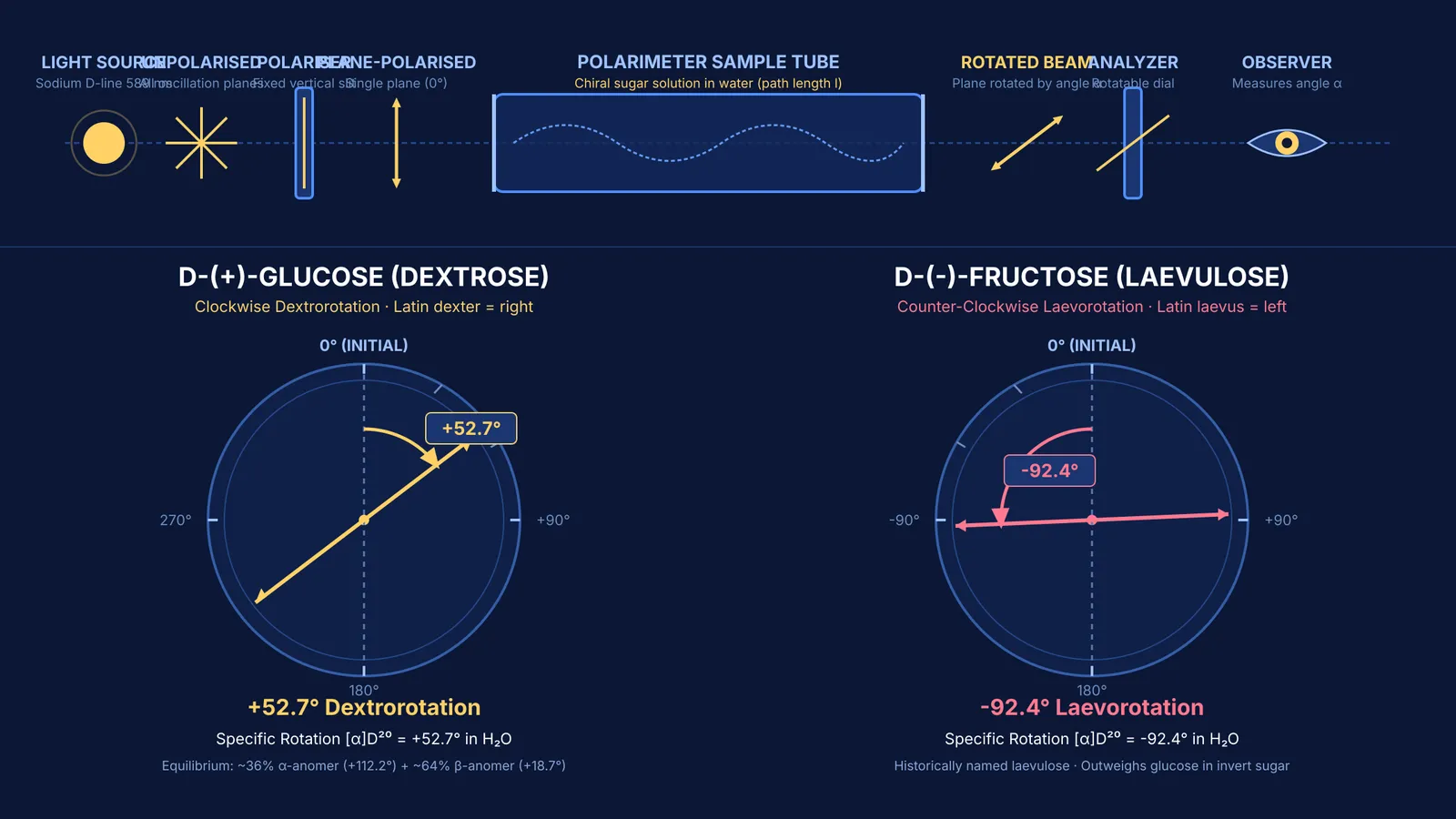
The name dextrose comes from the Latin *dexter*, meaning right, as recorded in Online Etymology Dictionary's entry for dextrose. When plane-polarised light passes through natural glucose in water, the plane of oscillation rotates clockwise, or to the right. Substances that rotate light to the right are dextrorotatory, designated by (+) or d-. French physicist Jean-Baptiste Biot discovered this in 1835, showing that sugar solutions rotate light in proportion to concentration, earning the Rumford Medal in 1840 as detailed in Britannica's biography of Jean-Baptiste Biot. Fructose does the opposite: it rotates light left, leading chemists in 1865 to name it laevulose from the Latin *laevus*, as noted in Online Etymology Dictionary's entry for levulose.
Why does glucose rotate light to the right while fructose rotates it left?
Optical activity stems from molecular chirality, as detailed in Britannica's guide to optical activity. Glucose is an aldohexose with four chiral carbons at C2, C3, C4, and C5, while fructose is a ketohexose with three chiral carbons at C3, C4, and C5, documented in PubChem's compound record for D-glucose. When plane-polarised light enters a chiral solution, its left- and right-circularly polarised waves travel at different speeds due to refractive index differences, producing a net rotation. See how molecular geometry drives this deflection in Chiral molecules in 3D: the mirror-image rotation test.
In water, glucose undergoes mutarotation, examined in T. M. Lowry's 1903 paper in the Journal of the Chemical Society and surveyed in C. S. Hudson's 1910 review in the Journal of the American Chemical Society. Pure alpha-D-glucose starts at an optical rotation of +112.2 degrees, while beta-D-glucose starts at +18.7 degrees. In solution, ring opening allows both anomers to equilibrate into roughly 36% alpha and 64% beta forms. The mixture settles at +52.7 degrees at 20 degrees Celsius, confirming that glucose remains dextrorotatory, as recorded in PubChem's compound record for D-glucose. Fructose equilibrates to a strong counter-clockwise rotation of -92 degrees at 20 degrees Celsius, documented in PubChem's compound record for D-fructose.
Why does D not mean dextrorotatory in chemistry exams?
A common exam trap is confusing the prefix D with optical rotation. Capital D and L indicate relative configuration compared to glyceraldehyde. In carbohydrates, you inspect the penultimate chiral carbon furthest from the carbonyl group (C5 in hexoses). If its hydroxyl group (-OH) points right in a standard Fischer projection, the sugar belongs to the D-family. If it points left, it belongs to the L-family.
Both natural glucose and fructose have their C5 hydroxyl on the right, making both D-sugars: D-glucose and D-fructose. However, optical rotation is an experimental measurement from a polarimeter, shown by (+) for clockwise or (-) for counter-clockwise rotation. Because D-glucose rotates light right and D-fructose rotates it left, their full names are D-(+)-glucose and D-(-)-fructose. Capital D never guarantees a positive rotation. To see how stereocentres map across carbohydrates, the Fermi Concept Library arranges every concept in chemistry with its own lesson and its place in the map.
How do you calculate optical rotation with Biot's formula?
Polarimetry relates observed rotation to concentration and path length using Biot's formula, explained in Britannica's guide to optical activity: [α] = α / (l × c) Here, α is the observed rotation in degrees, l is the path length in decimetres (1 dm = 10 cm), and c is the concentration in g/mL. For evaluating optical purity, see our guide on Enantiomeric excess and optical purity: how to calculate them.
Consider a hospital 5% (w/v) dextrose infusion containing 5.0 g of D-(+)-glucose dissolved to 100 mL of solution. A sample is placed in a 2.0 dm polarimeter tube at 20 degrees Celsius. The equilibrium specific rotation of D-glucose is +52.7 deg·mL·(g·dm)⁻¹, verified in PubChem's compound record for D-glucose.
Concentration c: 5.0 g / 100 mL = 0.050 g/mL.
Path length l: 2.0 dm (200 mm).
Rearrange Biot's equation: α = [α] × l × c.
Calculate: α = (+52.7) × (2.0) × (0.050) = +5.27 degrees.
The polarimeter detects a clockwise rotation of +5.27 degrees. When working through stereochemistry problems, the Fermi Problem Library provides worked problems with a step-by-step solver that explains the reasoning rather than printing an answer.
How does dextrose behave during sugar inversion?
The opposite optical rotations of dextrose and laevulose explain the historic mystery of cane sugar inversion. Sucrose is a disaccharide of D-glucose and D-fructose with a dextrorotatory specific rotation of +66.5 degrees, as recorded in PubChem's compound record for sucrose. When hydrolysed by acid or the enzyme invertase, sucrose cleaves into equimolar D-(+)-glucose and D-(-)-fructose.
Because fructose's laevorotation of -92 degrees, recorded in PubChem's compound record for D-fructose, exceeds dextrose's dextrorotation of +52.7 degrees in magnitude, the equimolar product mixture exhibits a net negative rotation of approximately -19.7 degrees. As the reaction runs, the solution's rotation inverts from positive to negative. This optical inversion gives the reaction its name, inversion of cane sugar, producing what industry calls invert sugar. You can study this reaction in Why is sucrose hydrolysis called inversion of sugar?.


