

On this page
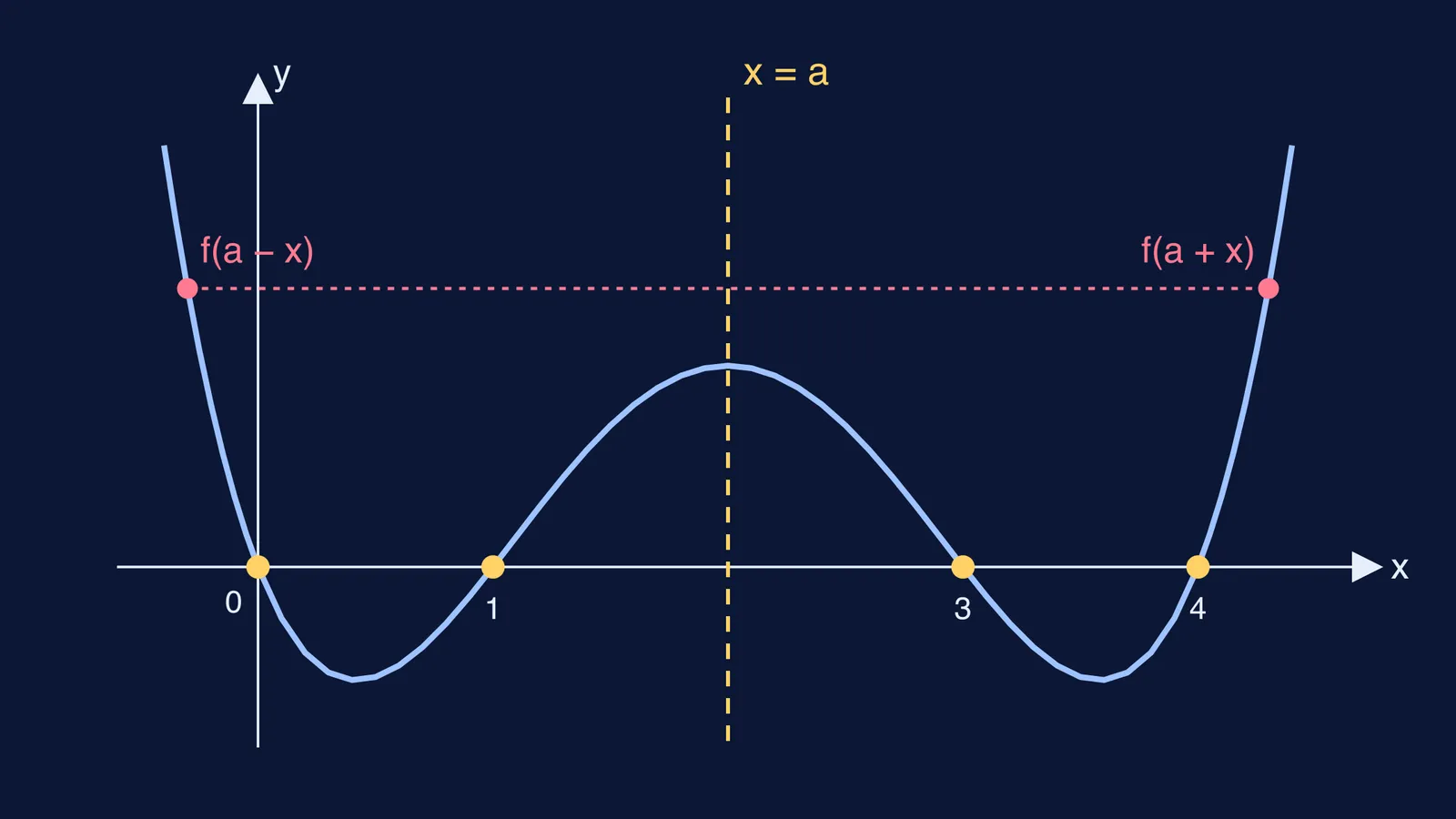
The line "f(a + x) = f(a − x) for all real x" turns up in JEE-style questions on functions, integrals and equations. It is a picture written in algebra; see the picture and questions get short.
What does f(a + x) = f(a − x) mean?
Read x as a distance. Step x units right of the line x = a and you reach a + x; step the same distance left and you reach a − x. The condition says the graph has the same height at both points, for every distance. So the graph is a mirror image of itself in the line x = a.
A graph is symmetric about the vertical line x = h when the test f(h + d) = f(h − d) holds for every d with both points in the domain (Just to the Point, Symmetry of graphs). Equivalently, f becomes an even function once you shift the variable by h.
Even functions are the case a = 0: the graph of an even function is symmetric about the y-axis (Wikipedia, Even and odd functions). Every parabola y = px² + qx + r is symmetric about its axis, the line x = −q/(2p) through the vertex (OpenStax College Algebra 2e, section 5.1).
Replacing x by x − a gives the equivalent form f(x) = f(2a − x). If a question gives f(p + x) = f(q − x), the mirror line is x = (p + q)/2. For a slanted mirror, see our post on why an inverse function is a reflection in y = x.
How does the symmetry shorten a definite integral?
NCERT's Class 12 Mathematics textbook lists property P6: the integral of f from 0 to 2a equals twice the integral from 0 to a if f(2a − x) = f(x), and equals 0 if f(2a − x) = −f(x) (NCERT Class 12 Mathematics Part II, Chapter 7 Integrals, p. 274). The first condition is symmetry about x = a: the two halves of the area are mirror images.
A second trick follows. If f is symmetric about x = a, then over any interval centred on a, the integral of x·f(x) equals a times the integral of f(x). Why: write x = a + (x − a). The piece (x − a)·f(x) is odd about x = a, so its integral over a centred interval is zero, the shifted version of NCERT's property P7 for odd functions.
Worked example: what is the integral of x sin x from 0 to π?
Check symmetry: sin(π/2 + t) = cos t = sin(π/2 − t), so sin x is symmetric about x = π/2, the centre of [0, π].
Apply the trick: the integral equals (π/2) times the integral of sin x from 0 to π.
The integral of sin x from 0 to π is 1 + 1 = 2.
Answer: (π/2) × 2 = π.
Integration by parts confirms π. Our walkthroughs of the a − x swap in beta-type integrals and the integral of sin 2x log tan x that comes out zero show more of these.
How do you find the sum of roots of a symmetric function?
Suppose r = a + t is a root. Then f(a − t) = f(a + t) = 0, so a − t is a root too. Roots come in mirror pairs, each adding to 2a. If the number of distinct roots is odd, the leftover root is a itself.
Here is an example with four roots around x = 2. Take f(x) = (x − 2)⁴ − 5(x − 2)² + 4. Only even powers of (x − 2) appear, so f(2 + x) = f(2 − x).
Put u = x − 2. Then u⁴ − 5u² + 4 = (u² − 1)(u² − 4) = 0, so u = ±1 or ±2.
That gives 4 distinct roots: x = 0, 1, 3 and 4.
Rule: sum = 4 × 2 = 8. Check: 0 + 1 + 3 + 4 = 8.
Questions sometimes give only the symmetry and the root count; the rule answers them in one line.
What mistakes should you watch for?
Checking one value. f(a + 1) = f(a − 1) alone proves nothing; it must hold for every x.
Mixing up the sign. f(a + x) = −f(a − x) means symmetry about the point (a, 0), so a centred integral is 0, not doubled.
Counting a repeated root twice. The rule counts distinct roots.
Off-centre limits. Both integral tricks need limits like a − c to a + c.
To practise, the Fermi Problem Library has worked problems with a step-by-step solver that explains the reasoning rather than printing an answer. If even and odd functions feel shaky, start with the Fermi Concept Library.


