

On this page
A free neutron does not last forever. Outside a nucleus it decays into a proton, an electron and an electron antineutrino, and the Particle Data Group's 2024 average for its mean life is 878.4 ± 0.5 seconds, a little under 15 minutes (PDG neutron listing). The energy this decay releases is set by mass alone, so you can calculate it in a few lines.
How do you calculate the energy released in neutron decay?
The Q value of a decay is the rest-mass energy that disappears and turns into kinetic energy of the products. For n → p + e⁻ + ν̄, it is Q = (mₙ − mₚ − mₑ)c², with the antineutrino's mass treated as zero, as school and JEE problems do.
Use the CODATA 2022 rest energies that NIST publishes:
Neutron: mₙc² = 939.565 421 94 MeV (NIST, CODATA 2022).
Proton: mₚc² = 938.272 089 43 MeV (NIST, CODATA 2022).
Electron: mₑc² = 0.510 998 950 69 MeV (NIST, CODATA 2022).
Neutron minus proton: 939.565 421 94 − 938.272 089 43 = 1.293 332 51 MeV.
Subtract the electron: 1.293 332 51 − 0.510 998 95 = 0.782 333 56 MeV.
The energy released in the decay of a free neutron is about 0.782 MeV, calculated from the CODATA 2022 masses listed by NIST. A positive Q means the decay happens on its own. A free proton cannot decay into a neutron this way, because the same sum comes out negative.
What if the question gives masses in atomic mass units?
Many problems give atomic masses in u. Then you use the hydrogen atom, not the bare proton. A ¹H atom already includes one electron, so the electron mass cancels and you do not subtract it again.
Neutron: 1.008 664 916 06 u (NIST, CODATA 2022).
Hydrogen-1 atom: 1.007 825 032 23 u (NIST atomic masses).
Difference: 0.000 839 883 83 u.
Multiply by 931.494 103 72 MeV per u (NIST, CODATA 2022) to get Q ≈ 0.782 35 MeV.
The two routes agree to the third decimal place. The tiny leftover difference comes from the energy that binds the electron inside a hydrogen atom. For where the 931.5 factor comes from, see our explainer on why 1 amu equals 931.5 MeV.
The most common mistake here is subtracting the electron a second time after using the atomic mass of hydrogen. If your answer is about 0.27 MeV, that is what happened: 0.782 − 0.511 = 0.271.
Why doesn't the electron always get 0.78 MeV?
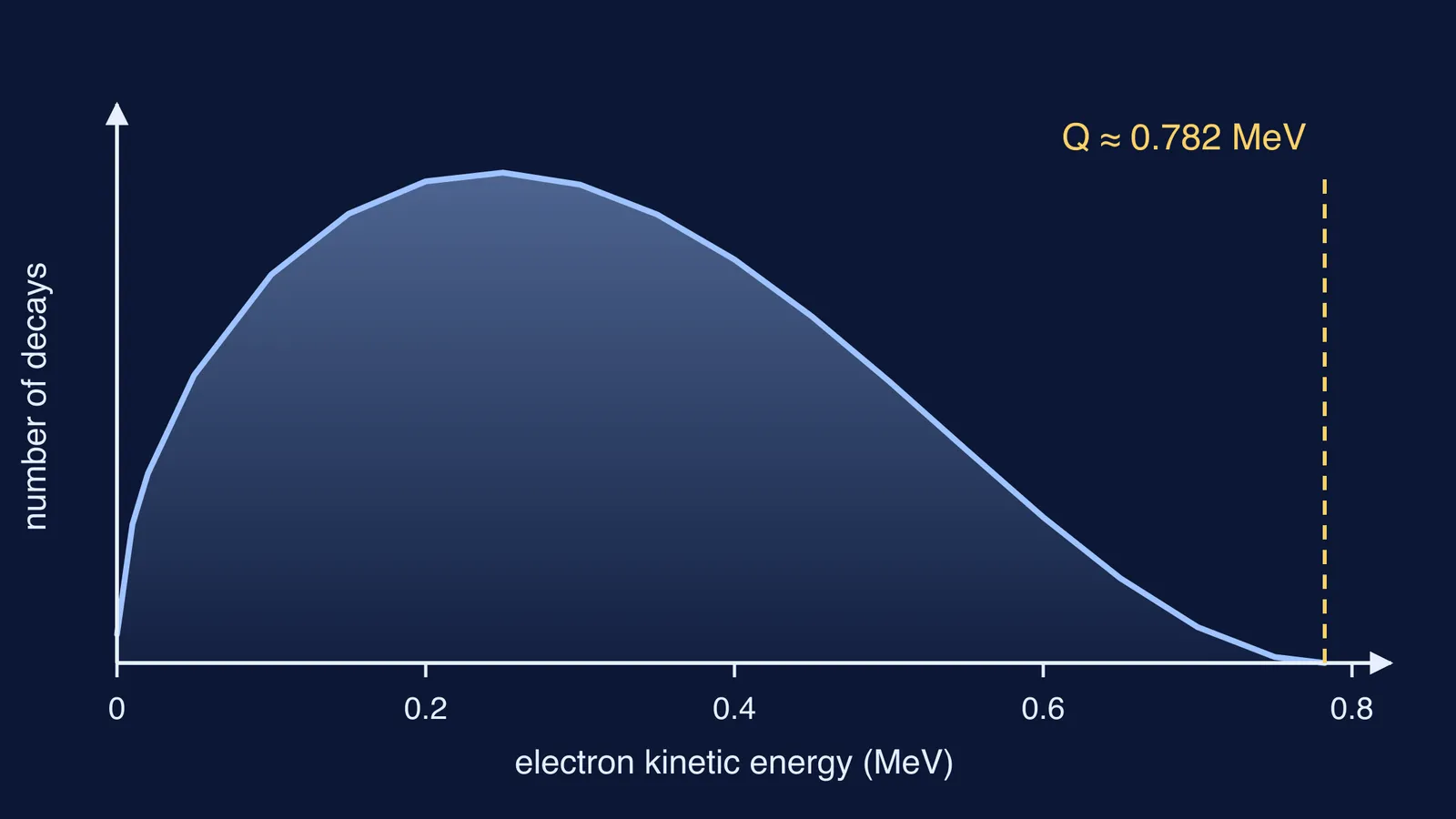
If a neutron at rest split into only two particles, they would fly apart back to back with equal and opposite momenta. Conservation of energy and momentum would then fix one exact energy for each. Neutron decay has three products, and three momenta can add to zero in endless ways. So the same 0.782 MeV is shared out differently every time, with K(electron) + K(antineutrino) + K(proton) = Q.
Using the NIST CODATA 2022 masses, the shares work out like this:
The proton is about 1,836 times heavier than the electron, so it barely moves. Its recoil energy can never be more than about 0.75 keV, under 0.1% of Q.
That leaves the electron and antineutrino to split almost all of Q. In one decay the electron might take 0.1 MeV and the antineutrino 0.68 MeV. The next decay splits it differently.
The electron reaches its maximum, about 0.78 MeV, only when the antineutrino leaves with almost nothing.
This is why electrons from beta decay have a continuous energy spectrum, not a single sharp energy. We explain the shape of that spectrum and how it pointed to an unseen particle in why beta particles have a continuous energy spectrum.
How can you check your answer in an exam?
Before you move on:
Write the decay and check charge: 0 = (+1) + (−1) + 0.
Pick one mass system. With particle masses, subtract mₑ. With atomic masses, do not.
Subtract first, round last.
Check the sign: Q must be positive for a decay that happens on its own.
For the maximum kinetic energy of the electron, answer Q, about 0.78 MeV from the NIST masses, ignoring the proton's recoil.
For the energy of the electron in a decay, the answer is a range from zero up to about 0.78 MeV, not one value.
For the same method applied to collisions and fission, see our guide to calculating the Q value of a nuclear reaction. If you get stuck halfway through a numerical, the Fermi Problem Library has worked problems with a step-by-step solver that explains the reasoning rather than printing an answer, so you can see the exact line where a mass got counted twice. If the idea of a shared, continuous energy is what feels shaky, the Fermi Concept Library gives each physics concept its own lesson and its place in the map.
Try it now: redo the calculation with 939.6 and 938.3 MeV, then with the NIST values.


