

On this page
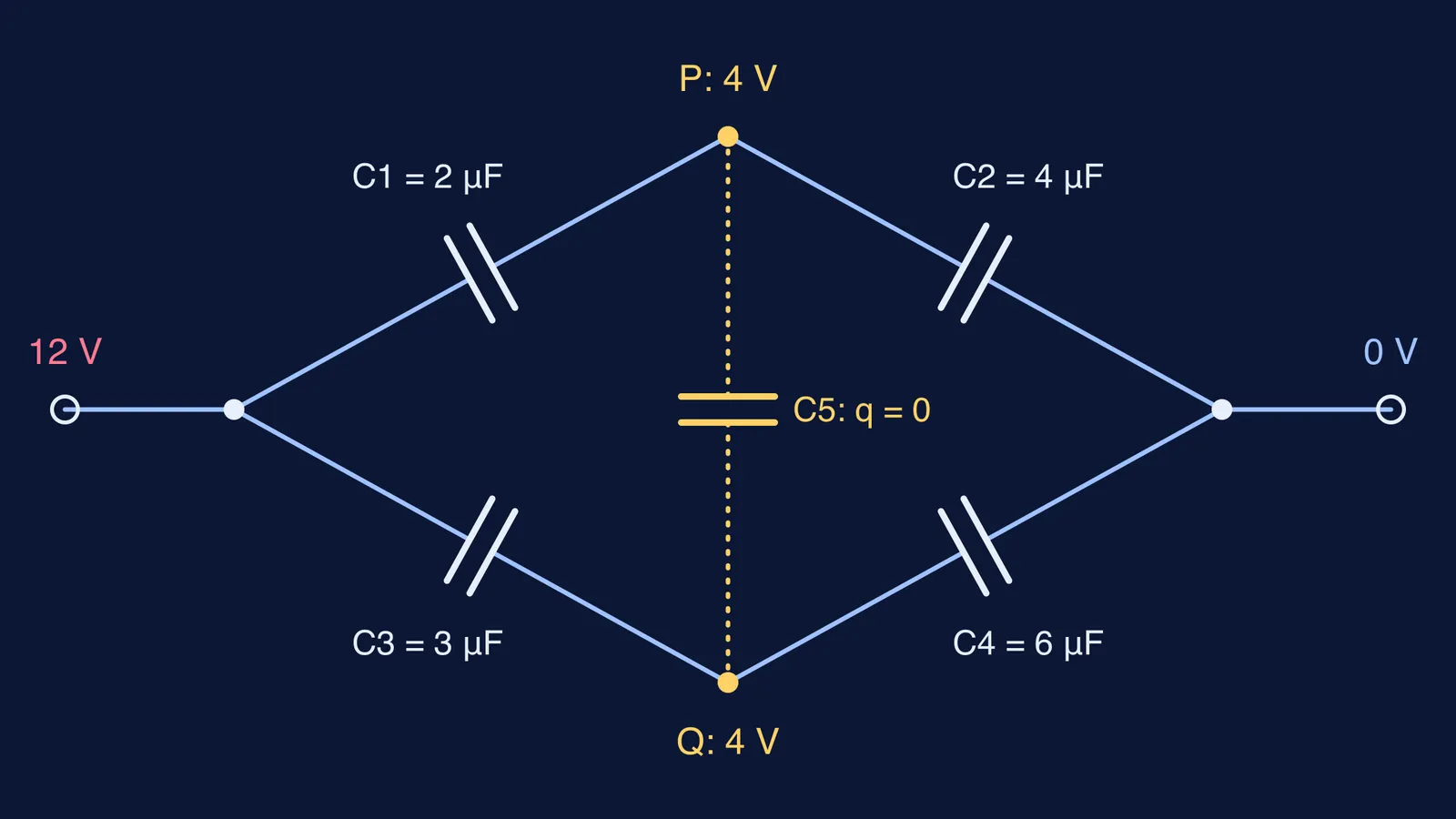
Draw a diamond of capacitors: C1 and C2 along the top path, C3 and C4 along the bottom, a battery across the left and right corners, and a fifth capacitor C5 joining the top and bottom corners. Whenever the four outer capacitors satisfy one simple ratio, C5 ends up with no charge, and the whole problem collapses to two series pairs in parallel. Exam problems lean on this shortcut, and some set traps for students who apply it without checking.
What is the balanced condition for a capacitor bridge?
Call the battery end A (potential V), the other end B (potential 0), the top middle junction P and the bottom one Q. NCERT defines capacitance as C = Q/V, the charge on a plate divided by the potential difference across it (NCERT Class 12 Physics, Chapter 2 summary).
First imagine C5 is missing, with every capacitor starting uncharged. C1 and C2 are then in series, so they carry the same charge q. The potential drops q/C1 and q/C2 add up to V, which puts junction P at V × C1/(C1 + C2). By the same steps, junction Q sits at V × C3/(C3 + C4).
Those two potentials are equal exactly when C1/(C1 + C2) = C3/(C3 + C4). Cross-multiply and simplify, and you get C1 × C4 = C2 × C3, which is the same as C1/C2 = C3/C4.
Now put C5 back. With no potential difference across it, Q = CV gives it zero charge, so it changes nothing and you can delete it.
Why is it the same ratio as the Wheatstone bridge?
NCERT states the Wheatstone bridge null-point condition as R1/R2 = R3/R4, the arrangement in which no current flows through the middle arm (NCERT Class 12 Physics, Chapter 3 summary). We walk through where that comes from in our derivation of the balanced Wheatstone bridge.
The two bridges look the same but split voltage in opposite ways. In a resistor pair, the larger resistor takes the larger share of the voltage. In a series capacitor pair, the larger capacitor takes the smaller share, because the charge is shared and V = q/C. Both sides of the ratio are flipped, so the flips cancel and the condition keeps the same shape.
Worked example: 12 V across a balanced bridge
Take C1 = 2 μF, C2 = 4 μF, C3 = 3 μF, C4 = 6 μF, C5 = 5 μF and a 12 V battery.
Check the ratio: 2/4 = 0.5 and 3/6 = 0.5. Balanced, so C5 holds no charge and drops out.
Top path: 2 and 4 μF in series give (2 × 4)/(2 + 4) = 4/3 μF.
Bottom path: 3 and 6 μF in series give (3 × 6)/(3 + 6) = 2 μF.
The two paths are in parallel: 4/3 + 2 = 10/3 μF, about 3.33 μF.
Charges: the top path holds (4/3) × 12 = 16 μC, the bottom path 2 × 12 = 24 μC, 40 μC in total, which matches (10/3) × 12.
Potentials: C1 drops 16/2 = 8 V, so P is at 4 V. C3 drops 24/3 = 8 V, so Q is also at 4 V. C5 sees 0 V.
Notice that the 5 μF of C5 never entered the answer.
What happens if the bridge is not balanced?
Change only C4 to 3 μF. Now 2/4 is not 3/3, and C5 does get charged. P and Q are isolated junctions that start uncharged, so the plates joined at each one must still add to zero charge. Writing that for both junctions gives P at 4.625 V and Q at 5.375 V. C5 sees 0.75 V and holds 5 × 0.75 = 3.75 μC.
That is the node-potential method, and we explain it step by step in solving unbalanced capacitor bridges with node potentials. If your answer for a bridge like this keeps coming out wrong, the Fermi Problem Library has worked problems with a step-by-step solver that explains the reasoning rather than printing an answer, so you can see which step went wrong.
A 30-second check before you solve any bridge
Find the two corners the battery connects to; the bridge is defined by them, not by the drawing.
Pair each middle capacitor with the two outer capacitors that meet at its ends.
Multiply diagonally: is C1 × C4 equal to C2 × C3?
If yes, delete the middle capacitor and use series and parallel.
If no, or if the network does not reduce to this diamond, write junction equations or look for symmetry, as in finding equivalent capacitance by symmetry.
If potential at a junction still feels shaky, rebuild it in the Fermi Concept Library before your next mock test.


