

On this page
You are in an exam, and you see a web of capacitors arranged in a 3D cube or a flat diamond grid. The standard rules for series and parallel circuits do not seem to work because the branches cross over each other, making it impossible to separate them cleanly. The trick to solving these grids is not setting up pages of complicated Kirchhoff's loop equations, but finding the points of symmetry.
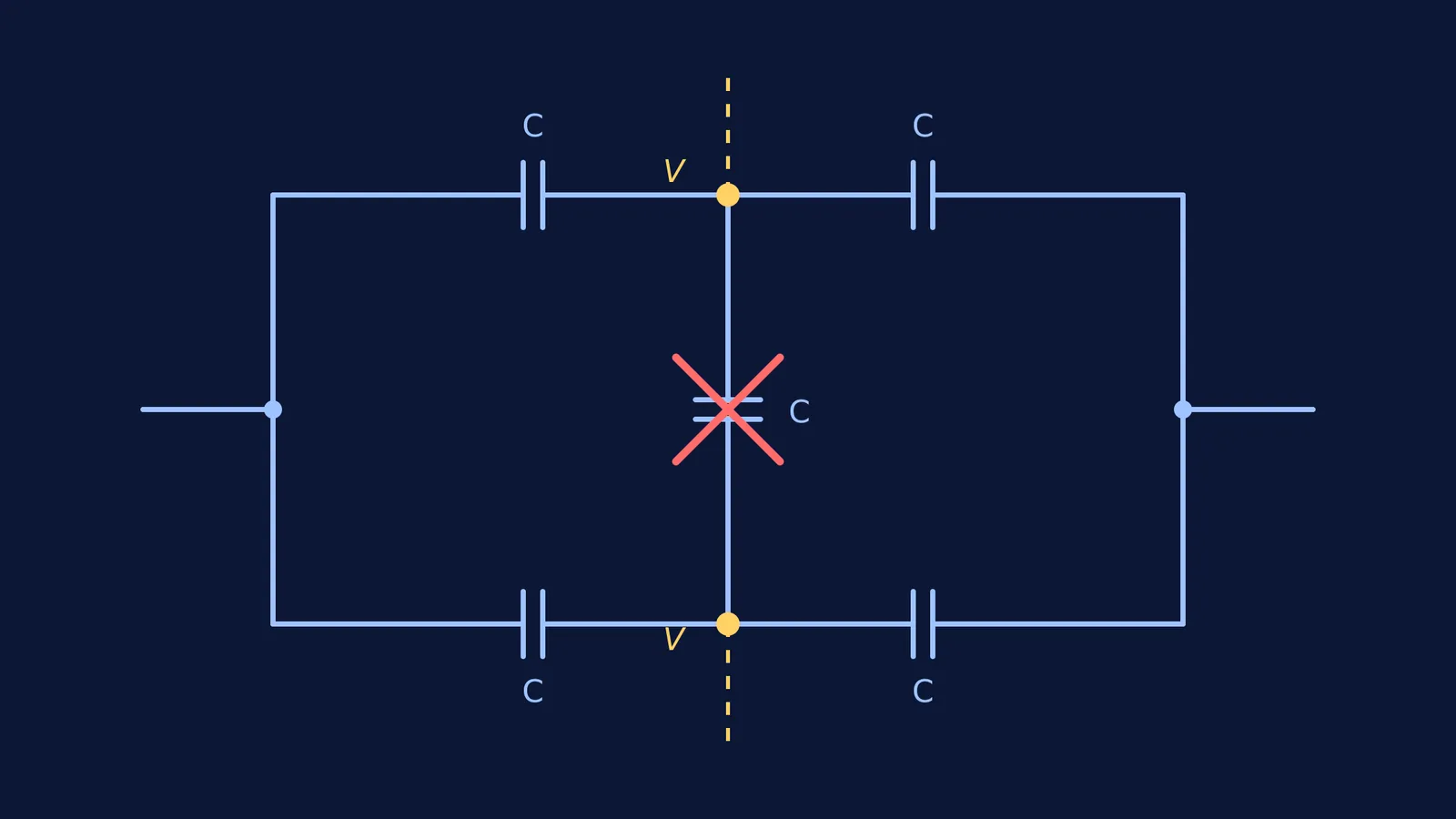
When points in a circuit sit at the exact same voltage—known as equipotential points—no charge moves between them. If a capacitor connects two such points, it stores zero charge. You can safely delete it from the drawing without changing how the rest of the circuit behaves. Once that bridging capacitor is gone, the impossible grid falls apart into simple series and parallel paths.
How do you find equipotential points?
Symmetry is your best tool for finding points with the same voltage. If a circuit looks exactly the same when you flip it like a mirror, or if the path from the battery to two different junctions is physically identical, those junctions share the same potential.
For example, the node potential method involves assigning voltages to junctions to find the charge distribution. But when you spot an axis of symmetry perpendicular to the way the current enters and leaves, you know every node on that axis is an equipotential point. You can connect them with a plain wire or fold the circuit over that axis to simplify the math.
Why can you remove a capacitor in a balanced Wheatstone bridge?
The classic example of this is the Wheatstone bridge, a diamond-shaped circuit originally designed in the 19th century to measure unknown resistance. The bridge is balanced when the ratio of the components in the two arms is exactly equal.
If you build a balanced bridge out of five identical capacitors C, the voltage at the junction above the central capacitor is equal to the voltage at the junction below it. Because the potential difference is zero, no charge is pushed onto the plates of that middle capacitor. You can erase it from the diagram entirely. Once it is gone, you are left with a top branch of two capacitors in series (giving C/2) parallel to a bottom branch of two capacitors in series (also C/2). Adding them up gives a total equivalent capacitance of C.
When you are comfortable with why this works, it becomes easier to spot similar patterns in other shapes. If you want to review the underlying rules for how potential drops across a grid, the Fermi Concept Library maps out every concept with its own lesson, so you can see why the voltage balances out.
How do you find the equivalent capacitance of a cube?
A famous step up from the bridge is a cube made of twelve identical capacitors C along its edges. If you connect a battery across the main body diagonal (from one bottom corner to the opposite top corner), you can find the total capacitance using the same symmetry rules.
According to standard circuit analysis, the current splits into three equal paths at the entry corner. The three corners it reaches are all one edge away from the start and two edges away from the finish, meaning they are equipotential points. You can effectively squash them together into a single node. The cube then simplifies into three stages in series: three capacitors, then six, then three. Because capacitors in parallel add up, this gives stages of 3C, 6C, and 3C. Adding them in series (1/(3C) + 1/(6C) + 1/(3C)) yields an equivalent capacitance of 6/5 C.
This is the exact reciprocal of the famous resistor cube problem, which gives an equivalent resistance of 5/6 R. The same method applies if you connect the battery across a face diagonal (giving 4/3 C) or a single edge (12/7 C). Once you group the equipotential corners, the messy 3D cube becomes a simple 2D drawing.
A step-by-step framework for symmetry problems
If you are staring at a complex network of capacitors, follow this checklist before you try to write out loop equations.
Check for a balanced bridge: Look for a diamond or an H-shape. If the product of the opposite arms is equal, erase the middle component.
Find the axis of symmetry: Draw a line from the input terminal to the output. Now draw a line perpendicular to it. If the left and right halves are mirror images, any capacitor sitting on that perpendicular line carries no charge and can be removed.
Squash equipotential nodes: If two nodes are perfectly symmetrical relative to the input and output, they are at the same voltage. You can connect them with a wire or fold the circuit over to turn a 3D shape into a flat drawing.
Just as the infinite ladder of resistors relies on a repeating pattern, grids rely on folding. When a problem looks too complex for series and parallel rules, it is almost certainly a test of whether you can spot the symmetry. If you are stuck on a specific grid and want a hint rather than an answer, you can bring the problem to Fermi's AI tutor, and it will draw the figure and teach through it to help you find the mirror line.


