

On this page
Series and parallel rules only work when a circuit actually contains series and parallel pairs. OpenStax University Physics states them plainly: all capacitors in a series combination have the same charge, and capacitors in parallel all have the same voltage across their plates. A bridge breaks both, because the middle capacitor means no two capacitors share a charge or both end points. The fix: give every junction a potential and let charge conservation write the equations.
Why doesn't a capacitor bridge reduce to series and parallel?
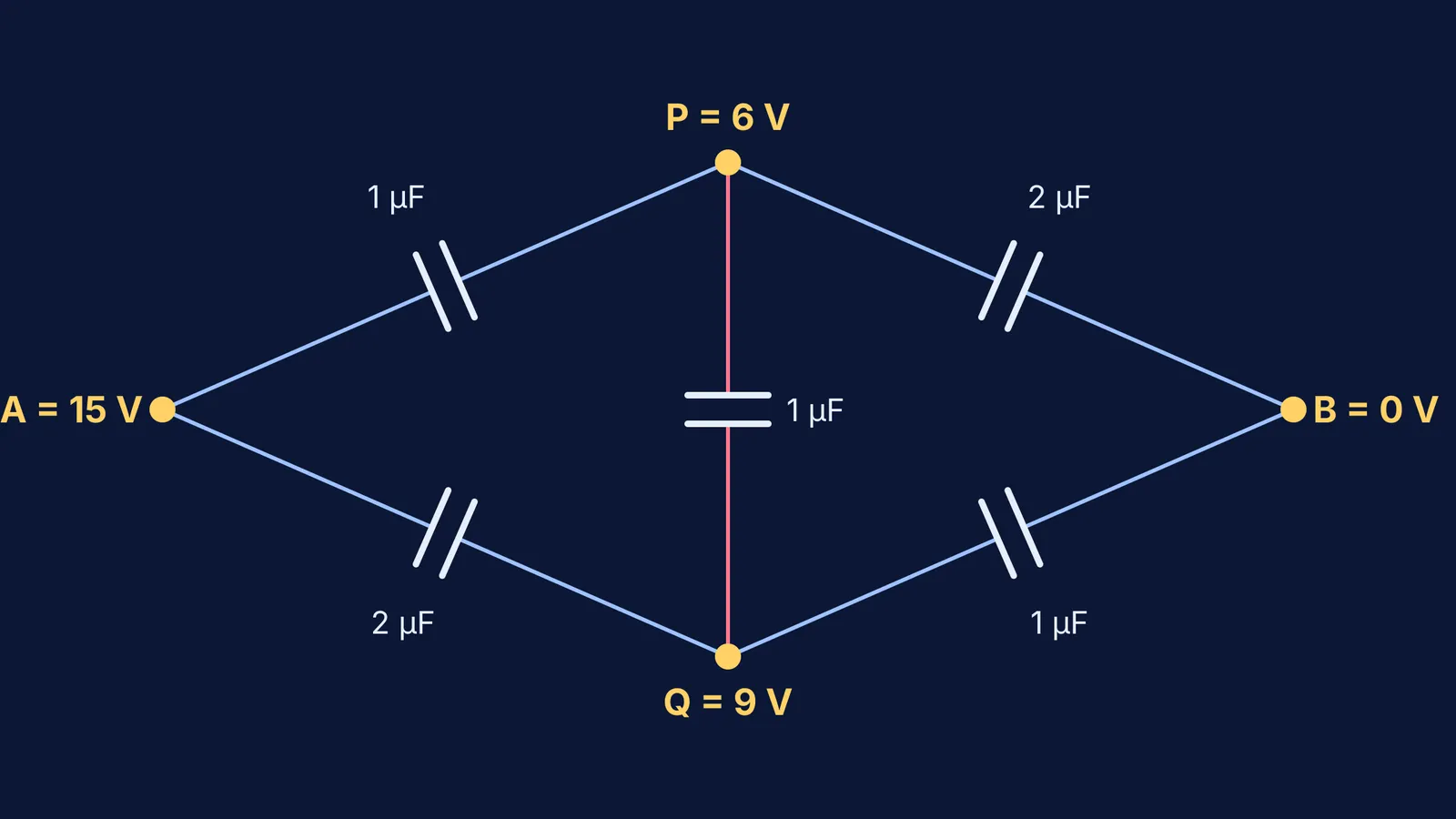
A battery holds A at V and B at 0 V. C1 joins A to P, C2 joins A to Q, C3 joins P to B, C4 joins Q to B, and C5 sits across the middle, from P to Q.
Without C5, P would sit at C1V/(C1 + C3) and Q at C2V/(C2 + C4). These are equal exactly when C1/C3 = C2/C4. That is the balanced case: P and Q share a potential, C5 holds no charge, and you can delete it. The condition has the same form as the one for a resistor bridge.
When the ratios differ, C5 carries charge and the shortcut fails, so check the ratio first.
How does the node potential method work for capacitors?
Ground one battery terminal (0 V).
Give each unknown junction a symbol: x, y and so on.
For every capacitor touching a junction, write the charge on its plate at that junction as C × (junction potential − far-end potential). This follows from C = Q/V, as defined in OpenStax's capacitor chapter.
If the junction is isolated and started uncharged, set the sum of those plate charges to zero. Charge cannot leave an isolated conductor, the same conservation principle OpenStax gives as the basis of Kirchhoff's junction rule.
Solve, then read off every charge.
If you have used node potentials for resistor circuits, the shape is identical, with charges in place of currents.
Worked circuit 1: an unbalanced bridge
Take a 15 V battery across A and B, with C1 = 1 µF, C2 = 2 µF, C3 = 2 µF, C4 = 1 µF and C5 = 1 µF. C1/C3 = 1/2 but C2/C4 = 2, so the bridge is unbalanced. Let P be at x and Q at y. Working in µF and volts gives charges in µC.
Junction P: 1(x − 15) + 2(x − 0) + 1(x − y) = 0, so 4x − y = 15.
Junction Q: 2(y − 15) + 1(y − 0) + 1(y − x) = 0, so 4y − x = 30.
From the first, y = 4x − 15. Substituting, 16x − 60 − x = 30, so x = 6 V and y = 9 V.
Every charge follows:
C1: 1 × (15 − 6) = 9 µC
C2: 2 × (15 − 9) = 12 µC
C3: 2 × 6 = 12 µC
C4: 1 × 9 = 9 µC
C5: 1 × (9 − 6) = 3 µC, positive plate on Q's side
Check junction P: the −9 µC plate of C1 and the −3 µC plate of C5 balance the +12 µC plate of C3. The plates joined to A hold 9 + 12 = 21 µC, so the equivalent capacitance is 21/15 = 1.4 µF. These are values after charging ends; see capacitors in DC circuits at steady state.
Worked circuit 2: one junction, three potentials
A junction O connects through 2 µF to a point at 10 V, through 3 µF to a point at 0 V, and through 5 µF to a point at 20 V.
One equation:2(x − 10) + 3(x − 0) + 5(x − 20) = 0, so 10x = 120 and x = 12 V.
The plate charges at O are +4 µC, +36 µC and −40 µC, which add to zero. The 5 µF plate at O is negative because its far end sits higher, at 20 V.
Notice that x = (2 × 10 + 3 × 0 + 5 × 20)/(2 + 3 + 5): an isolated junction sits at the capacitance-weighted average of its neighbours' potentials.
What mistakes cost marks in these questions?
Deleting the middle capacitor without checking C1/C3 = C2/C4.
Mixing (neighbour − junction) terms with (junction − neighbour) terms.
Applying the zero-sum rule to a point wired to a battery terminal, which is not isolated.
Forgetting initial charge: if a junction's plates started charged, their sum equals that starting charge, not zero.
Warm up with series, parallel and energy in capacitor problems.
For practice, redraw circuit 1 with C4 = 4 µF. The ratios now match, so the node equations should give C5 zero charge. If you keep slipping at the same step, the Fermi Problem Library has worked problems with a step-by-step solver that explains the reasoning rather than printing an answer. To revisit capacitance itself, the Fermi Concept Library gives each concept its own lesson and its place in the map.


