

On this page
"For Anne Gregory" by W. B. Yeats is easy to score on once you see that it is a conversation. It is the last of the ten poems in First Flight on the CBSE Class X English Language and Literature syllabus for 2026-27. Here is what each stanza says, what the poem means and how to answer questions on it.
Who was Anne Gregory?
Anne Gregory was the granddaughter of Lady Gregory and grew up at Coole Park, the family home in Ireland. Speaking to The Irish Times as an old woman, she recalled Yeats calling her in to hear a new poem about her hair, and admitted she was not impressed at first. Her father, Robert Gregory, is the airman of another Yeats poem.
The poem appeared in Yeats's collection The Winding Stair and Other Poems, which Macmillan published in London in September 1933, as the first edition's title page and contents show.
What does For Anne Gregory mean, stanza by stanza?
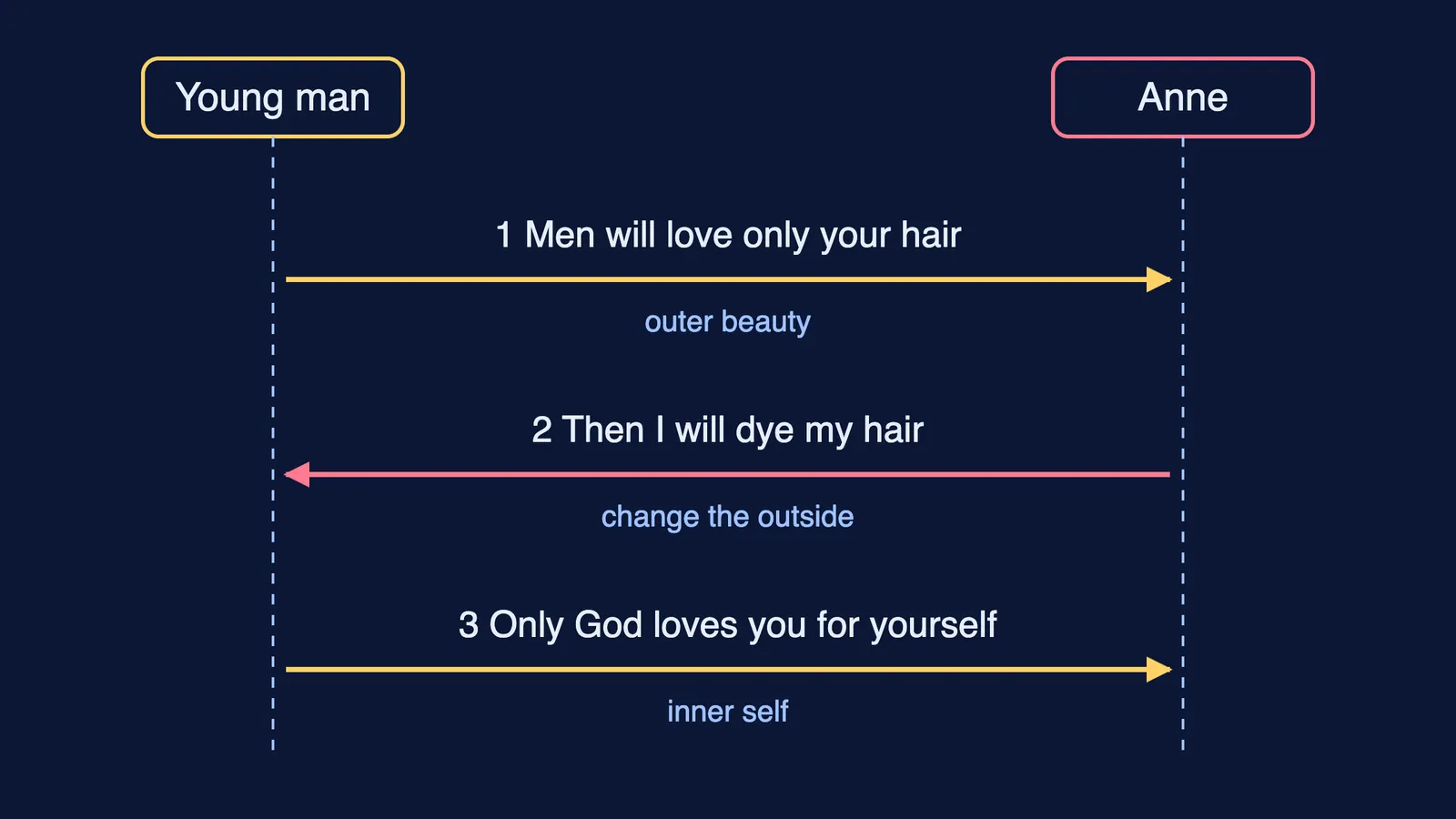
The poem has three stanzas of six lines each, and every stanza is a speech in quotation marks. Two people talk. NCERT's First Flight introduces them as a young man and a young woman, Anne. Many readers also hear Yeats in the young man.
Stanza 1: the young man warns Anne
The young man tells Anne that young men will fall hopelessly for her. Her golden hair, which he pictures as "honey-coloured / Ramparts at your ear", will be all they see. A rampart is a protective wall around a fort, so the image says her beauty is both attractive and a barrier: it stands between her and anyone who might love the real person behind it. His point: no young man will love her for herself.
Stanza 2: Anne answers back
Anne is young and quick. If the hair is the problem, she says, she will simply dye it "Brown, or black, or carrot". Then young men would have to love her for herself. It is witty, but it assumes a new outside fixes an inner problem.
Stanza 3: the young man has the last word
He replies with something he says he heard from "an old religious man" the night before: that man had found a text proving only God could love her for herself alone. In plain words, no human looks fully past appearance; only divine love sees the soul. Anne does not reply.
What are the main themes of For Anne Gregory?
Outer beauty versus inner worth. Every stanza weighs looks against the self.
Human love versus divine love. Anne thinks a quick fix will change how young men see her; the reply says only God sees past the hair.
Ideal love. Love "for yourself alone" is what Anne wants, and the poem suggests only God gives it fully.
Notice the tone too. The poem is light and teasing, not a sermon; mention that gentle humour in a short answer.
What poetic devices are used in For Anne Gregory?
Dialogue form: three speeches, two speakers, a question settled by the last voice.
Metaphor: hair as "ramparts", walls around Anne's true self.
Refrain: "yellow hair" closes all three stanzas.
Enjambment: sentences run over line ends, so it reads like speech.
Rhyme: in each stanza the even lines rhyme (in stanza 1 despair and hair, with ear as a near rhyme), and every stanza ends on hair.
How to answer exam questions on For Anne Gregory
The 2026-27 CBSE paper has a poetry extract with short questions, short answers of 40-50 words from First Flight, and a long answer of 100-120 words, according to the official syllabus. Use this three-step plan:
Name the speaker. Say who is talking in the stanza (the young man or Anne). Mixing them up weakens an answer.
State the idea in one line. For example: stanza 2 shows Anne thinks dyeing her hair will solve the problem.
Prove it with a short phrase. Quote three to six words, then explain the image.
Try these practice questions, written by us:
Why does the young man compare Anne's hair to ramparts? (Image, plus what the wall keeps out.)
What does Anne's plan to dye her hair tell you about her age and attitude?
Long answer: Do you agree that people judge by appearance first? Use the poem and one example from school life, such as first impressions on the first day of a new class.
For the long answer, give one paragraph to the poem, one to your example and a closing line on the ending.
Where to go next
If you are revising First Flight poems together, the line-by-line guide to The Ball Poem, the Amanda! explanation with devices and Fog and The Trees, with their metaphors follow the same speaker, meaning and devices method.
English poems often take less time than board science. If you want that saved time to count in physics, chemistry or maths, Fermi's AI tutor works out what you already know and builds a plan for the session, so you start with a clear next step.


