

On this page
The tiger is on posters, stamps and fundraising appeals, and it is also the reason large forests in India are protected. Those are two different jobs. Conservation biologists call the first a flagship role and the second an umbrella role, and exam questions often test whether you can tell them apart.
The short version: a flagship is chosen for how people feel about it, an umbrella for how much habitat it needs. One species can be both, and the tiger is the classic example.
What is a flagship species?
Flagship species are used by conservation practitioners to raise funds and awareness for reducing biodiversity loss, as Verissimo, MacMillan and Smith note in Conservation Letters. Their paper treats the flagship as a marketing idea: you decide the purpose of the campaign, work with the audience you want to reach to pick the species, then check whether the campaign worked. A flagship does not need to be ecologically special; it needs to appeal to that audience.
What is an umbrella species?
An umbrella species is one "whose conservation is expected to confer protection to a large number of naturally co-occurring species", in the definition used by Roberge and Angelstam's review in Conservation Biology.
The logic is about space. An animal that ranges widely needs a large, connected area of habitat, so protecting enough land for it also protects the smaller plants and animals inside that area. Roberge and Angelstam reviewed 18 studies testing this idea and found that a single umbrella species cannot protect every species that lives alongside it, because some of those species face limits that have nothing to do with the umbrella.
Is the tiger a flagship or an umbrella species?
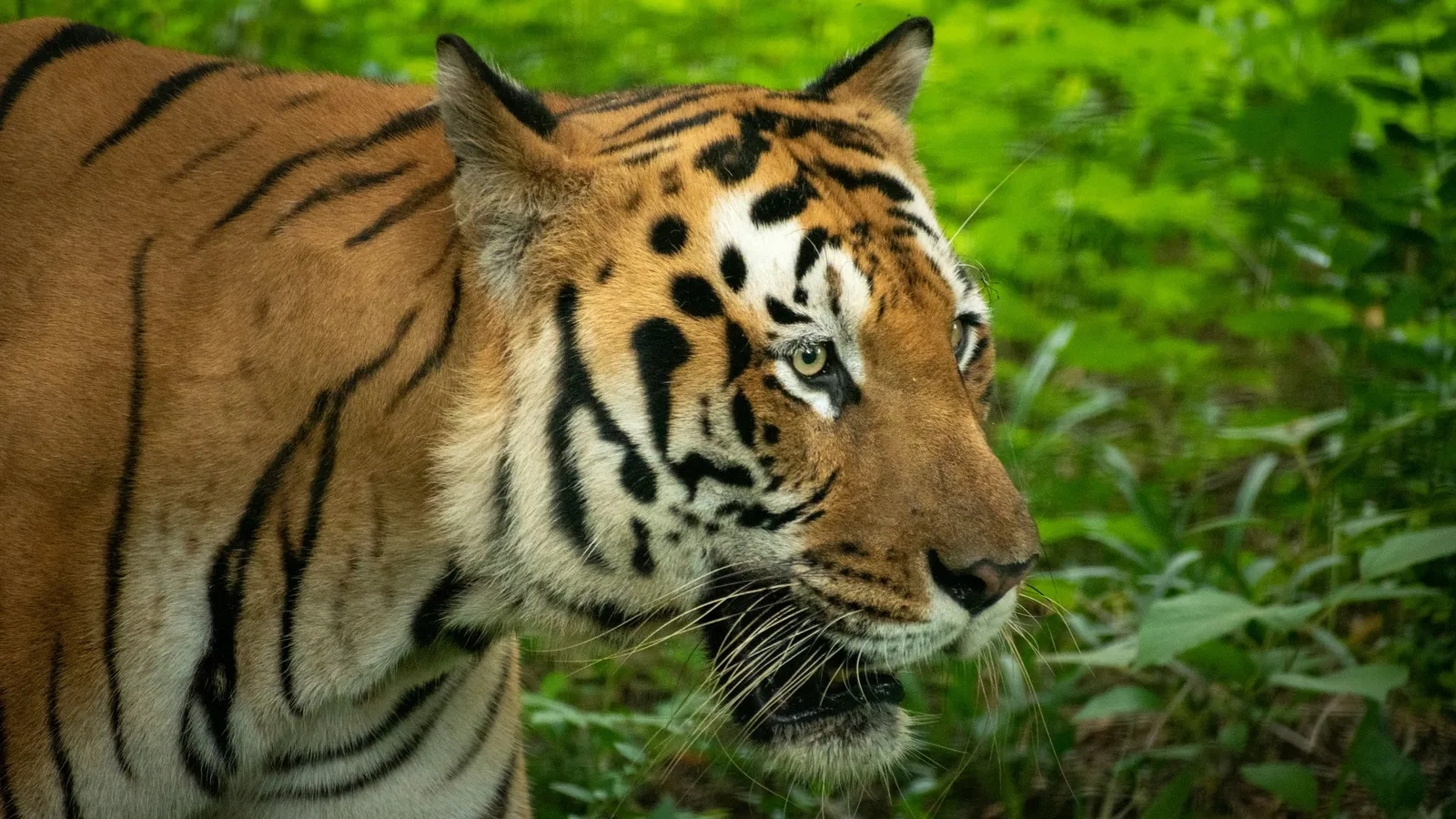
Both. As a flagship, the tiger drew national support early: the government launched Project Tiger in 1973, starting with 9 tiger reserves, according to the National Tiger Conservation Authority. The 2022 national assessment by the NTCA and the Wildlife Institute of India estimated 3,682 tigers in India, about 75 percent of the world's tiger population, as summarised by the India Environment Portal.
As an umbrella, the tiger is one of nine species identified in a 2026 study in Conservation Letters by Lamba and colleagues. The study looked at 160 legally protected threatened vertebrates in India and found that protecting the habitat of any one of nine key species could safeguard over a third of the country's above-ground carbon (about 1.1 gigatonnes) and of its vertebrate diversity (more than 700 species). Besides the tiger, the nine include the sambar, dhole, leopard and great hornbill, as reported by Mongabay India.
What are the limits of the umbrella species idea?
The umbrella idea has a known weakness. Daniel Simberloff's 1998 paper in Biological Conservation00081-5) argued that intensive management of an umbrella species, such as moving animals or feeding them, defeats the purpose, because the rest of the community it is meant to protect does not get that treatment.
A 2022 study of the Greater Panna Landscape in central India put numbers on the gap. Vasudeva and colleagues, writing in Land, found that conserving 20% of the landscape would protect 50% of the tiger habitat with connectivity. Protecting all of their biodiversity categories needed 55% of the landscape, and covering tiger habitat and biodiversity together needed conservation or restoration across 62%. The tiger brought the area into focus, but it did not cover everything on its own.
How do you answer flagship vs umbrella questions in an exam?
Use three questions on any species named in the question:
Why was it chosen? If the answer is public appeal or fundraising, it is acting as a flagship.
How much land does it need? If it ranges widely and its habitat contains many other species, it can act as an umbrella.
What does it do in the ecosystem? If removing it changes the whole community, it is a keystone species, which is a separate idea.
Worked example. "Project Tiger protects deer, birds and plants in tiger reserves. Which concept does this show?" The question is about other species being protected, and tigers need large areas, so the answer is umbrella species. Had it said "the tiger was chosen to win public support", the answer would be flagship species.
Our explainer on keystone species and their ecosystem role shows where that third idea fits, and the story of Kailash Sankhala and the 1973 launch of Project Tiger gives the history; tiger reserves are also a standard example of in situ vs ex situ conservation.
If these terms keep blurring together, the Fermi Concept Library gives each biology concept its own lesson and its place in the map. To practise questions like the worked example, the Fermi Problem Library has a step-by-step solver that explains the reasoning rather than printing an answer.
Next time you see a tiger on a poster, ask which job it is doing there.


