

On this page
Extend one side of a triangle past a corner and you get an angle outside it. That exterior angle tells you the sum of the two far corners, which turns many “find x” questions into one line.
What is the exterior angle property of a triangle?
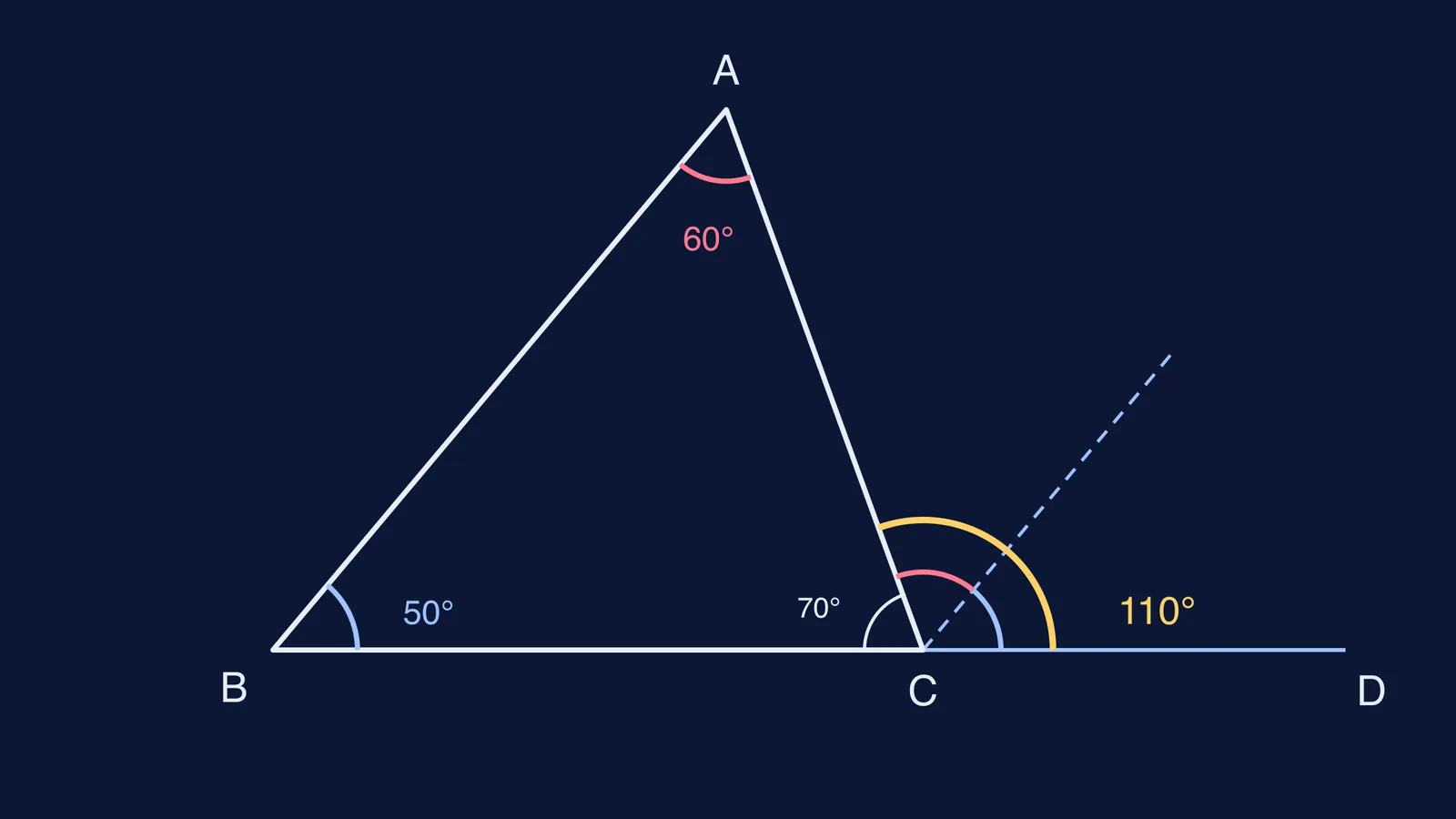
The exterior angle of a triangle equals the sum of the two interior angles opposite it. This is the first half of Proposition 32 in Book I of Euclid's Elements, which says that if one side of a triangle is produced, “the exterior angle equals the sum of the two interior and opposite angles.”
Take triangle ABC and extend side BC beyond C to a point D. The exterior angle is ∠ACD. The remote (interior opposite) angles are ∠A and ∠B. The interior angle at C, right beside it, is not part of the sum.
How do you prove it from the angle sum?
You need two facts you already know:
The angles of a triangle add to 180°: ∠A + ∠B + ∠ACB = 180°.
Angles on a straight line add to 180°: ∠ACB + ∠ACD = 180°, because BCD is a straight line.
Both expressions equal 180°, so set them equal: ∠A + ∠B + ∠ACB = ∠ACB + ∠ACD. Cancel ∠ACB from both sides and you are left with ∠ACD = ∠A + ∠B. That is the whole proof.
Euclid went the other way, as the Clark University edition of Proposition 32 shows. He drew a line through C parallel to BA and showed that one piece of the exterior angle equals ∠A (alternate angles) and the other equals ∠B (corresponding angles). To see the 180° fact proved the same way, read our walk-through on how to prove the angle sum of a triangle is 180 degrees.
The two results stand or fall together: the equality form of the theorem depends on the parallel postulate and is logically equivalent to the 180° angle sum, according to Wikipedia's article on the exterior angle theorem.
How do you use it to find unknown angles?
Example 1: one missing remote angle. An exterior angle is 115° and one remote interior angle is 48°. The other remote angle is 115° − 48° = 67°. The interior angle next to the exterior angle is 180° − 115° = 65°. Check: 48° + 67° + 65° = 180°.
Example 2: algebra. The remote angles are (x + 10)° and (2x − 5)°, and the exterior angle is 125°. Then (x + 10) + (2x − 5) = 125, so 3x + 5 = 125 and x = 40. The angles are 50° and 75°, and the third angle is 180° − 125° = 55°. Check: 50 + 75 + 55 = 180.
Example 3: a ratio. An exterior angle is 120° and the two remote angles are in the ratio 3 : 5. Write them as 3k and 5k, so 8k = 120 and k = 15. The angles are 45° and 75°, and the third is 60°.
Before you write anything, run this quick check:
Mark which vertex the exterior angle sits at.
Circle the angles at the other two vertices. Only those go in the sum.
If the question asks for the angle at the same vertex, use the straight line: 180° minus the exterior angle.
Check that the three interior angles add to 180°.
Figures with several triangles follow the same logic; our guide to angle chasing in a 5-step order shows where this property fits. The Fermi Problem Library has worked problems with a step-by-step solver that explains the reasoning rather than printing an answer, so you can see which angle went where.
Why do the exterior angles of a triangle add up to 360°?
Take one exterior angle at each vertex. By the property, they are ∠B + ∠C, ∠A + ∠C and ∠A + ∠B. Add them: 2(∠A + ∠B + ∠C) = 2 × 180° = 360°.
Every angle of the triangle appears exactly twice. With the angles from Example 3 (45°, 75° and 60°), the exterior angles are 135°, 105° and 120°, which add to 360°.
The same holds for every convex polygon. Proclus's second corollary to Proposition 32, listed in the Clark University notes, says the exterior angles of any convex rectilinear figure together equal four right angles, or 360°. Our post on the sum of interior and exterior angles of a polygon takes it from triangles to n-sided shapes.
If straight-line and parallel-line angles still feel shaky, the Fermi Concept Library gives each mathematics concept its own lesson and its place in the map.
Next step: draw a triangle, extend one side and check the property with a protractor.


