On this page
Put x = 0 into (eˣ − 1)/x and you get 0/0, which tells you nothing. Yet this limit and two relatives sit behind many exponential and log limits in Class 11 tests and JEE Main practice. Learn the three results and four ways to reshape a question into them.
What is the limit of (eˣ − 1)/x as x → 0?
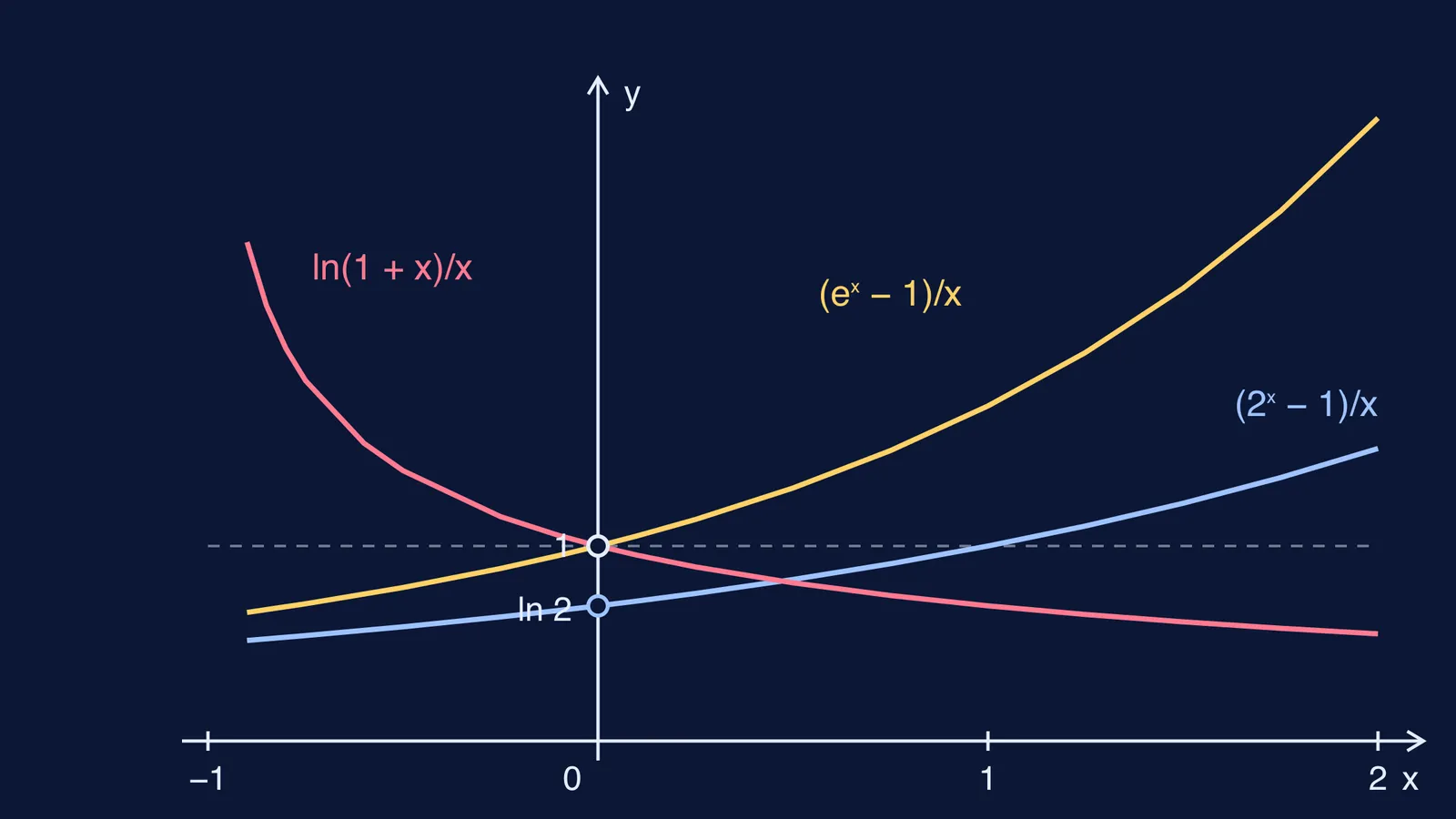
The limit is 1. The list of standard limits on Wikipedia gives lim (eˣ − 1)/x = 1, lim (aˣ − 1)/x = ln a for all positive a, and lim ln(x + 1)/x = 1, each as x → 0.
You can watch it happen on a calculator. At x = 0.1 the ratio is about 1.0517, at x = 0.01 it is about 1.0050, and at x = 0.001 it is about 1.0005.
The reason is a definition. OpenStax Calculus Volume 1 defines e as the unique base b > 0 for which the exponential function bˣ has slope 1 at x = 0. Now read (eˣ − 1)/x as a slope: it is the slope of the chord from (0, 1) to (x, eˣ) on the curve y = eˣ. As x shrinks, the chord turns into the tangent at 0, whose slope is 1 by that definition.
Why does (aˣ − 1)/x give ln a, and ln(1 + x)/x give 1?
Both come from the first result. OpenStax Calculus Volume 1, section 1.5 shows that, for a > 0, aˣ = e^(x ln a) for any real x.
So put u = x ln a. Then (aˣ − 1)/x = ln a × (eᵘ − 1)/u, and u → 0 as x → 0, so the limit is ln a. For a = 2 that is ln 2 ≈ 0.693; try x = 0.01 and you get about 0.6956.
For the log, let y = ln(1 + x). Then x = eʸ − 1, and y → 0 as x → 0, so ln(1 + x)/x = y/(eʸ − 1), which is the first limit turned upside down: 1/1 = 1. At x = 0.01 it is about 0.9950.
How do you bring a messy limit into standard form?
Most questions need one or two of these four moves.
Scale. Multiply and divide by a constant. lim (e³ˣ − 1)/x = 3 × (e³ˣ − 1)/(3x) → 3 × 1 = 3.
Split. Subtract 1 and add 1, then break the fraction. (e²ˣ − e⁻ˣ)/x = (e²ˣ − 1)/x − (e⁻ˣ − 1)/x → 2 − (−1) = 3.
Shift. When x → a instead of 0, put x = a + h so the small quantity is h. lim as x → 1 of ln x/(x − 1) becomes lim as h → 0 of ln(1 + h)/h = 1.
Flip. When x → ∞, put t = 1/x. lim as x → ∞ of x(e^(1/x) − 1) becomes lim as t → 0 of (eᵗ − 1)/t = 1.
For a ratio such as (3ˣ − 1)/(2ˣ − 1), divide top and bottom by x to get ln 3/ln 2 ≈ 1.585.
Worked example: a JEE Main-style limit, step by step
Find L = lim as x → 0 of (5ˣ − 3ˣ)/ln(1 + 2x).
Check the form. At x = 0 the top is 1 − 1 = 0 and the bottom is ln 1 = 0: it is 0/0.
Split the top: 5ˣ − 3ˣ = (5ˣ − 1) − (3ˣ − 1).
Divide top and bottom by x. The top becomes (5ˣ − 1)/x − (3ˣ − 1)/x → ln 5 − ln 3 = ln(5/3).
Scale the bottom: ln(1 + 2x)/x = 2 × ln(1 + 2x)/(2x) → 2 × 1 = 2.
Combine: L = ln(5/3)/2 ≈ 0.255.
When the standard forms cancel each other out, series expansions of eˣ and ln(1 + x) take over.
If you keep reaching for the wrong move, the Fermi Problem Library has worked problems with a step-by-step solver that explains the reasoning rather than printing an answer.
What mistakes cost marks with these limits?
Using a formula when nothing tends to 0. lim as x → 1 of (eˣ − 1)/x is not 1; just substitute and get e − 1.
Mismatched denominators. (e³ˣ − 1)/x is 3, not 1, because the denominator is x and not 3x.
Forgetting that ln a can be negative. For a = 1/2, (aˣ − 1)/x tends to ln(1/2) = −ln 2.
Our post on the derivative of aˣ and log base a picks up from there. If limits themselves still feel shaky, the Fermi Concept Library covers every concept in mathematics, each with its own lesson.
Tonight, try the worked example with 7ˣ and 2ˣ in place of 5ˣ and 3ˣ, and check that you get ln(7/2)/2.