

On this page
You already know two essential rules from calculus: the derivative of eˣ is just eˣ, and the derivative of the natural logarithm ln x is 1/x. But these rules only work when the base is e.
If you face a function where the base is a constant a instead, such as 2ˣ or log₁₀ x, you cannot apply the standard e rules directly. Instead, you need the exponential rule and the general logarithmic rule. Here is how they are derived and used in exams like the JEE.
What is the derivative of a power x?
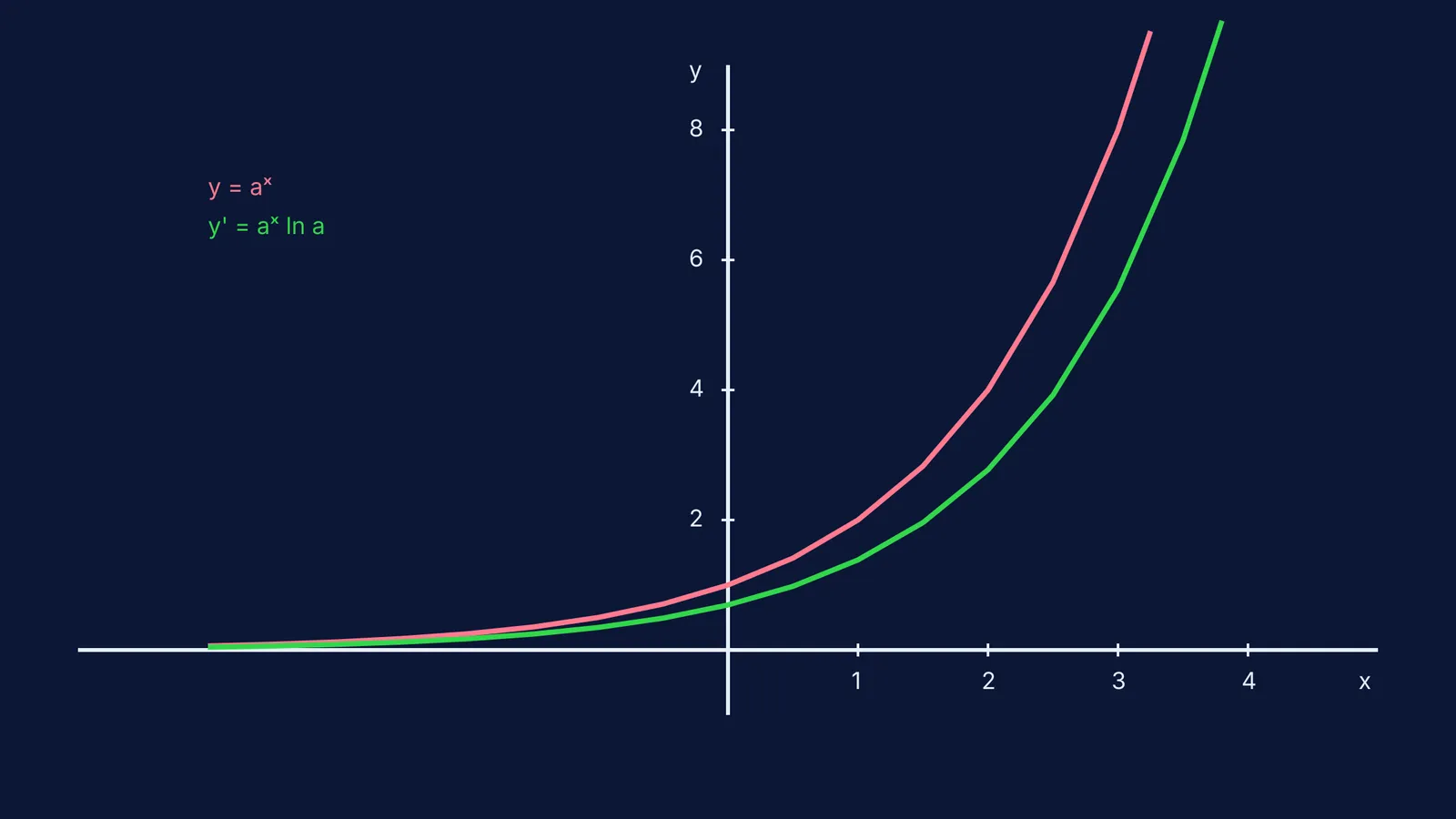
When you have an exponential function y = aˣ (where a > 0 and a ≠ 1), the derivative is: d/dx(aˣ) = aˣ ln a
You can prove this using the properties of exponents and the chain rule. Any positive number a can be written as e^(ln a). Therefore, you can rewrite the original function to have the base e: y = aˣ = (e^(ln a))ˣ = e^(x ln a)
Now, apply the chain rule to differentiate e^(x ln a) with respect to x: d/dx [e^(x ln a)] = e^(x ln a) × d/dx(x ln a)
Since ln a is just a constant multiplier: d/dx [e^(x ln a)] = e^(x ln a) × ln a
Finally, substituting aˣ back in for e^(x ln a) gives: d/dx(aˣ) = aˣ ln a
What is the derivative of log base a?
For a logarithmic function y = logₐ x, the derivative is: d/dx(logₐ x) = 1 / (x ln a)
To prove this, you can convert the logarithm to the natural base e using the change-of-base formula. The change-of-base formula states that logₐ x = (ln x) / (ln a).
Because 1 / (ln a) is a constant, you can move it outside the derivative: d/dx(logₐ x) = d/dx [ (ln x) / (ln a) ] d/dx(logₐ x) = [ 1 / (ln a) ] × d/dx(ln x)
Since the derivative of ln x is 1/x, this becomes: d/dx(logₐ x) = [ 1 / (ln a) ] × (1 / x) = 1 / (x ln a)
If you have concept gaps around the chain rule or logarithms, the Fermi Concept Library contains every concept in physics, chemistry, biology, mathematics and computing, each with its own lesson and its place in the map.
How does the change of base formula connect them?
In both proofs, we turned the function into a form involving e. The present-day notion of logarithms, which connects them to the exponential function with base e, was established by Leonhard Euler in the 18th century. By shifting any base a into base e, we can use the simplest calculus rules to solve the problem.
For example, if you want to find the derivative of an implicit function or read a derivative as the slope of a tangent, writing everything in terms of base e prevents you from dropping the ln a scaling factor.
How do you differentiate a mixed exponential function?
Let's apply these rules to a common exam problem where you must differentiate term by term. Find the derivative of y = 5ˣ + log₅ x.
Differentiate 5ˣ.
Using the rule d/dx(aˣ) = aˣ ln a, where a = 5: d/dx(5ˣ) = 5ˣ ln 5
Differentiate log₅ x.
Using the rule d/dx(logₐ x) = 1 / (x ln a), where a = 5: d/dx(log₅ x) = 1 / (x ln 5)
Add them together.
dy/dx = 5ˣ ln 5 + 1 / (x ln 5)
Notice how the ln a factor appears in the numerator for exponential functions, but in the denominator for logarithmic functions. Writing down the general formulas before you start calculating will help you avoid mixing them up. As you build towards understanding the difference quotient of a function and formal calculus, you will see that this ln a constant simply scales the rate of change.


