

On this page
What is the difference quotient?
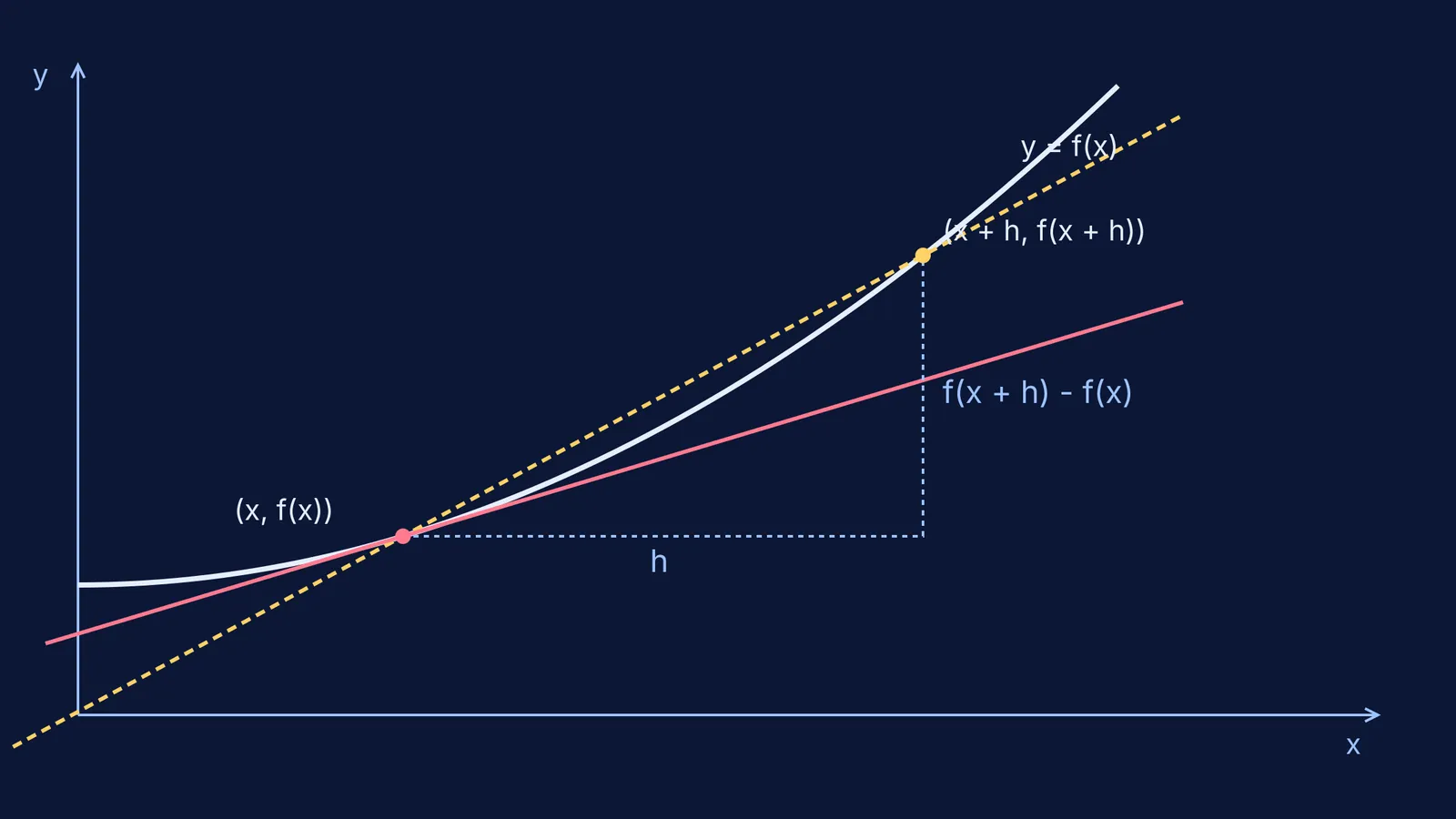
The difference quotient of a function f(x) is the mathematical expression (f(x + h) − f(x)) / h. Geometrically, it represents the slope of a secant line passing through two points on a given curve: the starting point (x, f(x)) and a second point a small distance away, (x + h, f(x + h)). According to OpenStax *Calculus*, this formula calculates the average rate of change of the function over the interval h (OpenStax).
When you encounter the difference quotient in algebra or precalculus, the primary goal is almost always to simplify the expression enough so that you can factor out and cancel the h in the denominator. This algebraic simplification sets the necessary stage for calculus, where letting h approach zero gives you the exact instantaneous rate of change, otherwise known as the derivative.
Students often struggle with the algebra required to simplify these expressions, especially for rational functions or square roots. If you get stuck simplifying these algebraic steps, the Fermi Problem Library acts as a step-by-step solver that explains the reasoning for each factoring and expansion line, helping you find the right path forward without skipping over the crucial algebra.
What is the difference quotient of x squared?
To compute the difference quotient for the quadratic function f(x) = x², you must substitute the function into the formula and carefully expand the squared binomial:
Write the general formula: (f(x + h) − f(x)) / h
Substitute the specific function f(x) = x² into the formula: ((x + h)² − x²) / h
Expand the binomial square (x + h)² using the pattern a² + 2ab + b²: (x² + 2xh + h² − x²) / h
Cancel the x² terms in the numerator, as x² − x² equals zero: (2xh + h²) / h
Factor out the common term h from the remaining terms in the numerator: h(2x + h) / h
Cancel the h in the numerator with the h in the denominator: 2x + h
The simplified difference quotient for x² is 2x + h. This expression tells you the average rate of change between the points x and x + h. To find the actual derivative, you must take the mathematical limit as the interval h shrinks to zero. As h → 0, the h term in the expression 2x + h vanishes, leaving simply 2x. This process confirms the well-known calculus rule that the derivative of x² is 2x.
What is the difference quotient of 1 by x?
Computing the difference quotient for the rational function f(x) = 1/x is slightly more complex because it requires finding a common denominator to subtract the two fractions present in the numerator.
Write the general formula: (f(x + h) − f(x)) / h
Substitute f(x) = 1/x into the expression: (1/(x + h) − 1/x) / h
Find a common denominator, which is x(x + h), for the two top fractions: ((x − (x + h)) / (x(x + h))) / h
Carefully distribute the negative sign into the parenthesis: ((x − x − h) / (x(x + h))) / h
Cancel the x and −x terms in the top numerator: (−h / (x(x + h))) / h
Divide the top fraction by h, which is mathematically the same as multiplying by 1/h: −h / (h × x(x + h))
Cancel the h in the numerator and denominator: −1 / (x(x + h))
The simplified difference quotient for 1/x is −1 / (x(x + h)). To find the derivative, you apply the limit as the interval h shrinks to zero. As h goes to zero, the (x + h) term in the denominator becomes simply x. The expression thus becomes −1 / (x × x), which simplifies to −1 / x². This confirms the power rule result that the derivative of 1/x (or x⁻¹) is −1/x² (or −x⁻²).
How does the difference quotient become the derivative?
The difference quotient is ultimately a mathematical tool for estimating. If you want to know exactly how fast a car is moving at exactly 3:00 PM, you could measure its physical position at 3:00 PM and again at 3:01 PM, and find the average speed over that one-minute interval (where h = 1 minute). That calculated average speed is the real-world equivalent of the difference quotient.
But to find the exact instantaneous speed at precisely 3:00 PM, you need the time interval to be zero. You cannot divide by zero in algebra without creating an undefined result. This is exactly why we must first simplify the difference quotient algebraically to cancel the h in the denominator. Once the h is removed from the bottom of the fraction, you can safely apply the calculus limit as h → 0. Visually, the secant line connecting two points pivots and settles into a tangent line touching the curve at just one single point, giving you the exact rate of change—the derivative.
Once you master finding the first derivative using limits and the difference quotient, you can move on to applying the much faster derivative rules. These shortcuts will allow you to handle more advanced tasks, such as differentiating one expression with respect to another, and finding second-order derivatives for complex physics and engineering problems.


