

On this page
When you first study Limits and continuity for JEE: indeterminate forms, standard limits, you encounter standard forms like lim x→0 (sin x)/x = 1. These formulas are extremely useful, but they only work when the variable approaches zero. What happens when you face a trigonometric limit where x approaches a non-zero value, such as π/2 or π?
A 2023 study of 35 Grade 12 learners published in *Research in Social Sciences and Technology* (doi:10.46303/ressat.2023.34) found that a weak grasp of basic algebraic skills and substitutions is a major reason students struggle to solve limit problems correctly. The substitution x = a + h is a simple algebraic shift that solves this exact problem: it moves the point you are evaluating back to zero, allowing you to use the standard formulas you already know.
Why shift the limit to zero?
Most of the fundamental limit identities in calculus—like those involving sine, cosine, and exponential functions—are built around the behaviour of a function as its input approaches zero. If a question asks for the limit as x → π/2, you cannot directly apply these identities.
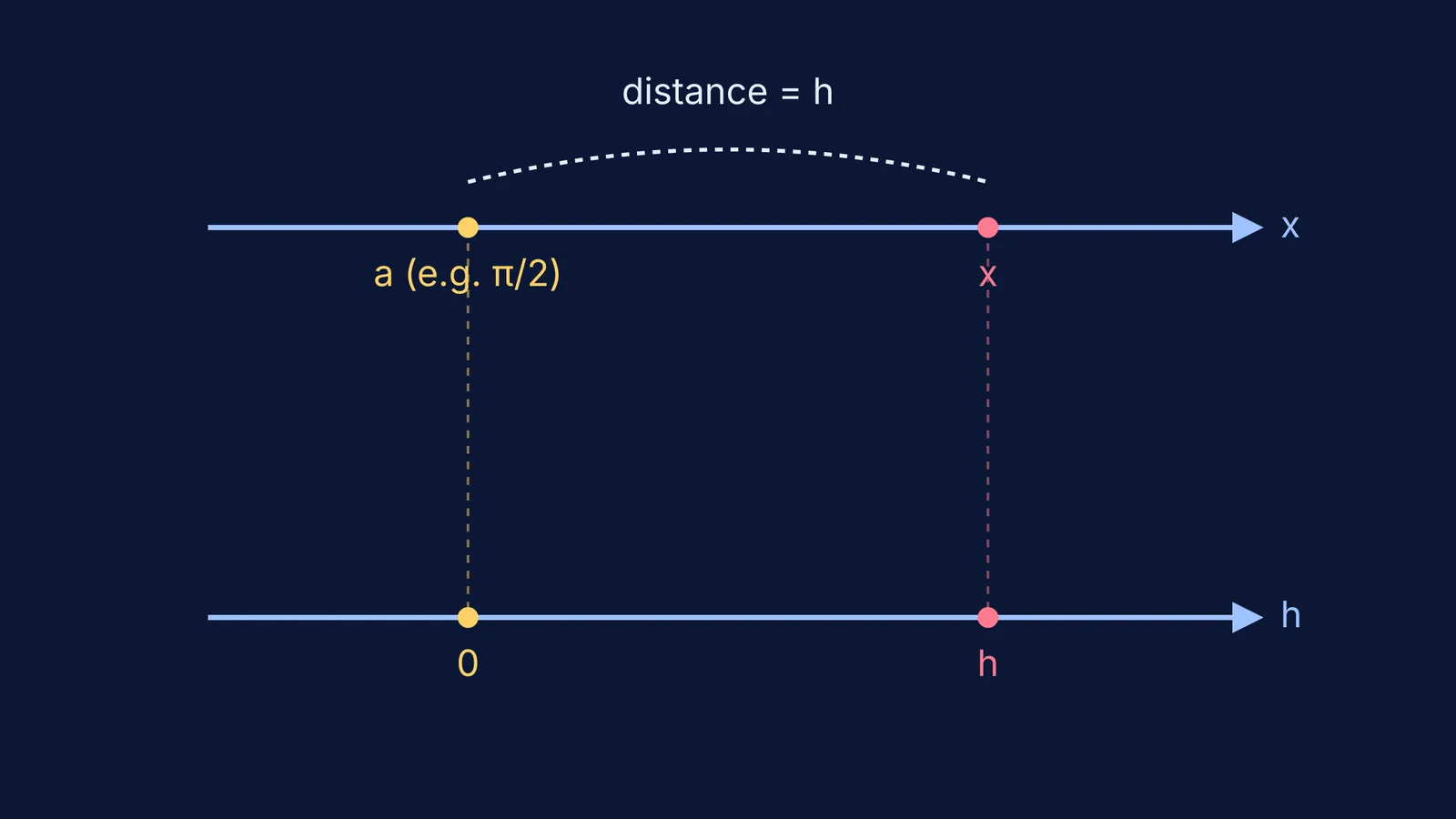
Instead of trying to manipulate the trigonometric functions from afar, you can define a new variable, h, representing the small difference between x and the target value a. By putting x = a + h, as x gets closer and closer to a, the difference h gets closer and closer to 0.
If a problem asks for lim x→a f(x), you replace it with lim h→0 f(a + h). The concept of limits relies heavily on formalising this idea of "closeness"—a mathematical rigour pioneered by Karl Weierstrass and the epsilon-delta definition of a limit.
If you find yourself stuck at this first step because the method feels unintuitive, the Fermi Concept Library breaks down calculus ideas like limits and continuity into manageable steps.
How do you solve a limit by putting x = a + h?
Trigonometric limits are the most common place this substitution is tested, particularly in Class 11 exams and the JEE.
Consider the problem: Evaluate lim x→π/2 (cos x)/(π/2 - x).
Here, a = π/2. We substitute x = π/2 + h. When x → π/2, the new variable h → 0.
Now, rewrite the entire expression using h: The numerator becomes cos(π/2 + h). From basic trigonometry, we know that cos(π/2 + h) = -sin h. The denominator becomes π/2 - (π/2 + h) = -h.
Substitute these back into the limit: lim h→0 (-sin h)/(-h) = lim h→0 (sin h)/h.
This is a standard limit identity, which equals 1. By shifting the problem to zero, a complex trigonometric fraction simplifies into a known formula.
How does this work for left-hand and right-hand limits?
Sometimes, a limit problem asks you to evaluate the behaviour of a function strictly from one side. This is common when dealing with piecewise functions, absolute values, or points of discontinuity. The substitution method easily adapts to these scenarios.
To find the right-hand limit, where x approaches a from values larger than a, you use the standard substitution x = a + h. Because you are approaching from the positive side, h remains a strictly positive value that shrinks to zero.
To find the left-hand limit, where x approaches a from values smaller than a, you substitute x = a - h instead. In this case, as x approaches a, h still shrinks to zero from the positive side. By evaluating lim h→0 f(a - h) and lim h→0 f(a + h) separately, you can prove whether the overall limit exists. If both one-sided limits yield the same finite number, the overall limit is mathematically verified.
When should you use this substitution?
This technique is not needed for every limit problem, but it is the most reliable approach in a few specific scenarios:
Trigonometric limits approaching π, π/2, or other multiples. If you see a trigonometric ratio and the limit is not zero, the x = a + h substitution is often the intended method.
Denominators that approach zero. If plugging in the limit value a gives you a 0/0 indeterminate form and the denominator looks like (x - a) or (a - x), substituting x = a + h will turn that messy denominator into a single, easy-to-cancel h or -h.
Inverse trigonometric functions. Similar to standard trig functions, inverse trig limits often require shifting the variable to use standard expansions.
If you are working through an assignment and keep arriving at the wrong sign or getting stuck on the trigonometric expansion, Fermi's AI tutor can work out where the error happened and explain the reasoning behind the correct substitution.
How does this work for limits approaching π?
Let us look at another common exam pattern, this time approaching π.
Evaluate lim x→π (sin x)/(x - π).
Identify the substitution: The limit approaches π, so let x = π + h.
Determine the new limit: As x → π, h → 0.
Rewrite the numerator: sin(π + h). In the third quadrant, sine is negative, so this equals -sin h.
Rewrite the denominator: (π + h) - π = h.
Evaluate: The limit becomes lim h→0 (-sin h)/h = - (lim h→0 (sin h)/h) = -1.
By consistently applying this algebraic shift, you remove the guesswork from evaluating calculus limits at non-zero points.


