On this page
Every exponential growth numerical asks for one of three things: the final population, the rate r, or the time. Below is one solved problem for each, then a check for when the J-shaped curve stops describing a real population.
What does each symbol in Nt = N0 e^rt mean?
The equation comes from Chapter 11, Organisms and Populations, of the NCERT Class 12 Biology textbook. It starts from dN/dt = rN and integrates it to Nt = N0 e^rt.
Nt is the population density after time t.
N0 is the population density at time zero.
r is the intrinsic rate of natural increase, equal to b − d, the per capita birth rate minus the per capita death rate.
e is the base of natural logarithms, about 2.71828.
To show how much r varies, NCERT gives three values: 0.015 for the Norway rat, 0.12 for the flour beetle, and 0.0205 for India's human population in 1981.
How do you solve an exponential growth numerical step by step?
Problem 1: find Nt, starting from birth and death rates
A culture starts with 500 bacteria. The per capita birth rate is 0.5 per hour and the death rate is 0.1 per hour. How many bacteria are there after 5 hours, if resources are unlimited?
r = b − d = 0.5 − 0.1 = 0.4 per hour.
rt = 0.4 × 5 = 2.
e^2 = 7.389.
Nt = 500 × 7.389 ≈ 3,695 bacteria.
Problem 2: find r from two counts
A population grows from 200 to 800 in 10 days. What is r?
Divide by N0: 800 ÷ 200 = 4, so e^(10r) = 4.
Take ln of both sides: 10r = ln 4 = 1.386.
r = 0.139 per day.
Check it: doubling time = ln 2 ÷ r = 0.693 ÷ 0.1386 = 5.0 days. Two doublings (200 to 400 to 800) take 10 days, which matches.
If taking logs feels shaky, practise it with our guide to solving exponential equations with logarithms.
Problem 3: find t, the doubling time
If India's population kept growing at the 1981 rate, how long would it take to double?
Doubling means Nt = 2N0, so e^(rt) = 2.
rt = ln 2, so t = ln 2 ÷ r.
NCERT gives r = 0.0205 without a time unit. Reading it as per year: t = 0.693 ÷ 0.0205 ≈ 33.8 years.
This is a what-if that assumes r never changes, not a forecast.
When does the J-shaped exponential model stop working?
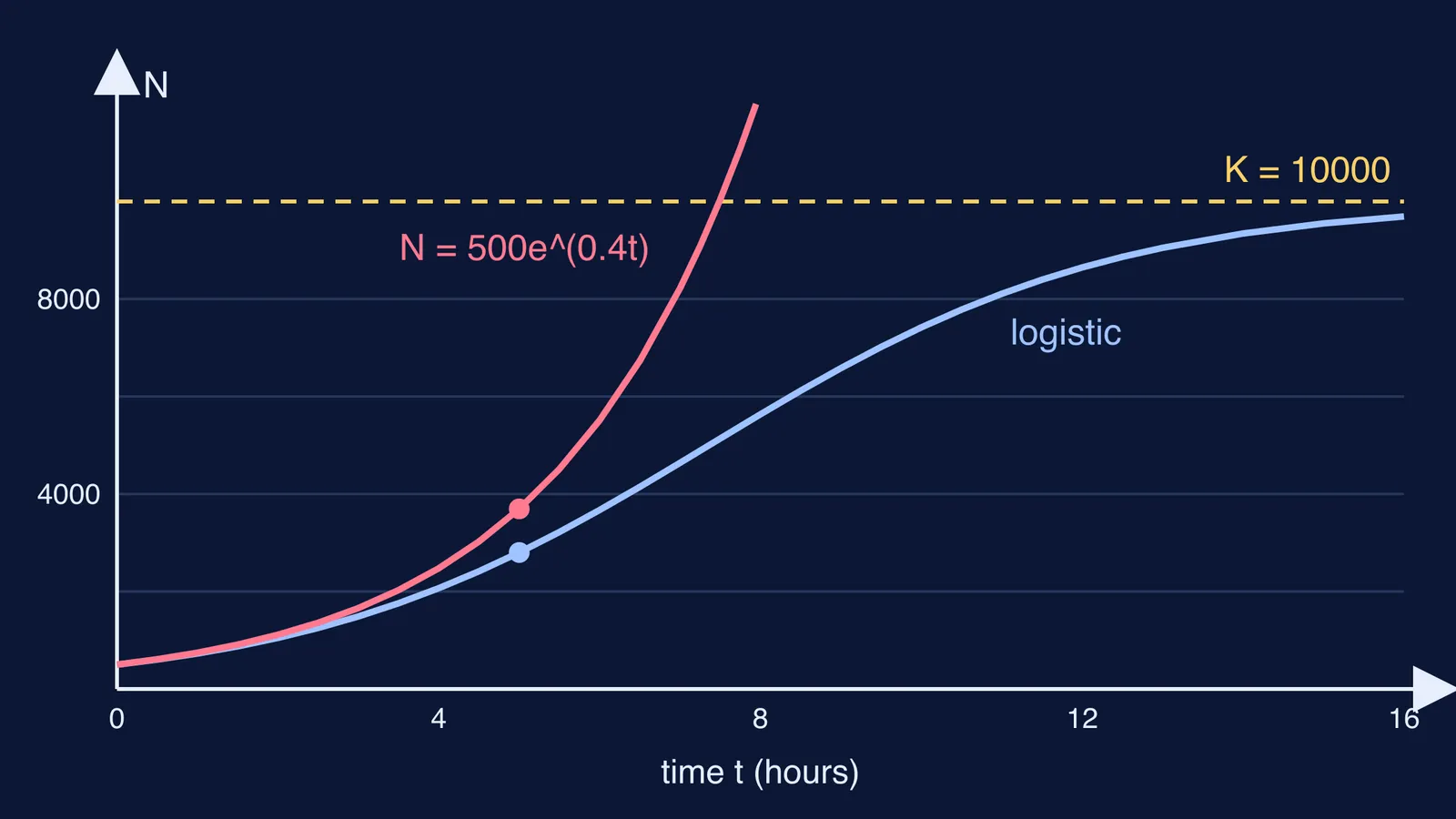
It stops when resources run short. NCERT notes that no population in nature has unlimited resources, so each habitat has a carrying capacity K. Growth then follows the Verhulst-Pearl logistic equation, dN/dt = rN(K − N)/K, which NCERT calls a more realistic model because resources for most animal populations are finite. OpenStax Biology 2e gives yeast grown in a test tube as an example of the S-shaped curve: growth levels off as the yeast use up the nutrients.
Now run Problem 1 forward. After 24 hours, Nt = 500 e^9.6 ≈ 7.4 million bacteria. Suppose the flask can support only K = 10,000 (our own example value). The logistic solution, N = K ÷ (1 + ((K − N0) ÷ N0) e^(−rt)), gives about 1,049 at 2 hours, against the exponential 1,113. At 5 hours it gives 2,800 against 3,695, so the exponential answer is about 32% too high.
The factor (K − N) ÷ K in the logistic equation tells you how much the growth has slowed. Use it as a rough rule of thumb:
N below about one-tenth of K: the factor is above 0.9, so growth is still at least 90% of the exponential rate rN. Use Nt = N0 e^rt.
N between one-tenth and one-half of K: the models drift apart. State which model you are using.
N above half of K: growth is slowing sharply. Use the logistic model.
No K given, or the question says resources are unlimited: the question intends the exponential model.
How can you practise these without just memorising them?
First ask: which quantity is unknown? Are r and t in the same time unit? Is N small compared with K? Then compare the two curves in our post on the logistic growth curve and carrying capacity, and try more practice sets in exponential growth population numericals.
If you get the right setup but the wrong answer, the Fermi Problem Library has worked problems with a step-by-step solver that explains the reasoning rather than printing an answer. If e or ln is the real gap, the Fermi Concept Library has a lesson on each concept in mathematics and biology.
Pick one problem above, cover the solution, and solve it again tomorrow with different numbers.