

On this page
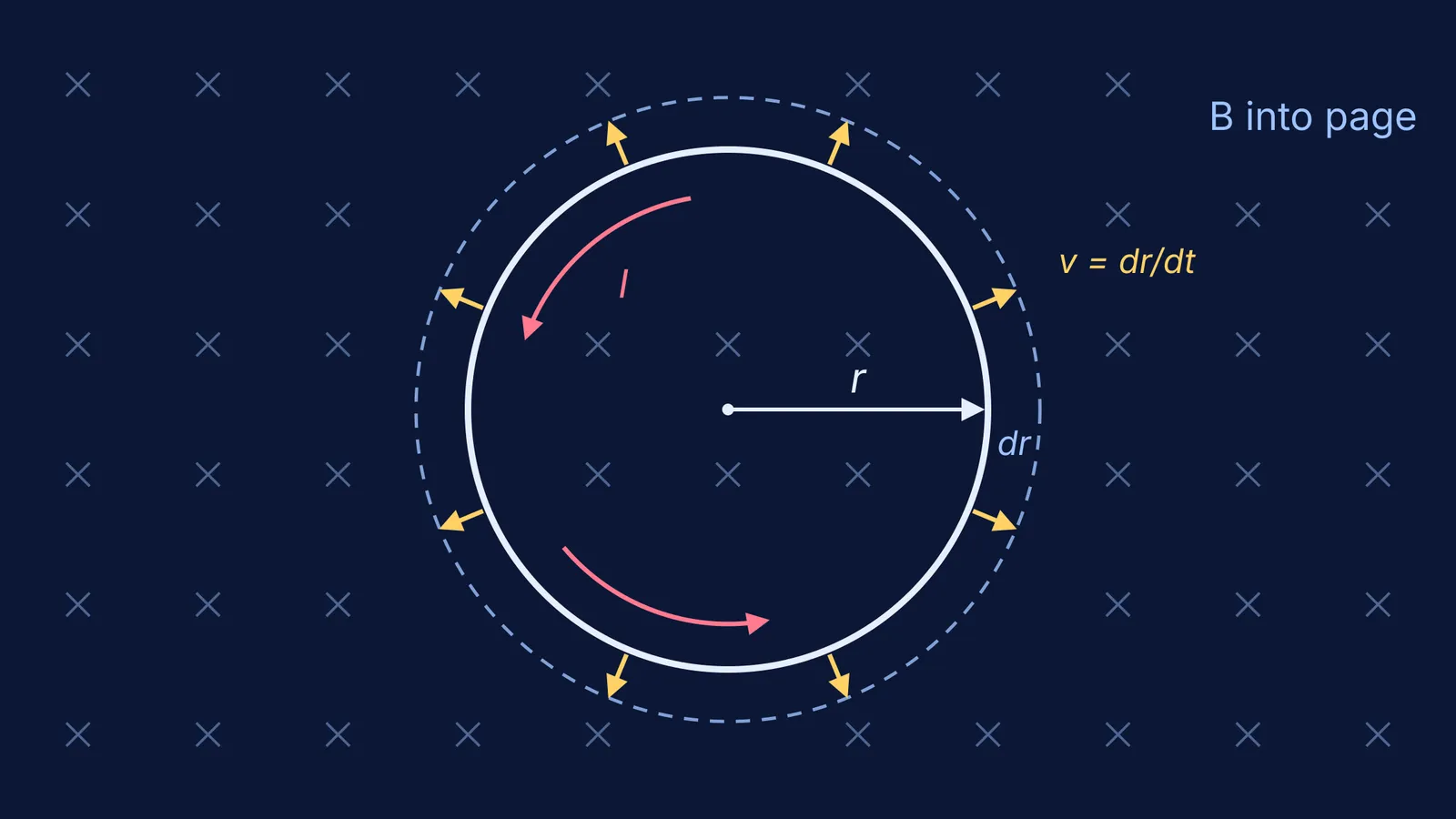
A wire ring is sitting in a uniform magnetic field, and its radius is growing. The field never changes, yet a voltage appears around the ring. This is a standard induction problem in Class 12 and JEE practice, and it takes three lines once you see that the area, not the field, is changing.
What is the EMF in a circular loop whose radius is increasing?
Faraday's law says the induced emf equals the negative rate of change of magnetic flux, ε = −N dΦ/dt (OpenStax University Physics, Faraday's law). The same source defines magnetic flux as the field integrated over the surface, with SI unit the weber, where 1 Wb = 1 T·m².
For a flat circular loop of radius r with a uniform field B perpendicular to its plane, the flux is simply Φ = B × πr². If B is constant and only r changes, B comes outside the derivative:
|ε| = B × d(πr²)/dt
|ε| = B × 2πr × dr/dt
|ε| = 2πrB (dr/dt)
That is the whole result. If flux still feels fuzzy, our explainer on the difference between magnetic field and magnetic flux is a good warm-up.
How do you solve it step by step?
Use the same four steps every time, so you never guess which formula applies.
Write the flux as a function of time: Φ(t) = B(t) × A(t) × cos θ, where θ is the angle between B and the loop's normal.
Ask what is changing: B, the area, the angle, or more than one.
Differentiate. If only r changes, d(πr²)/dt = 2πr dr/dt by the chain rule.
Multiply by the number of turns N, then use Lenz's law for the direction.
Worked example: how big is the EMF?
Take a single-turn loop in a uniform field of 0.5 T directed into the page. At the instant its radius is 10 cm, the radius is increasing at 2 cm/s. Applying Faraday's law in SI units:
r = 0.10 m, dr/dt = 0.02 m/s, B = 0.5 T
|ε| = 2π × 0.10 × 0.5 × 0.02 = 0.002π V
|ε| ≈ 6.3 mV
The answer depends on r. If dr/dt stays at 2 cm/s, then at a radius of 20 cm the EMF doubles to about 12.6 mV, because each extra centimetre of radius adds more area on a bigger ring.
Now make it harder. Suppose that at the same instant the field is also falling at 0.1 T/s. By the product rule, dΦ/dt = πr² dB/dt + 2πrB dr/dt. The first term is π × 0.01 × (−0.1) ≈ −3.1 mV and the second is +6.3 mV, so the net EMF is about 3.1 mV. The shrinking field cancels half of what the growing area adds.
Which way does the induced current flow?
Lenz's law states that the induced emf drives current in a direction that opposes the change in flux that caused it (OpenStax University Physics, Lenz's law).
In our example, flux into the page is increasing as the loop grows. The induced current must make its own field out of the page inside the loop, so it flows anticlockwise as you look at the page. For why this rule is really energy conservation in disguise, read why Lenz's law follows from conservation of energy.
Why does the motional EMF method give the same answer?
This second method makes a good exam check. A conductor of length l moving at speed v perpendicular to a field has motional emf ε = Blv (OpenStax University Physics, motional emf).
When the ring expands, every small piece of its rim moves outward at speed v = dr/dt, perpendicular to both the wire and the field. Add up all the pieces and the total length is the circumference, 2πr. So ε = B × 2πr × dr/dt, exactly the flux answer. Our post on induced EMF when a rod moves at an angle shows what happens when the velocity is not perpendicular.
What mistakes cost marks on this question?
Run through this checklist before you write the final answer.
Differentiating the area wrongly: d(πr²)/dt is 2πr dr/dt, not πr² dr/dt.
Leaving r in centimetres while B is in tesla. Convert everything to metres and seconds first.
Missing the number of turns N when the question says "coil".
Ignoring cos θ when the field is not perpendicular to the loop.
Treating B as constant when the question says it is also changing. Use the product rule.
Giving a sign without the direction. Say clockwise or anticlockwise, and from which side.
If you get the number but lose the method when the field and the area change together, try similar questions in the Fermi Problem Library, where a step-by-step solver explains the reasoning rather than printing an answer. For the underlying idea of flux and induction, each concept in the Fermi Concept Library has its own lesson and its place in the map.


