

On this page
Watch an excavator dig and the arm seems to move by muscle. It moves by oil, and one page of your Class 11 fluids chapter explains how.
How does a JCB excavator arm work?
An excavator arm has three moving parts: the boom, the arm (or dipper) and the bucket. Each is swung by its own hydraulic cylinder, a steel tube with a sliding piston and a rod out of one end. The diesel engine does not push the arm directly. It drives pumps, the pumps push oil, and the oil pushes the pistons.
JCB's specification leaflet for the JCB NXT 205 tracked excavator lists two variable-displacement piston pumps with a maximum flow of 2 x 220 litres per minute. The same sheet gives a relief-valve setting of 343 bar for the boom, arm and bucket circuit, and an operating weight of 20,500 kg.
What does Pascal's law have to do with it?
NCERT's Class 11 physics chapter puts Pascal's law this way: “whenever external pressure is applied on any part of a fluid contained in a vessel, it is transmitted undiminished and equally in all directions” (NCERT, Mechanical Properties of Fluids).
The same chapter turns this into the hydraulic lift: a force F1 on a small piston of area A1 makes a pressure P = F1/A1, and a larger piston of area A2 then feels F2 = P × A2. The force is multiplied by A2/A1, which NCERT calls the mechanical advantage.
In an excavator, the pump plays the small piston: it forces oil in until the pressure moves the load or the relief valve opens. NCERT also notes that liquids are largely treated as incompressible, which is why oil works and air would not.
How much force can one hydraulic cylinder push?
The leaflet gives pressure, not cylinder sizes, so take round numbers for practice: a cylinder with a 120 mm bore and an 85 mm rod. These are our assumptions, not JCB figures. The pressure is the 343 bar relief setting from the JCB NXT 205 leaflet, the most the circuit allows, and 1 bar = 10^5 Pa according to NCERT.
Pressure: 343 bar = 343 × 10^5 Pa = 3.43 × 10^7 Pa.
Area pushing out, with oil on the full piston face: A = π × (0.06 m)² = 0.01131 m².
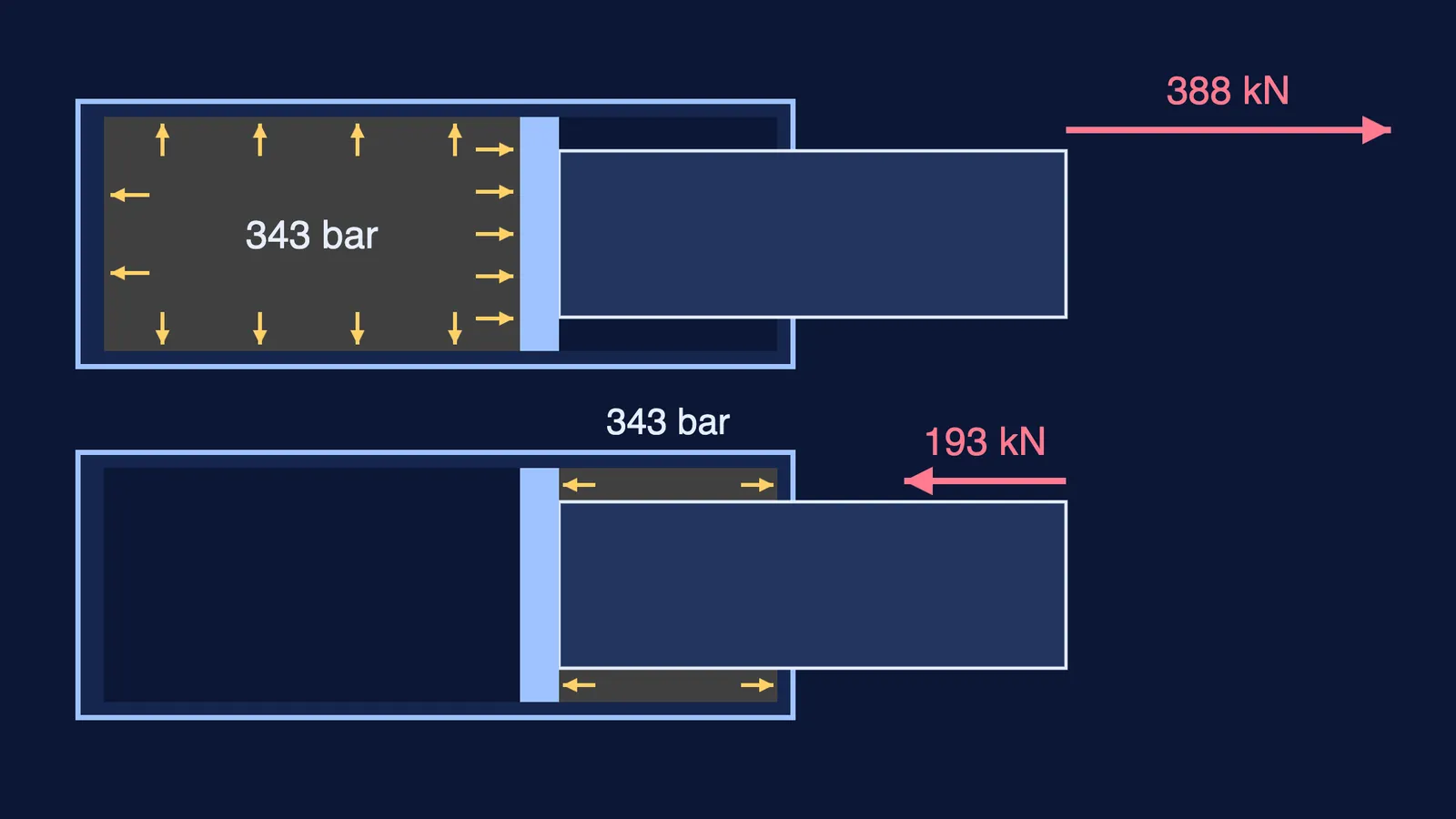
Force: F = PA = 3.43 × 10^7 × 0.01131 ≈ 3.88 × 10^5 N, about 388 kN. Divide by g = 9.81 m/s² and that is the weight of about 39,500 kg, nearly twice the machine's own 20,500 kg.
Pulling in, with oil on the rod side: the rod covers part of the piston, leaving π/4 × (0.120² − 0.085²) = 0.00564 m². The force is about 193 kN, roughly half.
Now speed. One pump's 220 L/min is 0.00367 m³/s. Fed into the full face, the rod moves out at 0.00367 / 0.01131 ≈ 0.32 m/s. Fed into the smaller rod side, it comes in at about 0.65 m/s. Smaller area: less force, more speed. Multiply force by speed for either direction and you get the same 126 kW, which is pressure × flow. That is more than the leaflet's 140 hp engine (about 104 kW), so the machine cannot give full pressure and full flow at once.
Pascal's law multiplies force, never energy, the same rule that explains why you can't bounce higher for free on a trampoline. The leaflet's bucket tearout, 13,460 kgf (about 132 kN), is well below a cylinder push like ours. One reason is that the bucket linkage acts as a lever, giving up force to swing the teeth through a wide arc. And the cylinder pushes back on the boom it is pinned to with the same force, which is why action and reaction forces do not cancel.
How can you check a hydraulics numerical?
Run this list on any Pascal's law question, from a JEE problem to a workshop car lift:
Convert pressure to pascals first: bar × 10^5.
Use radius, not diameter, in πr², and metres, not millimetres.
Ask which side the oil is on: the full face or the rod-side ring.
Check volume and energy: NCERT's Example 9.5, with two syringes, uses L1A1 = L2A2 for how far each piston moves. Multiply by pressure: force × distance matches.
Run it backwards: why heavy trucks have so many wheels uses the same P = F/A to spread a load.
If pressure acting equally in all directions still feels abstract, the Fermi Simulation Lab has interactive simulations for ideas that are easier to see than to read. When a numerical goes wrong at step 2 or 3, the Fermi Problem Library has a step-by-step solver that explains the reasoning rather than printing an answer. And if you are not sure where fluids fit in your revision, Fermi's AI tutor can work out what you already know and build a plan for the session.
Next time you pass a construction site, look for the three shiny rods on the arm. Each one is Pascal's law at work.


