

On this page
An exam paper tells you to answer 10 questions with at least 4 from each section. How many different sets of 10 could you pick? The quick method looks right but isn't. The method that works has three steps: list the possible splits, count each split, add.
How do you count choices with "at least" from each section?
An "at least" condition doesn't fix how many questions come from each section. It allows several splits. Each split is a separate case, and no selection can belong to two cases, so you count each case on its own and add them.
Inside one case you choose from Section A and from Section B independently. The NCERT Class 11 textbook calls this the multiplication principle: if one event can occur in m ways and the next in n ways, together they can occur in m × n ways (NCERT Mathematics Class 11, Chapter 6). So within a case you multiply, and across cases you add.
The same chapter uses this structure in its Example 21(ii). To count teams of 5 from 4 girls and 7 boys with at least one of each, it lists four cases and adds them: 7 + 84 + 210 + 140 = 441 (NCERT, Chapter 6).
Order doesn't matter here: a set of questions is the same set whichever you write first. If that feels unclear, try the does-order-matter test for permutations and combinations.
Worked example: 10 questions, at least 4 from each section
Suppose Section A has 6 questions and Section B has 7. You must answer 10, with at least 4 from each section.
Step 1: List the splits. Call the number from A "a" and from B "b", with a + b = 10. Section B needs at least 4, so a is at most 6. Section A needs at least 4, so a is at least 4. That leaves three cases.
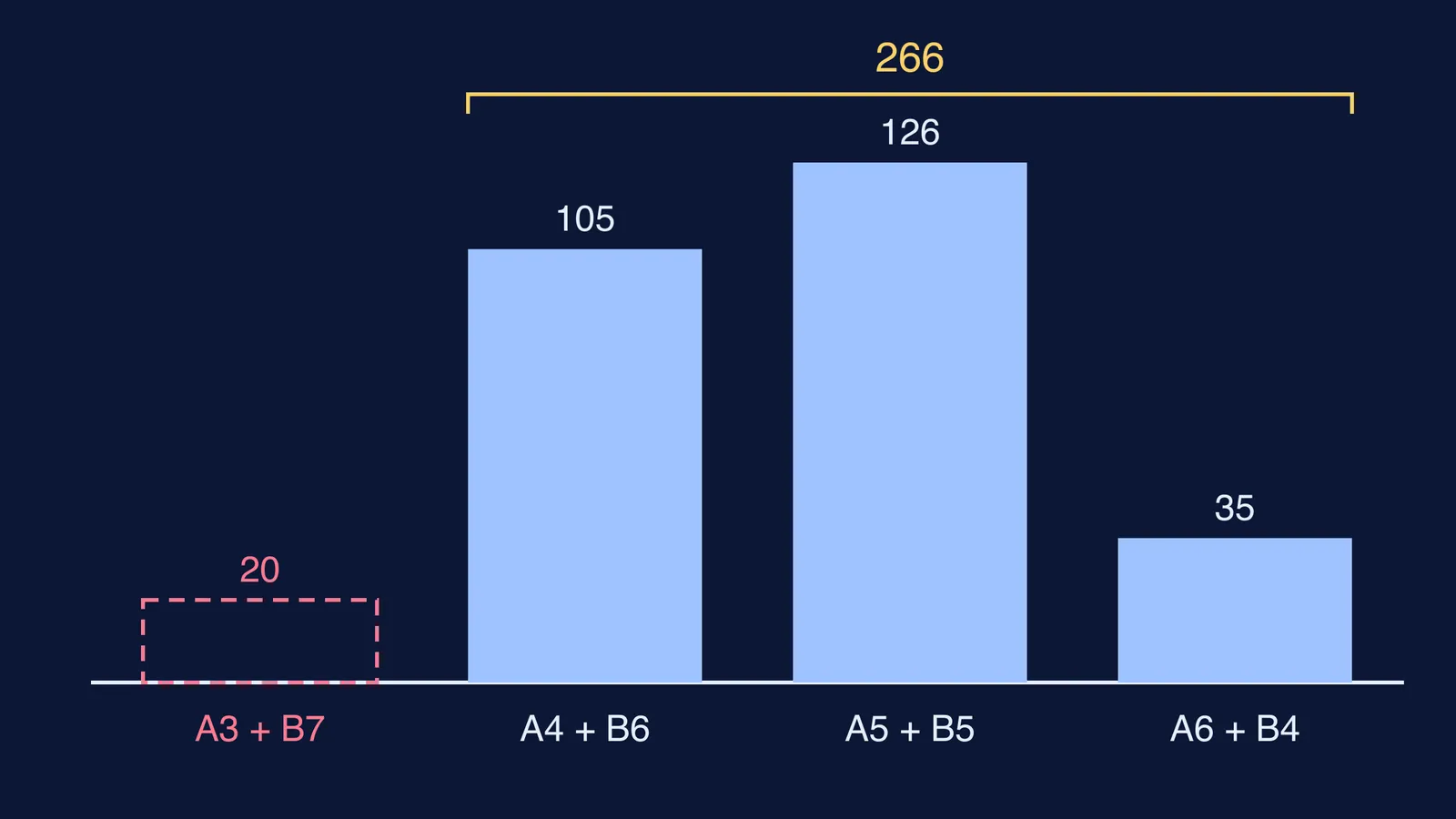
a = 4, b = 6: 6C4 × 7C6 = 15 × 7 = 105
a = 5, b = 5: 6C5 × 7C5 = 6 × 21 = 126
a = 6, b = 4: 6C6 × 7C4 = 1 × 35 = 35
Step 2: Add. 105 + 126 + 35 = 266 ways.
Why is choosing 4 + 4 first and then 2 more wrong?
The tempting shortcut is: pick 4 from A, pick 4 from B, then pick any 2 of the remaining 5. That gives 6C4 × 7C4 × 5C2 = 15 × 35 × 10 = 5250, far more than 266.
The shortcut counts the same final set many times. Take a set with 5 questions from A and 5 from B. Any 4 of those 5 A-questions could have been your "first" four, and the same goes for B, so this one set is counted 5 × 5 = 25 times. Sets with a 4 + 6 or 6 + 4 split are each counted 15 times. Check it: 105 × 15 + 126 × 25 + 35 × 15 = 5250.
The same overcounting trap appears in committee problems, which we work through in how to choose a committee with a chairperson.
How can you check your answer?
Count the complement. Without any condition, there are 13C10 = 286 ways to choose 10 of 13 questions. The bad selections are those with 3 or fewer from A (only a = 3, b = 7 is possible: 6C3 × 7C7 = 20) or 3 or fewer from B (impossible, since A cannot supply 7). So 286 − 20 = 266, which matches.
Try both methods on NCERT's own version: a paper of 12 questions, 5 in Part I and 7 in Part II, where you attempt 8 with at least 3 from each part (Miscellaneous Exercise, question 7, NCERT Chapter 6). The cases give 5C3 × 7C5 + 5C4 × 7C4 + 5C5 × 7C3 = 210 + 175 + 35 = 420. The complement gives 12C8 − (5C2 × 7C6 + 5C1 × 7C7) = 495 − 75 = 420.
A five-step routine for any section-condition question
Write a + b = total, and the minimum and maximum for each section.
List every allowed split, crossing out any that need more questions than a section has.
Multiply the combinations within each split.
Add the splits.
Check with the complement before you move on.
The same case-then-add pattern runs through card problems too, as in the probability of getting 2 aces in 5 cards.
If you keep landing on 5250-type answers, the problem is the method, not the arithmetic. The Fermi Problem Library has worked problems with a step-by-step solver that explains the reasoning rather than printing an answer, so you can see where each case comes from. If nCr itself still feels shaky, the Fermi Concept Library gives combinations its own lesson.


