

On this page
Calculating the probability of holding specific cards in a 5-card hand is a classic problem in competitive examination mathematics. Finding the chance of getting exactly 2 aces tests whether you understand how to count unordered combinations without falling into the trap of double counting.
Why does card order not matter in a 5-card hand?
According to the NCERT Class 11 Mathematics curriculum, combinations apply whenever the order of selection is irrelevant. In games like poker or rummy, a 5-card hand is an unordered set: holding two aces and three kings is identical regardless of the order in which the cards are dealt.
Modeling the deal as an ordered sequence yields P(52, 5) = 52 × 51 × 50 × 49 × 48 = 311,875,200 permutations. Because any 5 distinct cards can be arranged in 5! = 120 ways, an ordered sample space counts each distinct hand 120 times. Combinations divide out this redundant factor from both the numerator and denominator from the start. This distinction between ordered and unordered selections mirrors the reasoning required when evaluating problems with and without replacement.
How do you calculate the probability of getting 2 aces in 5 cards?
To find the probability using combinations, divide favourable hands by total possible 5-card hands:
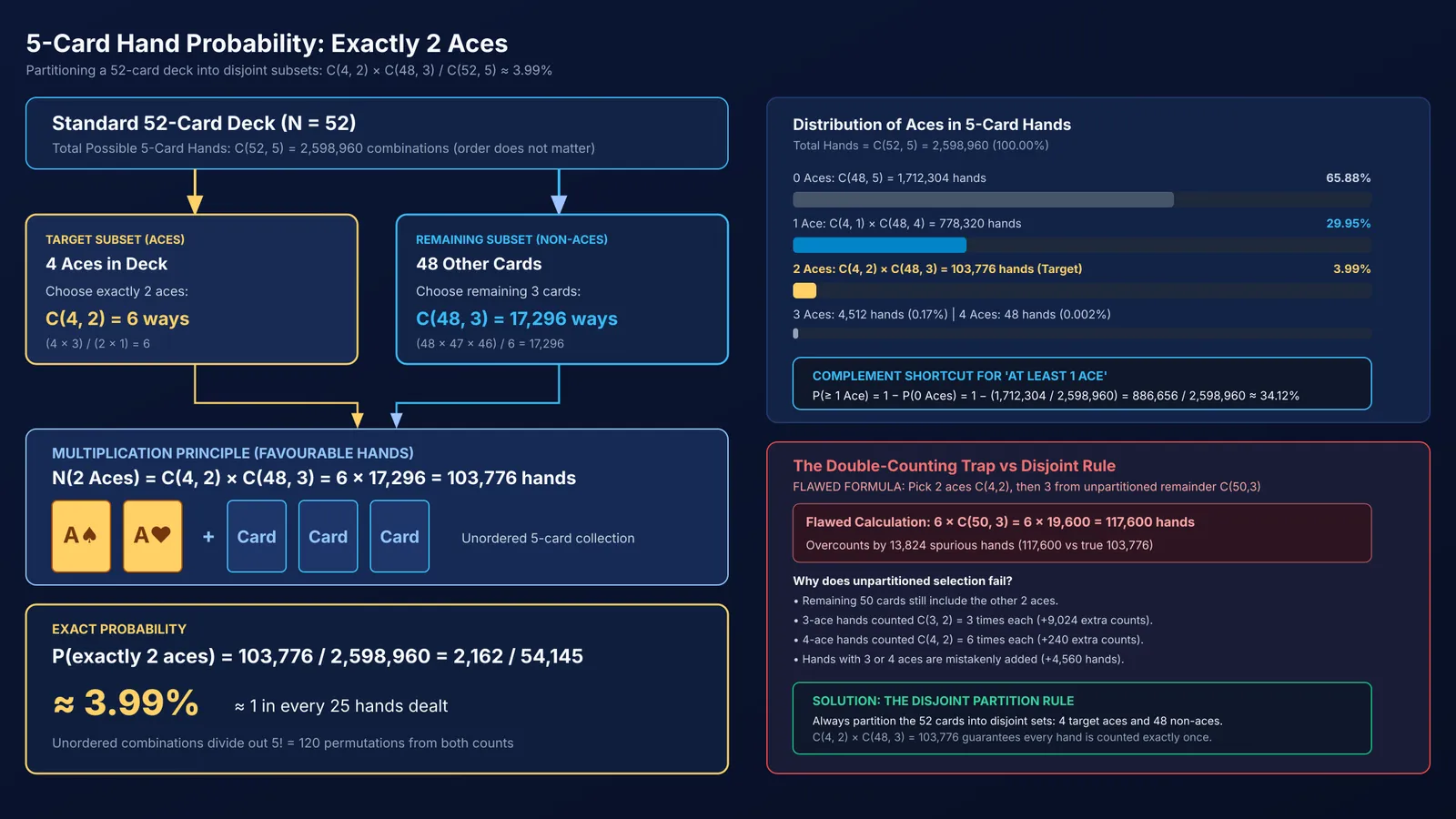
Total sample space: The number of ways to choose 5 cards from 52 is C(52, 5) = 52! / (5! × 47!) = 2,598,960 hands, as listed in Wolfram MathWorld's poker probability tables.
Choose 2 aces: From 4 aces, choose 2 in C(4, 2) = (4 × 3) / 2 = 6 ways.
Choose 3 non-aces: From the 48 remaining non-aces, choose 3 in C(48, 3) = (48 × 47 × 46) / 6 = 17,296 ways.
Multiply favourable choices: By the multiplication principle, favourable hands equal C(4, 2) × C(48, 3) = 6 × 17,296 = 103,776.
Dividing favourable hands by total hands gives the probability:
P(exactly 2 aces) = 103,776 / 2,598,960 = 2,162 / 54,145 ≈ 0.03993
This equals approximately 3.99%, or about 1 in every 25 hands dealt. When practicing problem variations, the Fermi Problem Library provides worked problems with a step-by-step solver that explains the reasoning rather than printing an answer.
What is the common double-counting trap in card selections?
In *The Journal of Mathematical Behavior* (2013), mathematics education researcher Elise Lockwood analyzed students' combinatorial thinking, showing that overcounting occurs when formulas are used without attending to outcome set structure. A classic error is arguing: "Choose 2 aces in C(4, 2) = 6 ways, then pick any 3 cards from the remaining 50 in C(50, 3) = 19,600 ways, giving 6 × 19,600 = 117,600 hands."
This argument fails because the 50 remaining cards still contain the other 2 aces. Hands with 3 aces are counted C(3, 2) = 3 times, while 4-ace hands are counted C(4, 2) = 6 times. This inflates the total by 13,824 spurious hands to 117,600 instead of 103,776.
Partitioning sets prevents the counting errors covered in our guide to permutations and combinations without double counting.
Why is the complement rule faster for at least one ace?
To find the probability of holding "at least one ace", using the complement theorem from the NCERT Class 11 Probability chapter avoids summing multiple cases. The probability of an event equals one minus the probability of its complement: P(E) = 1 − P(E').
A direct calculation sums four mutually exclusive cases:
Exactly 1 ace: C(4, 1) × C(48, 4) = 4 × 194,580 = 778,320 hands
Exactly 2 aces: C(4, 2) × C(48, 3) = 6 × 17,296 = 103,776 hands
Exactly 3 aces: C(4, 3) × C(48, 2) = 4 × 1,128 = 4,512 hands
Exactly 4 aces: C(4, 4) × C(48, 1) = 1 × 48 = 48 hands
Summing these yields 886,656 favourable hands.
The complement of "at least one ace" is "zero aces". Choosing all 5 cards from the 48 non-aces gives C(48, 5) = 1,712,304 hands:
P(0 aces) = 1,712,304 / 2,598,960 ≈ 0.6588
P(at least 1 ace) = 1 − 0.6588 = 0.3412 (34.12%)
This subtraction saves substantial time, as shown in our guide to selection problems with combinations. For exploring the foundations connecting discrete counting to probability, the Fermi Concept Library covers every concept in physics, chemistry, biology, mathematics and computing, each with its own lesson and its place in the map.
How should you structure card probability problems in exams?
When solving card selection problems in timed exams, apply this four-step checklist:
Define the sample space: Note deck size N (52) and hand size r (5). Compute total combinations as C(N, r).
Partition into disjoint sets: Split the 52 cards into target cards (4 aces) and non-target cards (48 non-aces) so no target cards remain in the second pool.
Choose the route: Use direct combination products for exact targets, and use the complement rule for "at least one" conditions.
Simplify arithmetic: Cancel factorials before multiplying to avoid computational errors under exam pressure.
If you need structured practice identifying the right combinatorial model, Fermi's AI tutor can work out what you already know and build a plan for the session, working through problems alongside you.


