

On this page
Any function whose domain is symmetric about zero can be written as an even function plus an odd function, in exactly one way. The trick takes one line, and it returns in matrices, definite integrals and hyperbolic functions.
How do you write a function as a sum of even and odd functions?
Start with the two definitions. A function is even if f(−x) = f(x) for every x in its domain, and odd if f(−x) = −f(x) (Even and odd functions, Wikipedia). To see this by reflecting graphs, our post on testing odd and even functions by symmetry walks through it.
Now the split. Define two new functions:
even part: g(x) = [f(x) + f(−x)]/2
odd part: h(x) = [f(x) − f(−x)]/2
Add them and the f(−x) terms cancel, leaving f(x). So f(x) = g(x) + h(x) for every x in the domain.
Why does the formula always work, and why is it unique?
Replace x by −x in g: g(−x) = [f(−x) + f(x)]/2 = g(x), so g is even. In h: h(−x) = [f(−x) − f(x)]/2 = −h(x), so h is odd. We assumed nothing about f except that f(−x) exists whenever f(x) does.
For uniqueness, suppose f = g + h with g even and h odd. Then f(−x) = g(x) − h(x). Adding and subtracting the two equations forces g and h back to the same formulas. Put another way, the only function that is both even and odd is the zero function (Wikipedia), so two different splits cannot exist.
How does eˣ split into cosh x and sinh x?
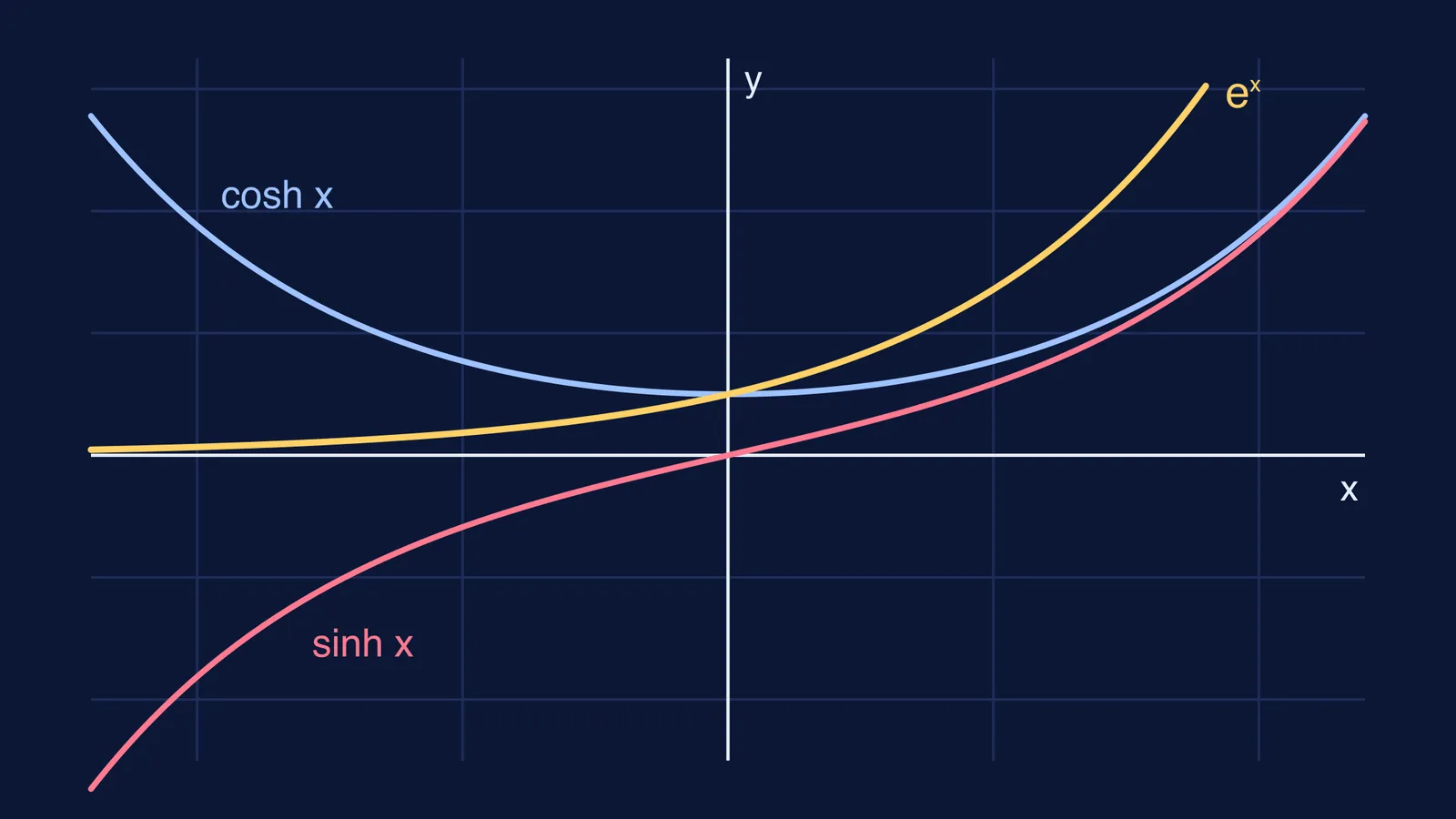
Put f(x) = eˣ into the formula. The even part is (eˣ + e⁻ˣ)/2 and the odd part is (eˣ − e⁻ˣ)/2. The hyperbolic cosine is cosh x = (eˣ + e⁻ˣ)/2 (Wolfram MathWorld). The hyperbolic sine is sinh x = (eˣ − e⁻ˣ)/2 (Wolfram MathWorld). So eˣ = cosh x + sinh x, a standard example of an even-odd decomposition (Wikipedia).
The graph at the top shows all three. cosh x is a U shape, symmetric about the y-axis, with its lowest value 1 at x = 0. sinh x passes through the origin and is unchanged by a half-turn. Add their heights at any x and you land on the eˣ curve.
One identity falls out for free: cosh²x − sinh²x = [(eˣ + e⁻ˣ)² − (eˣ − e⁻ˣ)²]/4 = 1. So the point (cosh t, sinh t) lies on the hyperbola X² − Y² = 1, which is where the name hyperbolic comes from.
Worked examples you can check yourself
f(x) = x² + 3x + 5. Then f(−x) = x² − 3x + 5. Even part: (2x² + 10)/2 = x² + 5. Odd part: 6x/2 = 3x. For any polynomial, the even part is the even powers plus the constant, and the odd part is the odd powers.
f(x) = 1/(1 + x). Here is the domain trap: f(1) exists but f(−1) does not, so remove both x = 1 and x = −1. The even part is [1/(1 + x) + 1/(1 − x)]/2 = 1/(1 − x²). The odd part is [1/(1 + x) − 1/(1 − x)]/2 = −x/(1 − x²). Add them: (1 − x)/(1 − x²) = 1/(1 + x). It checks.
A definite integral. Over an interval from −a to a, an odd function integrates to 0 and an even function gives twice the integral from 0 to a (Wikipedia). So the integral of eˣ from −1 to 1 equals 2 times the integral of cosh x from 0 to 1, which is 2 sinh 1 = e − 1/e. The sinh part vanished without any work.
The same eˣ and e⁻ˣ pair turns up in integrals such as 1/(eˣ + e⁻ˣ), which our post on the eˣ multiplication trick for integrals solves step by step.
Where else does this split appear in Class 12?
In NCERT Class 12 Mathematics, Chapter 3 (Matrices), Theorem 2 states that any square matrix can be expressed as the sum of a symmetric and a skew symmetric matrix, using A = ½(A + A′) + ½(A − A′) (NCERT textbook, Chapter 3). The transpose plays the role of replacing x by −x. Our post on why A + A′ is symmetric and A − A′ is skew-symmetric has the proofs.
When a question asks you to express a function as the sum of an even and an odd function, use this routine:
Check that the domain is symmetric, and remove any point where f(−x) is not defined.
Write out f(−x) neatly before doing anything else.
Take the average for the even part and half the difference for the odd part.
Add the two parts back together and confirm you get f(x).
If step 2 gets messy with a harder function, the Fermi Problem Library has worked problems with a step-by-step solver that explains the reasoning rather than printing an answer. To revisit the ideas behind hyperbolic functions, the Fermi Concept Library gives each concept its own lesson and its place in the map.


