

On this page
A function's symmetry is a geometric blueprint that dictates how its curve behaves under reflections. When preparing for algebra and calculus, distinguishing between even, odd, and asymmetrical functions often starts with algebraic substitutions. Yet evaluating formulas on paper without picturing their reflections leads to persistent misconceptions—especially when dealing with combined powers or products of trigonometric terms.
What makes a function algebraically even, odd, or neither?
A real-valued function f(x) defined on a domain centered at zero falls into one of three parity categories based on its response to negating its input.
An even function satisfies f(-x) = f(x) for all x in its domain. Geometrically, this condition produces bilateral symmetry across the vertical y-axis: folding the Cartesian plane along the vertical axis places the right side of the graph directly atop the left side. Familiar examples include even polynomial powers such as x² and x⁴, as well as the standard cosine function.
An odd function satisfies f(-x) = -f(x) for every x in its domain. Geometrically, this produces origin symmetry, corresponding to a 180° rotation about the origin (0, 0). Reflecting the curve across the vertical y-axis and then across the horizontal x-axis reproduces the original curve. Standard examples include x³, x⁵, and sin x.
Most relations belong to neither category. If replacing x with -x neither preserves the original function nor inverts its overall sign, the function lacks parity. In Class 12 mathematics, identifying parity quickly is essential for applying properties that simplify definite integrals, where the integral of an odd function from -a to a evaluates to zero, while an even function doubles the area evaluated from 0 to a.
How do reflections reveal symmetry for x³ + x², cos x, and x sin x?
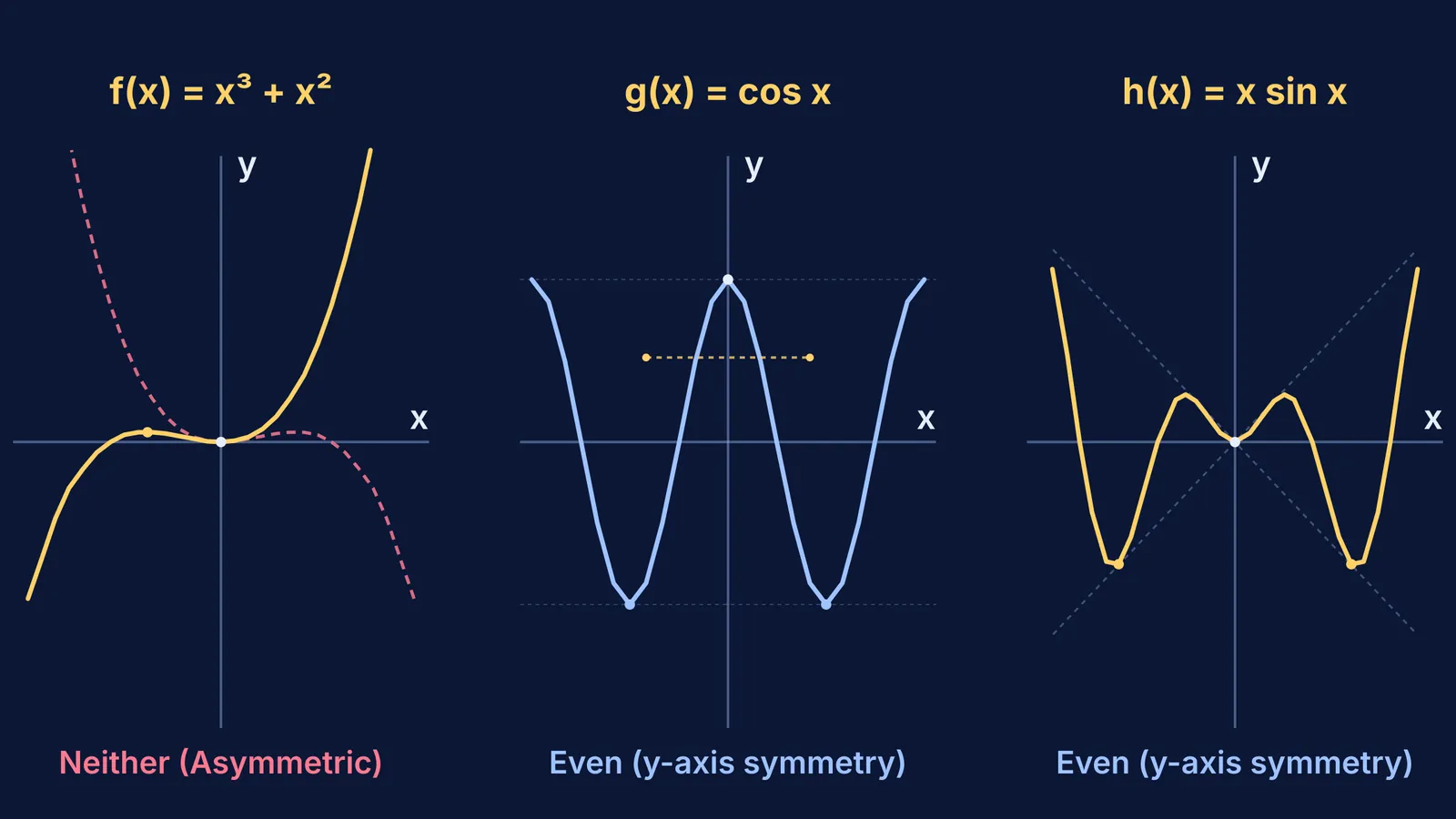
To connect algebraic tests with physical reflections, consider three representative functions that frequently appear in problem sets:
The mixed polynomial: f(x) = x³ + x²
Substitute -x into the function: f(-x) = (-x)³ + (-x)² = -x³ + x². This expression equals neither f(x) = x³ + x² nor -f(x) = -x³ - x². Reflecting the graph across the y-axis yields y = -x³ + x², where turning points flip horizontally while their vertical elevations remain altered. Because the reflected graph fails to coincide with the original curve, f(x) is neither even nor odd.
The circular cosine: g(x) = cos x
Substitute -x into cosine: g(-x) = cos(-x). In the unit circle definition documented in OpenStax Precalculus, an angle x defines a point (cos x, sin x). Moving by -x reflects that point across the horizontal axis to (cos x, -sin x). Because the horizontal coordinate is identical, cos(-x) = cos x. Folding y = cos x along the vertical line x = 0 leaves every crest, trough, and zero crossing unchanged, confirming that cos x is an even function.
The oscillating product: h(x) = x sin x
Substitute -x into both factors: h(-x) = (-x) · sin(-x). Because sine is odd, sin(-x) = -sin x. Multiplying both negative terms yields (-x) · (-sin x) = x sin x = h(x). The product of two odd functions is always even. Geometrically, h(x) oscillates between the linear envelopes y = x and y = -x. Reflecting the graph across the y-axis aligns both branches perfectly, providing intuition for shifts, reflections and modulus.
Why does predicting before graphing build deeper mathematical reasoning?
Watching a graphing tool plot a curve feels effortless, but passive observation rarely resolves underlying conceptual gaps.
In a 2011 study published in *School Science and Mathematics*, researchers Kasmer and Kim (2011) tracked middle school algebra students across linear and exponential units. Students who answered prediction questions before lessons significantly outperformed control peers on unit assessments, demonstrating stronger reasoning and conceptual understanding. Generating a prediction forces learners to evaluate structural relationships rather than passively copying formulas.
This finding matches research on interactive digital simulations. In their study in the *American Journal of Physics*, Wieman, Perkins, and Adams (2008) showed that dynamic simulations achieve their greatest impact when embedded in a predict-test-explain cycle. When students predict whether h(x) = x sin x is odd or even before viewing the dynamic reflection, the visual outcome directly challenges false assumptions about signs and parity.
How can you test function symmetries interactively?
To develop durable mastery when using graphing tools to explore functions, approach symmetry problems with an active three-step routine:
Predict algebraically: Calculate f(-x) and check whether it simplifies to f(x), -f(x), or an asymmetric mixture.
Anticipate the reflection: Visualize whether the curve needs a vertical flip across the y-axis or a 180° rotation about the origin.
Test dynamically: Plot y = f(x) alongside y = f(-x) on the same axes to inspect whether they coincide.
For learners testing algebraic predictions against geometric transformations, Fermi Simulation Lab provides interactive simulations for the ideas that are easier to see than to read. When students struggle to follow the chain of negative substitutions or simplify expressions like (-x)·sin(-x), the Fermi Problem Library offers worked problems with a step-by-step solver that explains the reasoning rather than printing an answer. When navigating tricky functional equations or mixed symmetries, Fermi's AI tutor can work out what you already know and build a plan for the session, noticing where you are stuck and deciding whether to explain, ask or show.


